The Durbeyfields' arrival at Kingsbere
Tess of the d'UrbervillesThe Durbeyfields’ arrival at Kingsbere is a reversal in which the place supposed to restore the family’s ancestral dignity offers them no roof at all. Their long journey ends not in a homecoming but beside the churchyard: the rooms they had sought are already let, the family’s possessions are unloaded in the open, and Joan turns a bedstead into a tent beneath the d’Urberville aisle. The family’s claim to ancient lineage meets the material fact of poverty, while Alec d’Urberville’s presence makes their refuge precarious as well as exposed.
Arrival and failed lodging
The journey to Kingsbere is too long for a single day, and the horses can barely manage it. Although the family starts early, it reaches the eminence of Greenhill late in the afternoon. From there, Tess sees the half-dead townlet below: the place her father had repeatedly celebrated as the d’Urbervilles’ home, where her ancestors had lived for five hundred years. That inherited claim gives the destination its emotional force, but it does not provide the family with a practical welcome.
A man comes out from the town and confirms that the rooms Joan had wanted are no longer available. The people there did not know the family was coming until they received Joan’s letter that morning, too late to prevent the rooms being let. He suggests that they might find other lodgings, but the news drains the hope from Tess’s face and leaves Joan asking what they can do. The failure is not simply a disappointment after a journey: it turns the family’s supposed return to its ancestral domain into a fresh search for shelter.
The family moves into Kingsbere and tries to find accommodation. Tess remains with the waggon to look after the children while Joan and ’Liza-Lu make inquiries. An hour later Joan returns without success. The driver says the goods must be unloaded because the horses are half-dead and he must at least travel part of the way back that night. Joan accepts the necessity and says she will find somewhere for them to stay, even though no lodging has been secured.
A household exposed beneath the church
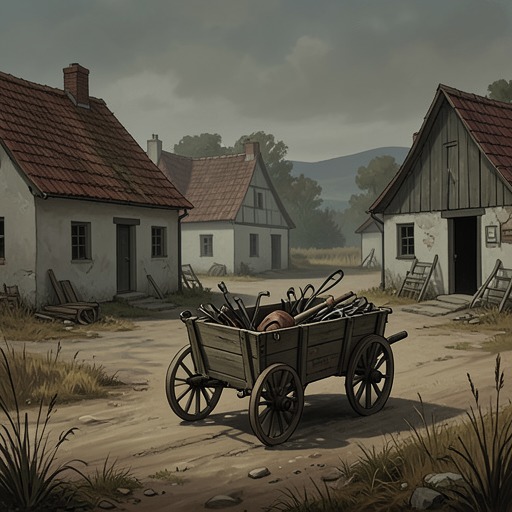
The waggon stops in a place screened from view beneath the churchyard wall. The driver quickly removes the family’s poor heap of household goods; Joan pays him, reducing herself to almost her last shilling, and he leaves, glad to end his dealings with the family. The dry night offers some immediate protection, but the arrangement makes their displacement visible in every object they have had to put outdoors.
Tess looks at the crocks, kettles, dried herbs, dresser handles, wicker-cradle, and carefully rubbed clock-case in the cold spring light. These are articles made for the ordinary shelter and continuity of a home, now exposed to the weather and the uncertainties of the road. Nearby, the hills and slopes have been divided into small paddocks; the green foundations mark where the d’Urberville mansion once stood, and a stretch of Egdon Heath remains associated with the estate. The family’s surroundings thus place signs of former possession beside the present household’s lack of even a room.
Joan proposes using the family vault as their freehold and camping there until their ancestors’ home finds them a roof. In a quarter of an hour, Tess helps separate the old four-poster bedstead from the pile and set it against the church’s south wall, in the part known as the d’Urberville aisle. Beneath it are the great family vaults; above it is a fifteenth-century traceried window called the d’Urberville Window, whose heraldic emblems resemble those on John Durbeyfield’s old seal and spoon. The improvised shelter is physically aligned with the family’s emblems and burial place, but its makeshift character gives that lineage an ironic present-tense form: the heirloom bed becomes a tent because the living family has nowhere to sleep.
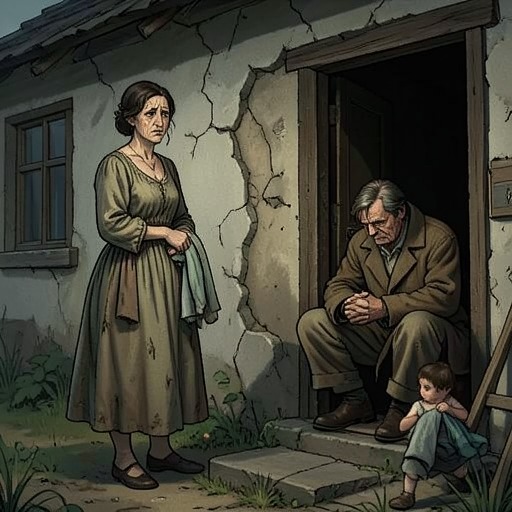
Joan draws the curtains around the bed to make a shelter for the younger children and says that they might all sleep there if matters come to the worst. She then goes back toward the town with ’Liza-Lu and Abraham to seek food and lodging. Her reproach to Tess connects the family’s present hardship with Tess’s marriage to a gentleman, but the immediate crisis remains more basic: the children need somewhere to sleep and something to eat.
The ruined signs of ancestry
While the others continue their search, Tess stays with the children and then walks through the churchyard as night falls. The church door is unfastened, and she enters for the first time. Inside, beneath the window above the makeshift bed, lie the family tombs, spanning several centuries. They are canopied and altar-shaped, but plain; their carvings are defaced, their brasses torn away, and empty rivet-holes remain where the metal once sat.
The damage gives material form to the family’s social extinction. The tombs do not merely preserve a title or a line of descent: their broken surfaces show that even the visible memorials of that past have been stripped. Their condition sharpens the contrast between the emblems still displayed in the window and on John Durbeyfield’s seal and spoon, and the family’s inability to secure a dwelling in the town associated with its ancestry. Kingsbere contains the evidence of what the family once was, but that evidence cannot shelter the living.
Alec’s offer and the threatened refuge
Alec d’Urberville finds Joan and tells her he is looking for Tess. When Joan indicates that Tess is at the church, he says he will see the family again if they remain unsuccessful in finding shelter; he has already heard of their difficulty. His promised return makes the family’s vulnerability an immediate part of Tess’s private danger, not merely a question of lodging.
Alec later speaks of the contrast between his own power and the supposed greatness of the real d’Urbervilles beneath the church. He presents himself as more able to help than the dead dynasty and asks Tess to command him. Tess tells him to go away. As he passes, he says he will look for her mother, then whispers that she will yet be civil to him. The offer of assistance therefore carries a threat of renewed pressure: his power is practical and present, while the family’s ancestral status survives chiefly in damaged stone and symbols.
After Alec leaves, Tess bends down at the entrance to the vaults and asks why she is on the wrong side of the door. The gesture brings the scene’s oppositions together: the family has arrived at its ancestral burial place, yet the dead are housed within the vaults while Tess and the children must make shelter outside them. Their descent from a supposedly powerful line has not protected them from homelessness, and the old name offers no defense against Alec’s living leverage.
Significance of the homecoming
The arrival shifts the meaning of Kingsbere from promised ancestral home to a place where the Durbeyfields’ displacement is starkly exposed. The waggon’s exhausted horses, the almost-last shilling paid to the driver, the household goods left outdoors, and the bedstead repurposed beneath the family window make poverty concrete rather than abstract. Against them stand the five centuries of claimed residence, the heraldic signs, the former mansion foundations, and the tombs whose carved and metal memorials have been ruined.
The scene also sets Tess’s immediate need for shelter beside the danger posed by Alec. His offer seems to answer the family’s material crisis, but his whispered assurance of future compliance reveals that accepting his power would not be a neutral transaction. The supposed refuge of ancestry cannot help Tess, and the help available from Alec comes with coercion attached. Kingsbere thus becomes a threshold at which family history promises belonging but delivers neither security nor freedom.