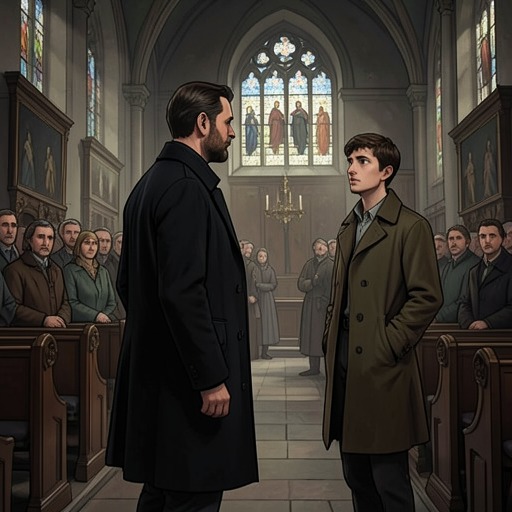
Alec d'Urberville's religious relapse and renewed pursuit of Tess
Tess of the d'UrbervillesAlec d'Urberville's religious relapse and renewed pursuit of Tess turns his abandoned preaching into both a sign of changed allegiance and a weapon of pressure: he casts his return to desire as Tess's doing, while she insists that his choices are his own and that he must respect her marriage to Angel Clare. The episode develops from a missed preaching engagement into repeated attempts to draw Tess away from her husband, revealing how Alec converts claims of care and past intimacy into assertions of control.
The abandoned preaching engagement
Alec is meant to preach at Casterbridge Fair, where he has agreed to address a crowd from a wagon at half-past two. He shows Tess the printed announcement, evidence that his engagement is specific and publicly expected. Yet he explains that he has come to see her instead and cannot reach the fair. His failure to preach is not an accidental delay: he declares that his desire to see Tess has displaced the duty he had undertaken.
He describes this reversal as a collapse of religious conviction and self-command. Although he had believed preaching was his obligation, he says he has stopped doing it and yielded to passion. He calls his conduct backsliding and asks whether he has become one of those who escape worldly corruption only to be entangled again. His language borrows the authority of religious doctrine, but turns its moral judgment toward his own actions—and then, insistently, toward Tess.
Alec says that he had been close to what he calls social salvation until seeing her again. He claims that he had respected her because, when she understood the situation at Trantridge, she withdrew from him quickly and resolutely rather than remaining at his pleasure. He now treats that remembered resistance as the reason he regards her differently from other women, even as he uses it to frame their renewed encounter as a test of his faith. Tess recoils from the suggestion that she has tempted him and asks what she has done; the scene exposes the gap between her involuntary presence and his decision to abandon his commitment.
From relapse to renewed pursuit
Alec later tells Tess that he has given up preaching entirely and broken every engagement since the Casterbridge Fair appointment. He acknowledges that the religious brethren may be kind and may grieve for him, but says he could not continue without faith without becoming a hypocrite. At the same time, he presents his apostasy as a revenge Tess has supposedly taken on him: she once encountered him as her deceiver, he says, and now finds him a Christian enthusiast whose faith she has undone. He then undercuts that solemn account by attributing his fixation to her appearance and by joking about the field-girl's bonnet and clothing.
Alec also claims that Tess has haunted him, especially since she told him about their child. He describes his former feelings as a puritanical stream that has abruptly found an outlet toward her, leaving the religious channel dry. Tess is appalled by his admission that he has stopped preaching, but his rhetoric shifts responsibility away from himself: his choice is repeatedly presented as an effect of her presence, her face, or what she disclosed. The religious relapse thus becomes a means of recasting pursuit as an irresistible consequence rather than an act for which he is answerable.
He says he came to the farm because he does not want Tess working there, and contrasts his own attempt to help with Angel Clare's absence. Alec questions whether Tess's husband is real to him, since he has never seen him and Tess has not told him his name. He then quotes Hosea and invokes the prospect of her returning to a first husband, using biblical language to make his desired reunion sound like a return to a rightful bond. Tess does not accept the premise: she tells him not to speak against Angel Clare, who is absent and has never wronged him, and urges Alec to leave before scandal damages her husband's good name.
Offers of help and the assertion of control
Alec says he will go away and try to stay away, but immediately asks for one embrace in the name of old friendship. Tess reminds him that Angel Clare's honour is in her keeping and urges him to be ashamed. The exchange makes the conflict plain: Alec casts closeness as a small concession between former intimates; Tess treats his approach as a threat to her responsibility and to her husband's reputation. His promised withdrawal is unstable from the outset.
At the threshing farm, Alec renews his claim that Tess is responsible for his backsliding and says she should leave the husband he derides and share the consequences with him. Tess strikes him with a heavy leather glove she had removed while eating. The action interrupts his attempt to direct the conversation and makes her resistance unmistakable. She then tells him he may punish or crush her, but calls herself trapped in the condition of a victim. Alec answers that he would have married her if she had not made it impossible, referring to his earlier proposal and her refusal.
Alec's appeal to that earlier proposal shifts rapidly into a threat. He tells Tess that he was once her master and will be her master again, and asserts that if she is any man's wife she is his. The language replaces the offer of kindness with an explicit demand for power. When the threshers begin to stir below, he releases her and says he will return for her answer during the afternoon. The scene ends not with reconciliation but with a renewed pressure that he intends to continue.
Continued pressure and the episode's significance
The pursuit persists through the day's work. Farmer Groby offers to let Tess stop and join her friend, Alec, but she understands that this concession has been made at Alec's request and refuses it, continuing to work. She has become afraid that losing the job would leave her exposed to his hovering presence. When the threshing ends and she steps down, Alec is promptly beside her again. His presence transforms what might have been a practical offer of relief into another occasion for contact.
Alec says he has told Farmer Groby that women should not be employed at steam-threshing and offers to walk Tess home. She accepts the walk with caution, acknowledging that Alec once came to marry her before knowing her circumstances, but distinguishing kindness from whatever else he may intend. He responds that although he cannot legitimize their former relationship, he can help her and her family; he claims to have enough money to make them comfortable and asks her to trust him. Tess immediately asks whether he has seen her family. He says that they did not know where she was and that he found her by chance.
The episode's central reversal is that Alec's apparent religious regeneration does not hold when he encounters Tess: he abandons an announced public duty, then interprets that choice as something she has done to him. Later, his talk of assistance and tenderness coexists with a claim to mastery. Tess's refusal to leave Angel Clare, her defense of his honour, and her physical resistance at the farm counter Alec's effort to turn his relapse into a claim upon her. His conduct therefore marks not a return to an honest relationship, but the renewed pursuit of a woman whose boundaries he repeatedly tries to redefine.