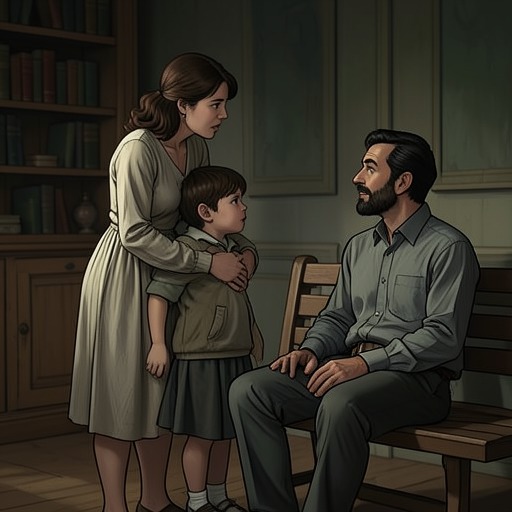
Angel Clare and 'Liza-Lu
Tess of the d'UrbervillesAngel Clare and 'Liza-Lu are connected by Angel’s marriage to Tess: he is 'Liza-Lu’s brother-in-law, not her husband or established romantic partner. Their final connection emerges through Tess’s request that Angel protect her sister and, if Tess dies, marry her. That appeal gives 'Liza-Lu a place in the imagined future Tess is about to lose, while Angel’s answer and the closing image of the two walking together leave their subsequent relationship unresolved.
Kinship and the circumstances of their relationship
' Liza-Lu is Tess’s sister, and Angel becomes her brother-in-law when he marries Tess. The relationship is therefore familial in fact, even as Tess later proposes a future marriage between them. Angel explicitly invokes the kinship tie when Tess asks him to marry 'Liza-Lu if he loses her; Tess counters that such a union would not be unusual in the communities around Marlott. The exchange records Tess’s argument, not a marriage agreement or a narrated change in their legal or romantic status.
The relation is shaped by Tess and Angel’s separation and the consequences of their estrangement. Earlier, Tess’s mother reproaches her for not having secured marriage to Alec, measuring the encounter by what it might have brought the family. Tess answers that she was a child when she left home and protests that no one warned her of danger from men. Those exchanges expose the unequal pressures surrounding her choices: her family looks to marriage as possible economic rescue, while Tess describes her lack of knowledge and protection. By the time she speaks about 'Liza-Lu at Stonehenge, the imagined marriage is framed not as a conventional courtship but as a request made in the shadow of Tess’s expected death.
Tess’s request at Stonehenge
As Tess and Angel rest among the monoliths before daybreak, Tess asks him to watch over 'Liza-Lu if anything happens to her. Angel agrees. Tess then asks him to marry her sister if he loses her, describing 'Liza-Lu as good, simple, and pure, and urging Angel to teach and raise her. She imagines her sister as having what she calls the best of herself without the bad, and suggests that their future union might make it seem as though death had not divided the sisters.
The request is Tess’s, and its emotional logic belongs to her vision of loss and continuity. She says she could share Angel with 'Liza-Lu when the sisters are spirits, then promises not to raise the matter again. Angel does not accept the proposal: he answers that if he loses Tess, he loses all, and that 'Liza-Lu is his sister-in-law. Tess replies that people around Marlott commonly marry their sisters-in-law. The exchange establishes her wish and his immediate resistance, but supplies no evidence that he later follows her suggestion.
Kinship, idealization, and the limits of the proposal
Tess’s description of 'Liza-Lu makes the younger sister a figure of hoped-for continuation. She calls her gentle and sweet and says that she is growing beautiful; she also imagines Angel training and educating her. These are Tess’s judgments and hopes, not an account of a shared life or of 'Liza-Lu’s own wishes. The proposal tries to translate a threatened separation into an imagined succession: Angel might remain connected to Tess through her sister, and Tess’s qualities might, in her phrasing, continue in someone who has not borne the same burdens.
That idealization also makes the proposal poignant rather than straightforwardly romantic. Tess distinguishes 'Liza-Lu from herself by saying that her sister has the best of her without the bad. Her language reveals how harshly Tess has come to assess herself, even as she asks Angel to care for someone she loves. The appeal places care, kinship, and anticipated bereavement at the center of the connection; it does not establish that Angel shares Tess’s idealized account or that 'Liza-Lu becomes a replacement for her sister.
The ending and what remains unresolved
After Tess is executed, Angel and 'Liza-Lu are seen leaving Wintoncester together. They are identified as Tess’s husband and her sister, and they walk hand in hand, their pale faces diminished by grief, without speaking. The image gives Tess’s request a final, concrete echo: Angel is beside the sister he had promised to watch over. Yet the narration neither reports a marriage nor identifies their joined hands as proof of romance. The close confirms their continued kinship and shared mourning while leaving the future Tess imagined unsettled.
This unresolved ending is central to the relationship’s significance. Tess’s request attempts to bind Angel and 'Liza-Lu together after her death, but the final scene offers only their silent departure, not the promised transformation of in-lawship into marriage. Her appeal can therefore be read as an act of care for her sister and as an effort to preserve a bond with Angel beyond her own life; the book does not say whether either hope is fulfilled.