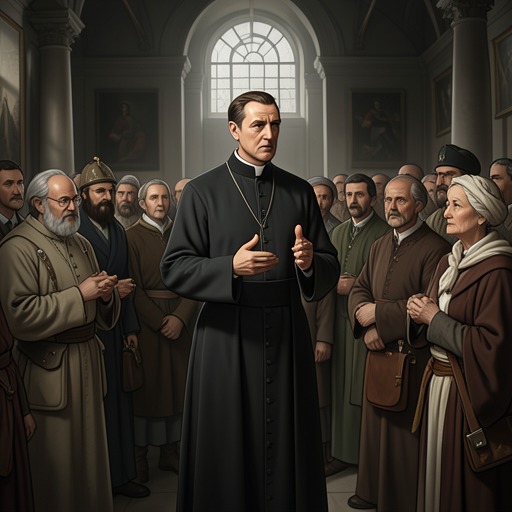
Angel Clare's religious heresy
Tess of the d'UrbervillesAngel Clare's religious heresy is not a simple abandonment of faith but a refusal to profess beliefs he cannot honestly affirm. When his father expects him to enter the ministry, Angel objects to the Church’s redemptive theology and its demand that its Articles be accepted literally. That conviction breaks the family’s settled plan for his education: rather than go to Cambridge as a path to ordination, he relinquishes the university and turns toward a vocation in farming, preserving what he values as intellectual liberty at the cost of belonging comfortably to his family’s religious world.
Identity and Belief
Angel describes his attachment to the Church as the affection one feels for a parent, and says he will always retain his warmest regard for it. He admires its history and does not dismiss its moral value; what he cannot do is become its minister while it refuses to free its thinking from what he calls untenable redemptive theology. His dissent therefore distinguishes the institution’s history and moral influence from doctrines he finds intellectually indefensible. It is a claim of conscience within a continuing attachment, not an uncomplicated rejection of religion.
His resistance becomes specific when he says he cannot affirm Article Four, much less the remaining Articles, in the literal and grammatical sense required by the Declaration. On that ground he cannot serve as a parson under existing conditions. He describes his religious instinct instead as one of reconstruction, invoking his father’s favorite Epistle to the Hebrews: shaken things should be removed so that what cannot be shaken may remain. The image makes his position reformative rather than merely destructive: the inherited structure must be tested, but something enduring may survive its dismantling.
Conflict with His Father
The dispute arises from a family arrangement built around ordination. Angel’s father has economized and restricted household spending to give his sons a university education for the honor and glory of God. To the devout Vicar, Cambridge has meaning chiefly as preparation for church service; a university education directed toward some other end appears to be an incomplete undertaking. Angel’s declaration that he would rather not take Orders therefore challenges both his father’s theology and the purpose attached to the family’s sacrifice.
His father answers with argument, persuasion, and entreaty, but the disagreement does not yield. The Vicar is deeply grieved, and his distress makes Angel ill to witness. Angel counters that education might serve the honor and glory of humanity instead. Yet he is sensitive to the possibility that accepting the family’s costly provision while refusing its intended religious purpose would misuse a trust. The conflict is thus not only over doctrine: conscience confronts filial obligation, and Angel ultimately treats the family’s expectations as a claim he has no right to accept on those terms.
Education and Vocation
Angel finally tells his father that he will do without Cambridge because he feels he has no right to attend in the circumstances. The decision interrupts the uniform educational course followed by his brothers and closes the route his father had imagined for him. It also carries a practical cost. In place of a clear professional path, Angel spends years in varied, unsettled study and reflection before considering work outside the Church.
The career that eventually attracts him is farming. He considers a careful apprenticeship and work at home or overseas, including in the Colonies or America, as a way to gain independence without surrendering intellectual freedom. His early attachment to country solitude makes modern town life distasteful, while the spiritual vocation he has declined and his discomfort with urban life leave him without an easy alternative. Religious dissent therefore reshapes not just what Angel believes but the conditions of his working life: independence becomes a substitute for the clerical future his education was meant to secure.
Growing Distance from the Vicarage
On returning to the family home, Angel feels that it is still home, yet he no longer feels himself fully one of the family. The difference has sharpened since his previous visit. The Vicarage’s aspirations remain grounded, in Angel’s view, in a cosmic scheme of heaven above and hell below, whereas he has come to experience life as a passionate pulse that creeds try futilely to check and that wisdom would regulate instead. The contrast places his dissent in a wider opposition between inherited transcendental explanations and an understanding centered on lived, embodied existence.
The family also sees a change in him. His manner has become more expressive and physical; the scholar and drawing-room young man have receded, and he behaves more like a farmer. This alteration is associated with his life among the people of Talbothays, and it makes the change in his religious outlook visible as a change in conduct and social bearing. His heresy is consequently not confined to arguments about doctrine: it accompanies a growing estrangement from the forms of life his family regards as proper, even as his father continues to welcome him with kindness.