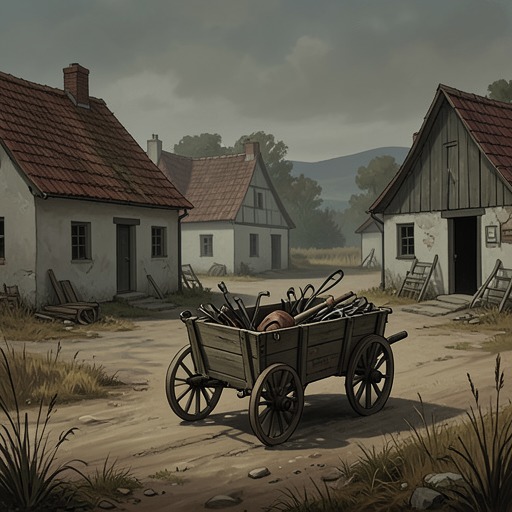
Candlemas Fair
Tess of the d'UrbervillesCandlemas Fair is the annual hiring fair where agricultural workers seeking a change of place enter into engagements for the twelve months following the next Lady-Day. Its significance lies in the choice it brings into view: workers may try to leave a harsh farm, but poverty and family obligations narrow Tess’s choices, while the farm’s machinery and workload make the conditions of her labor physically palpable.
Calendar and Hiring
The fair falls in February and serves as a hiring point for the approaching agricultural year. Those considering a change of employment attend the county town, a journey of ten to twelve miles across hilly country from Flintcomb-Ash. The timing ties a particular day of departure to the longer cycle of rural labor: new engagements are made for the year ahead, with service beginning at Lady-Day.
A Collective Departure, and Tess’s Exception
Nearly all the laborers at Flintcomb-Ash intend to leave, and the morning brings a general exodus toward the fair. Tess also means to leave at the quarter-day, but she is among the few who do not attend. She stays in her cottage, alone that day, holding to a vague hope that something will happen to make another outdoor job unnecessary. The contrast between the crowd’s movement and her waiting makes the fair more than a hiring date: it is a practical chance to change one’s circumstances, but not one Tess can confidently take.
Work and Economic Constraint
The labor the workers hope to leave is rendered in stark material detail. At Flintcomb-Ash, Tess works in a swede-field of more than a hundred acres on the farm’s highest ground, hacking the remaining earthy halves of turnips from the soil with a hooked fork. Later, on the threshing machine, she stands on its platform beside the feeder, untying each sheaf passed to her by Izz Huett so it can be spread over the revolving drum. The drum does not stop; unless Marian changes places with Tess, she cannot pause either. That demanding routine gives context to the workers’ desire to move on and to Tess’s intention to leave at the quarter-day.
Her choices are constrained beyond the farm. During her separation from Angel, she spends the money he left her slowly, reluctant to part with the new sovereigns because they have become tokens of their shared experience. When Joan writes that the family needs twenty pounds for roof repairs, Tess sends it from the thirty pounds due to her, leaving herself only a nominal sum for the winter after buying clothing. Though Angel had said she could apply to his father for further help, pride and shame about appearing a mendicant prevent her from doing so. The fair’s promise of a new engagement thus belongs to a wider struggle over scarce money, family support, and the cost of continuing to work outdoors.
Narrative Significance
Candlemas Fair marks a point when the agricultural workforce can collectively seek new employment, but the narrative places Tess outside that movement. Her hope that some other event will make another job unnecessary remains vague, while her plan to leave is deferred to the quarter-day. The fair’s ordinary function in the rural hiring calendar therefore carries a deeper contrast: laborers can set out for a new place, yet Tess’s immediate future is shaped by hardship, obligations to her family, and uncertainty about what will come next.