Flintcomb-Ash Farm
Tess of the d'UrbervillesFlintcomb-Ash Farm is a remote, harshly worked agricultural settlement where Tess Durbeyfield secures shelter and winter employment after leaving Talbothays and living apart from Angel Clare. Its exposed upland, impoverished village, and punishing field labor make the farm more than a backdrop: it gives material form to the precariousness of Tess’s life and becomes the setting for Alec d'Urberville’s return to her daily world.
Setting and Character
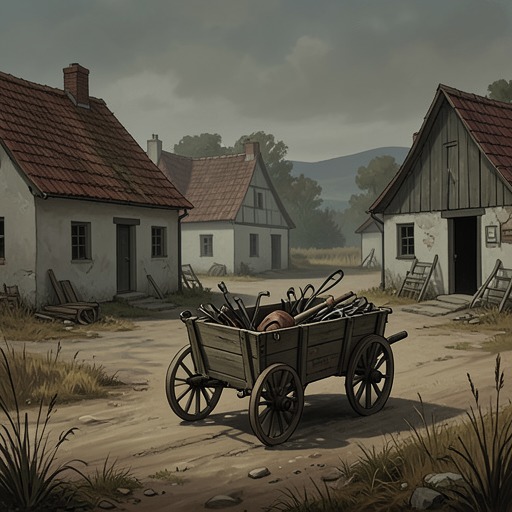
Tess reaches Flintcomb-Ash after crossing an upland plateau between the valley of her birth and the valley of her love. The land is open and cold: cart-roads whiten quickly after rain, hedges have been cut down with their trees and brush, and the horizon gives little shelter. She arrives at a slight depression containing the remains of a village, with the stubborn soil offering little promise of easy work. As rain begins, she pauses beneath the jutting gable of a cottage and warms her hands and cheek against the wall, which has absorbed heat from the fireplace within. For a woman who has nowhere secure to turn, that modest warmth briefly seems like companionship.
The farmhouse presents a landscape of agricultural deprivation. There is no tree in sight and, in that season, no green pasture: fallow and turnips occupy the broad fields, divided by hedges trimmed to bare levels. The narrator classifies Flintcomb-Ash as a village neglected both by its inhabitants and by its absentee owner, its land farmed without the attention of a resident squire. It is described as a “starve-acre place,” a judgment borne out by its bleak soil and limited prospects rather than by any single dramatic catastrophe.
Employment and Rural Poverty
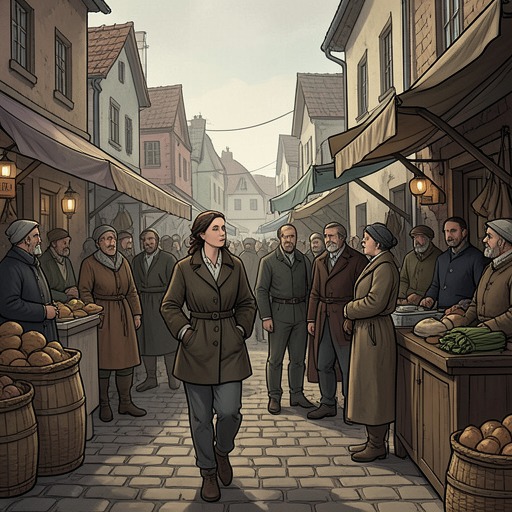
Tess waits outside the farmhouse until the workfolk have been paid; Marian then introduces her to the farmer’s wife, who is representing her absent husband. The wife hires Tess on condition that she remain until Old Lady-Day. Female field labor is seldom available, but women’s lower wages make their work profitable where the tasks can be performed by either sex. The agreement therefore gives Tess a means of subsistence while exposing the economic arrangement that makes her labor attractive: she is hired not because her work is valued equally, but because it costs less.
Her lodging is the cottage whose warm gable sheltered her arrival. Tess has secured only a poor livelihood, but it promises shelter for the winter. That evening she writes to tell her parents where she is, so that a letter from her husband can find her; she withholds how miserable her situation is, fearing that an account of it might bring reproach upon Angel Clare. Her silence leaves the material facts of her hardship at Flintcomb-Ash largely hidden from her family even as she maintains a connection with them.
The work itself is physically exacting. Tess and Marian are set to hacking turnips in a swede-field extending for more than a hundred acres on the farm’s highest ground. Livestock have eaten the upper portions of the roots, and the women must grub the remaining earth-covered halves out with hooked forks called hackers. The leaves are already gone, leaving a drab field beneath a sky described as similarly blank. The labor turns the farm’s poor conditions into a daily bodily task: the women must extract what remains from ground and crop already stripped of their more visible abundance.
Threshing and Alec’s Return
At the farm’s last wheat-rick, work begins before dawn on a March morning. Tess, Izz Huett, and the other women stand waiting and shivering while men strip the stack’s thatch. The threshing-machine, a red timber-framed contrivance with straps and wheels, imposes an unrelenting demand on the women’s muscles and nerves; an engine and its sooty attendant supply the power that drives this small working world. The machinery and its routine render the labor both organized and relentless, with the workers summoned early so that Farmer Groby can try to finish the job within the day.
Alec is present, watching Tess, though she cannot tell exactly where he is. His presence changes the meaning of remaining at the farm: a month or two earlier, the prospect of leaving might have brought her relief, but now she fears that she may have to go because he has begun hovering around her. Marian is uneasy for her, while Tess continues working, having gone without ale because of her inherited dread of its effects from childhood at home.
When the sheaf-pitchers and feeders have worked the rick low enough for people on the ground to speak with them, Farmer Groby comes up to Tess on the machine. He offers to let her leave and join her friend, saying that someone else can take her place. Tess understands that the supposed friend is Alec and that the offer has been made at his request. She refuses by shaking her head and continues working. Her choice is made under pressure: she does not welcome Alec’s intervention, but the possibility of losing her work has become frightening enough that she keeps at the task.
The rat-catching that follows the threshing brings the day’s labor to a noisy close. Rats, driven from the base of the stack, scatter across the open ground among barking dogs, shouts, screams, and confusion. Tess ties her final sheaf; the drum slows, the whizzing stops, and she steps down from the machine. Alec, who has only watched the hunt, is immediately beside her. The workplace thus becomes a point of renewed access for him, while Tess’s exhaustion and need to hold her job leave her to meet his return at the end of a long day.
Narrative Significance
Flintcomb-Ash concentrates the pressures that govern Tess’s choices in this part of the story: poverty, limited employment for women, physical toil, and the threat of renewed pursuit. The farm provides her with a roof and wages, yet neither is secure enough to free her from dependence on the labor market or from Alec’s ability to approach her there. Tess’s refusal to leave the threshing-machine when Farmer Groby offers a replacement captures this contradiction particularly sharply: endurance is not simple consent to the circumstances around her, but a means of retaining the little economic footing she has.
The farm’s barrenness also contrasts with the warmth Tess finds in the cottage wall. One is a landscape of stripped fields, cut-back hedges, and work imposed by necessity; the other is a brief, bodily comfort that cannot alter her circumstances. At Flintcomb-Ash, refuge and hardship occupy the same place. The farm sustains Tess through winter, but the work and the reappearance of Alec make it a setting where survival requires continued exposure to conditions she cannot easily control.