James Clare
Tess of the d'UrbervillesJames Clare, the Reverend James Clare and father of Angel Clare, is a sincerely devout Evangelical whose inflexible theology shapes his family life but does not exhaust his humanity. His story is marked by a consequential contrast: he cannot accept his son’s religious dissent, yet he meets Angel’s choice of a wife without asking whether she is rich or poor.
Identity and Background
James Clare is an earnest clergyman of the older Evangelical tradition, described as a spiritual descendant of Wycliff, Huss, Luther, and Calvin. In his youth he settled the major questions of belief to his own satisfaction and thereafter admitted little further argument. Even people who shared his religious outlook considered him extreme; opponents nevertheless admired his thoroughness and his determination to put his principles into practice. The account insists on his sincerity: his convictions are not a pose but the foundation of his life.
His theology is strongly shaped by St Paul. The New Testament, in his understanding, is less a general argument than an intense Pauline teaching; he loves Paul, likes St John, and dislikes St James as much as he dares. He despises the Canons and Rubric while affirming the Articles, a combination he considers consistent. His determinism is so pronounced that the narrative presents it as nearly a vice, and its negative aspect resembles a philosophy of renunciation. That severity gives his faith intellectual and emotional force, but also makes it difficult for him to recognize truths outside its settled boundaries.
The family’s circumstances help explain Angel’s unexpected career. James’s first wife died, leaving him a daughter; late in life he married again, and his second wife bore him three sons. Angel, the youngest, was the child of his father’s old age and seemed separated from him by almost a generation. He alone among the sons did not take a university degree, although his early promise appeared especially suited to academic training. Angel’s eventual entry into agriculture and livestock breeding was unforeseen, both by himself and by others.
Faith and Conflict with Angel
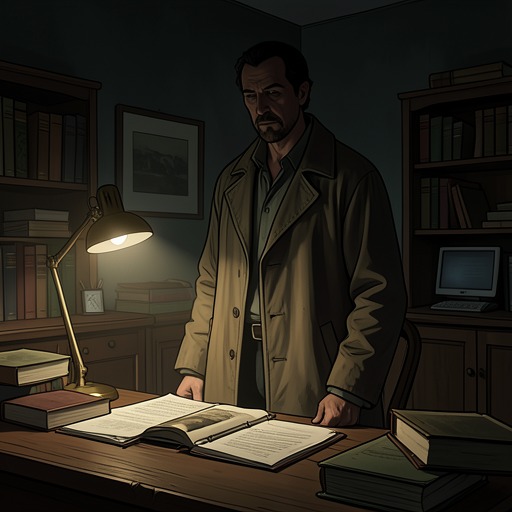
The clash between James’s convictions and Angel’s develops before Angel’s adult return home. While Angel was still studying at home, a parcel addressed to the Reverend James Clare arrived from the local bookseller. James opened it, read several pages, and hurried back to the shop, demanding to know why the book had been sent to his house. The bookseller explained that it had been ordered by Angel and misdirected. James returned home pale and dejected, summoned his son to his study, and asked what he knew of the volume. Angel answered simply that he had ordered it.
The book brought into the open a more serious disagreement than a misplaced delivery. James acknowledged that it was a system of philosophy and could be moral, but could not understand how Angel could regard it as religious while intending to become a minister of the Gospel. Angel then stated that he would prefer not to take Orders, because he feared he could not do so conscientiously. He continued to love the Church, admire its history, and feel deep affection for it, but could not honestly be ordained while it refused, in his view, to free its thinking from an untenable redemptive theolatry. His dissent is therefore not simple hostility toward the Church; it is a refusal to profess beliefs he does not hold.
James is shocked by the possibility that one of his own sons might reject ordination. He had assumed that Cambridge would lead Angel into the Church, and could see little purpose in university education if it did not serve that end. The scene establishes the limits of their agreement: Angel’s conscientious independence meets a father who treats settled doctrine as a matter no longer open to debate. Yet the narrative also distinguishes James’s rigid theology from personal malice. His kindness is such that he does not remain resentful for long, and, when Angel later returns, he welcomes him with a candid smile.
Family, Marriage, and Practical Counsel
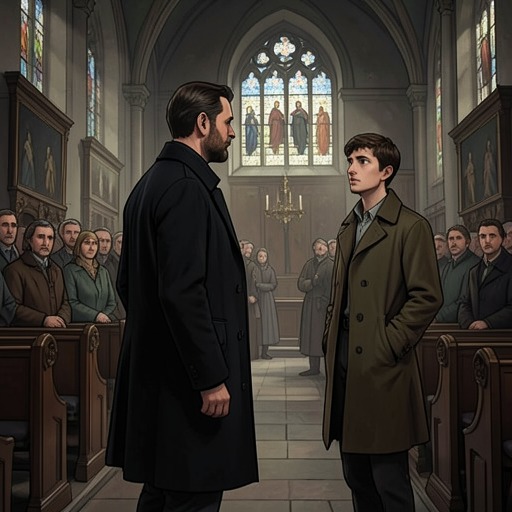
When Angel returns unexpectedly to Emminster, he arrives around breakfast time without having written ahead. His parents are at the table with his brothers, the Reverend Felix, a curate visiting from a neighbouring county, and the Reverend Cuthbert, a classical scholar and fellow and dean of his college at Cambridge. The family setting places James’s religious authority amid the different paths taken by his sons, while Angel’s return brings his altered plans into direct contact with the household’s expectations.
James’s neighbour and friend Dr Chant has a daughter, Mercy Chant, whom Angel’s parents quietly hope he may one day marry. Angel sees Mercy near the church vestry, carrying books and apparently preparing to teach a Bible class. She is known for Antinomianism and Bible classes, and her religious activity fits the kind of respectable match that James’s household can readily imagine. James himself describes Mercy as pure and saintly, and believes she would please both him and Angel’s mother. He regards her recent practice of decorating the Communion table with flowers as a temporary girlish fashion, one that her father thinks can be corrected.
Angel, however, is preparing to earn his living as a farmer and asks what sort of wife would suit that work. James first answers in spiritual and domestic terms: a truly Christian woman who will help and comfort her husband in his daily life. Beyond that, he says, little matters, and he begins to recommend Mercy through her father’s friendship. Angel presses the practical requirements of the life he has chosen: a farmer’s wife should be able to milk cows, churn good butter, make large cheeses, set hens and turkeys, rear chickens, direct field labourers in an emergency, and judge the value of sheep and calves. James accepts that these are desirable skills, admitting that he has not previously considered the question in those terms.
This conversation reveals a gap between James’s religious ideal of marriage and Angel’s concrete understanding of agricultural life. James begins with Christian character and comfort; Angel asks for competence in work that will determine the household’s daily survival. James can accommodate the practical point, but continues to commend Mercy’s piety and family suitability. His advice shows both the assumptions of a clergyman whose own life is organized around faith and the flexibility that appears when Angel makes his actual needs explicit.
Character and Significance
James’s strongest test comes when Angel’s marriage to Tess Durbeyfield is at issue. Despite their theological difference, James does not first ask whether Tess is well provided for or penniless. The narrative draws attention to that omission as evidence of his unworldliness: the same lack of concern for material advantage has helped make it necessary for Angel to earn a living as a farmer, and is likely to leave Angel’s brothers as poorly paid clergy. James’s principles have material consequences for his family, but Angel admires the integrity behind them.
Angel may reject his father’s narrow dogma, yet he reveres his practice and recognizes in him a hero beneath the pietist. Indeed, he often feels closer to James on the human side than either of his brothers does. The distinction is central to James’s characterization: he is intellectually unyielding about doctrine, but his religious seriousness is joined to generosity that does not depend on agreement. He welcomes Angel after earlier conflict, keeps praying for a young man whose future he fears may place him beyond another meeting in this life, and hopes that one of his words may someday take root.
James is consequently neither a mere emblem of oppressive religion nor a figure whose devotion dissolves into easy tolerance. He cannot follow Angel into theological freedom, and his fixed ideas make him unable to imagine the full force of the natural, sensuous life his son has experienced in the Var or Froom Valley. But his sincere practice gives Angel a model of moral seriousness, while his lack of worldly calculation permits him to accept a marriage without treating wealth as its measure. The tension between doctrinal narrowness and human generosity makes him one of the novel’s more complex portraits of religious conviction.