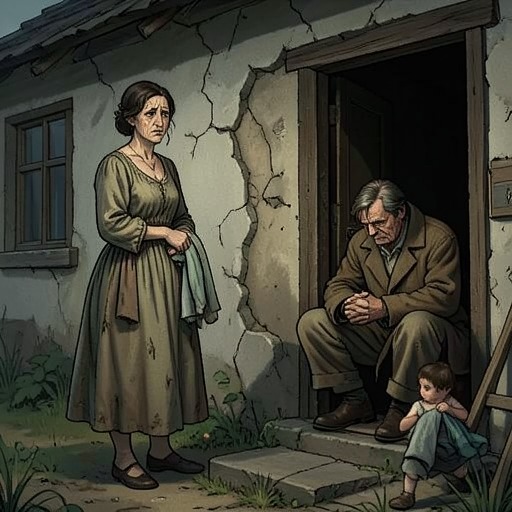
John Durbeyfield's death
Tess of the d'UrbervillesJohn Durbeyfield's death is both a family bereavement and the event that removes the last condition securing the Durbeyfields' home. Its force lies in the reversal surrounding it: Joan, who had seemed near death, recovers, while John, thought only slightly ill, dies suddenly; with his death, the family's precarious hold on its house and premises comes to an end.
The News and Its Reversal
Tess is returning home with a fork in her hand when one of her sisters meets her with the news. 'Liza-Lu is crying, the house is full of people, and their mother is much better, but John is believed to be dead. The child first treats the announcement as momentous news rather than fully grasping its sorrow, then asks whether they will never speak to their father again. Tess, taken aback, protests that he had been only a little ill.
'Liza-Lu explains that John has just collapsed. The doctor already at the house for Joan says there is no hope because John's heart has grown in. The account makes the reversal stark: the dying parent survives, and the apparently less gravely ill one is dead. The suddenness is sharpened by Tess's earlier assumption that John might have gone back to his own home; the news overturns that expectation before she can resume her work.
The Loss of the Home
The death has consequences beyond the family's grief. The house and its premises are held under a lease tied to the lives of three members of the household, and John's is the last of those lives. His death therefore brings the lease to its end, with no renewal expected. The practical consequence is decisive: the Durbeyfields lose the security that had allowed them to remain where they were.
The narration explains why the household's position was already vulnerable. The tenant-farmer covets the property for regular laborers, whose cottage accommodation is inadequate. The Durbeyfields' status as liviers—independent occupants under a lease—is also resented in villages, much like the position of small freeholders. John's death thus activates an existing pressure over land and housing; it does not create the family's insecurity from nothing, but makes its consequences immediate.
Reversal and Social Change
The passage places the family's dispossession within a longer historical reversal. The Durbeyfields, once the d'Urbervilles, are now among the landless, exposed to the same kind of power they had once exercised over people below them. The narrator describes this as a rhythm of flux and reflux: the rise and fall of social fortunes persist, and those who once imposed displacement may themselves experience it.
John's death consequently changes the family's circumstances while giving the change a wider social meaning. A single collapse ends a lease, and the end of that lease strips an already diminished family of its home. The event joins private bereavement to the decline of inherited status, showing how little protection ancestry offers when the family's remaining legal and material foothold depends on a life that can end without warning.