Retty Priddle
Tess of the d'UrbervillesRetty Priddle is a young dairymaid at Talbothays Dairy whose unspoken love for Angel Clare becomes visible in the company of her fellow milkmaids. Her story moves from hopeful watching, to painful recognition that Angel prefers Tess Durbeyfield, to a reported attempt to drown herself after Tess and Angel marry. Though the novel gives little access to her inner life beyond what she says and what others observe, her changing place in the women’s circle makes the emotional cost of an unreturned attachment part of the marriage’s aftermath.
Identity and Life at the Dairy
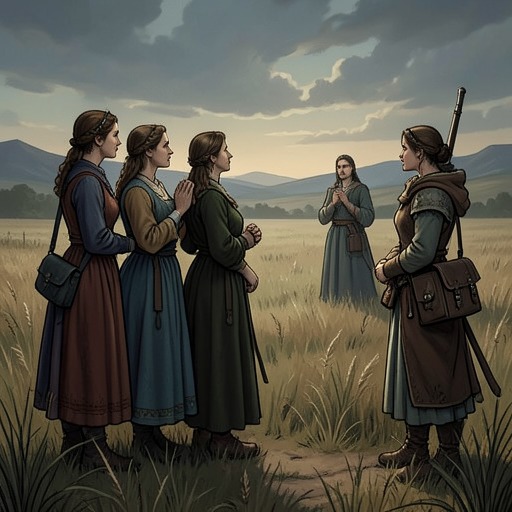
Retty is the youngest of the three milkmaids who watch Angel from their shared bedroom window. The scene gives her a distinct appearance and position among them: she is auburn-haired, and when she tells Marian not to push, she keeps her eyes on the person in the garden. The women’s close grouping at the window turns private admiration into a shared, though not equally voiced, secret.
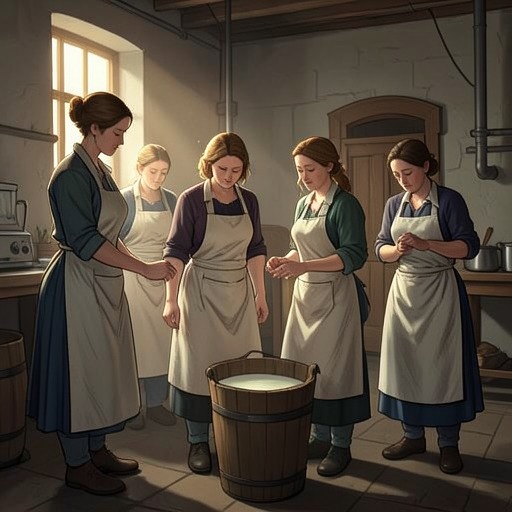
Her work also places her in the practical life of the dairy. Like the other milkers, Tess learns which cows respond readily to her hands; among the ninety-five animals, eight give milk particularly easily to her. The dairy’s working routines and the milkmaids’ attachments to particular cows form a grounded counterpoint to the romantic hopes that occupy them after work. Retty herself is not singled out in the milking account, but she belongs to the same household and laboring community whose daily intimacy makes Angel’s presence a common focus.
Love for Angel and Recognition of Tess
At night, Retty, Marian, and Izz Huett watch Angel in the garden and speak openly among themselves about their feelings. Marian says she would marry him at once; Izz agrees, and Retty, more timidly, whispers that she would too. Their conversation distinguishes the intensity of their wishes from any realistic expectation that Angel will choose one of them. Izz points out that he is a gentleman’s son who expects to become a great landowner and farmer abroad, making marriage to a dairymaid seem unlikely.
The decisive knowledge comes from Marian, who says she has watched Angel every day and concluded that he likes Tess best. Retty asks whether Tess cares for him, and Marian admits that she sometimes thinks Tess does not. Retty’s question registers both her hope and the uncertainty that sustains it: Angel’s preference appears plain to the other women, but Tess’s own feelings remain difficult to read. Their silent kiss toward Angel, followed by their candid admission of desire, makes the bedroom a small space where the women can acknowledge a wish they would not confess to outsiders.
Retty does not present herself as a rival who expects to win. When Marian says she does not think Angel will choose any of them, Retty moans that she never expected it, yet wishes she were dead. The abrupt extremity of the wish exposes a vulnerability that the group’s teasing and frankness cannot make harmless. The narrative describes her as a poor child torn by a feeling she hardly understands, emphasizing the disproportion between the modest outward scene and the distress within it.
Tess’s Engagement and the Changed Household
When Tess’s marriage to Angel becomes known, Retty is among the women who meet her in their bedroom. They sit upright in their white beds, waiting for Tess, but the scene is not an accusation or a confrontation driven by malice. Retty looks steadily at Tess and says that he is going to marry her, reading the change in Tess’s face before asking whether it is true. Tess confirms it.
The women’s response is complicated by what they had already understood: they had scarcely expected Angel to marry any of them, so they cannot quite experience his choice as the loss of a future they believed would be theirs. Yet Retty admits that she wants to hate Tess and cannot. Izz and Marian say they feel the same, adding that Tess somehow prevents hatred. This mixture of jealousy, affection, and restraint gives Retty’s disappointment a social setting: she is wounded by the marriage, but remains close enough to Tess to speak honestly rather than turn that hurt into open hostility. Tess, in turn, says that Angel ought to have married one of the other women, recognizing the emotional claim their shared life has created without pretending that it can undo his choice.
Attempted Drowning and Aftermath
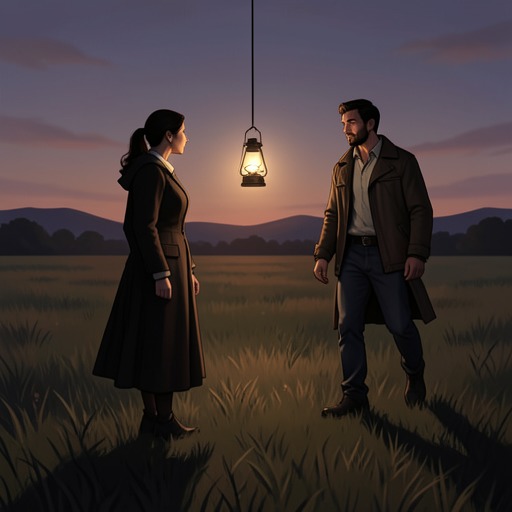
After Tess and Angel have left the dairy as a married couple, Dairyman Crick later tells Angel that Retty has tried to drown herself. His account places the attempt on New Year’s Eve. After Angel and his wife drove away, Retty and Marian put on their bonnets and went out; they went first to Lew-Everard, where they had something to drink, and then toward Dree-armed Cross. The two women parted there. Retty set off across the water-meads as if heading home, while Marian went on to another village.
The account then narrows from travel to discovery: a waterman on his way home noticed Retty’s bonnet and shawl packed up beside the Great Pool and found her in the water. He and another man brought her home, believing at first that she was dead; she gradually recovered. The episode is reported to Angel rather than shown from Retty’s own perspective, so the novel supplies the circumstances of the rescue without giving a direct explanation of her intention. The sequence nevertheless binds the attempt to the immediate aftermath of the wedding, when the household’s former possibilities have become an accomplished choice.
Later, when Angel asks Izz how the other women are and specifically asks about Retty, Izz describes her as nervous and so thin and hollow-cheeked that she seems to be in a decline. She adds that nobody will ever fall in love with Retty again. The remark makes visible a lasting physical and emotional deterioration as observed by another dairymaid, while also revealing how the women’s worth and prospects are measured through desirability and marriage. Retty’s fate remains peripheral to the main couple’s story, but it does not disappear once the wedding is over: her condition returns as evidence of the human cost left behind at the dairy.