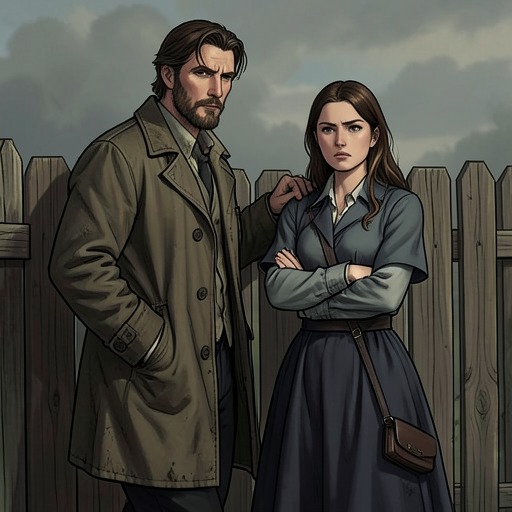
Tess leaves Trantridge and refuses Alec’s offer
Tess of the d'UrbervillesTess leaves Trantridge and refuses Alec’s offer in a scene that turns physical flight into a declaration of independence. Walking home to Marlott with her possessions, she rejects Alec’s renewed pursuit and refuses money that would bind her to him; back with her mother, she confronts a second judgment, as Joan reproaches her for not securing a marriage. The episode establishes the conflict between Tess’s understanding of her experience and the social and economic calculations imposed upon her.
The journey away from Trantridge
It is a Sunday morning in late October, about four months after Tess’s arrival at Trantridge and some weeks after the night ride in The Chase. At daybreak she is already on the road, carrying a heavy basket and a large bundle. She pauses mechanically at gates and posts to rest, then adjusts her burden and continues toward the ridge she must cross to reach her birthplace. The yellow light on the horizon behind her marks the direction she has left; the vale ahead is a place from which she has lately felt herself estranged.
The road crosses more than a short distance. Though Trantridge is less than twenty miles from Marlott, Tess has experienced the two places as far apart: the people on either side of the ridge trade, travel, court, marry, and direct their thoughts toward different parts of the country. Her laborious walk makes that separation visible in her body. The narrator also distinguishes the baggage she carries from the burden that matters most to her: she handles the material load steadily, as though it were not her especial burden.
Alec catches up in a two-wheeled vehicle, driving hard enough that he complains about the mare. He says he discovered Tess’s departure by accident and followed to spare her the rest of the walk, while also asking her to return. Tess answers directly that she will not. She accepts a ride for part of the way, placing her basket and bundle in the dog-cart, but her willingness to travel beside him does not imply renewed trust or a change of decision. The narration says that she has no fear of him now, and locates her sorrow in that confidence.
Refusal and financial independence
During the ride, Alec offers to pay for Tess’s needs and presents his money as a way to free her from work in fields and dairies. He says she could dress better than she has chosen to do. His offer makes the power imbalance plain: he can propose comfort and relief because she is economically vulnerable, but the relief would come through dependence on the man she has left.
Tess rejects that bargain. She says that accepting anything more from Alec would make her his creature, and insists that she cannot do it. The language of her refusal makes the issue one of self-possession, not simply preference for plain clothes or agricultural work. Alec admits that he has done wrong and calls himself a bad man, yet couples that admission with renewed assurances that he would not harm her again and that she could write if she ever needed help. His promise leaves the offer available as a future means of support even as Tess rejects it in the present.
The exchange briefly exposes the assumptions behind his pursuit. Alec calls Tess a princess in mockery of her manner and invokes her supposed d’Urberville ancestry; his teasing shifts between her social bearing and the lineage that has linked them. Tess does not accept either money or the identity he uses to frame their relation. When Alec asks again that she return, she refuses emphatically, explaining that she had made up her mind when she saw what she ought to have recognized earlier. He calls himself her four-month cousin at parting, then drives away between the red-berried hedges.
Tess chooses where the journey ends. She tells Alec she does not want him to drive farther, and they stop beneath a clump of trees. He lifts her down and places her parcels beside her; she gives him a slight bow and turns to collect them. The small, practical transfer of her belongings closes the encounter: the vehicle has carried her part of the way, but she continues on her own terms.
Return to Marlott and family conflict
At home, Joan senses that Tess has not told her everything. Tess goes to her mother, rests her face against Joan’s neck, and tells her the truth. The intimacy of the gesture contrasts with the painful reception of what she reveals. Joan immediately centers the fact that Alec has not married Tess, treating marriage as the outcome that might have rescued both daughter and family from their predicament.
Joan’s disappointment is tied to material hopes. She recalls the talk about Tess and Alec, the family’s belief that assistance had come because they were kin, and her expectation that something would come of Tess’s association with him. She points to her own hard work and to Tess’s father’s weakness, and reproaches Tess for thinking of herself instead of doing something for the family. Her view turns the departure into a lost opportunity for social and economic security.
The gap between mother and daughter is not merely a disagreement about tactics. Tess understands her relation with Alec through fear, helplessness, and a confused episode of surrender followed by dislike and departure; she has not wanted him and does not regard marriage to him as a desirable rescue. Joan, by contrast, had hoped that talk of Alec’s affection would lead to a match. The contrast shows how poverty can make marriage appear to be a practical family strategy even when it conflicts with Tess’s feelings and sense of what she has endured.
Tess answers her mother by insisting that she left home as a child and had not been taught to recognize danger from men. She asks why Joan did not warn her, contrasting the knowledge available to women who learn from novels with her own lack of preparation. Joan is subdued and admits that she feared a warning would make Tess cautious and cause her to lose her chance. Her explanation exposes the failed logic of that silence: what she treated as an opportunity to secure a marriage left Tess without guidance about danger.
Consequences and significance
The episode establishes a repeated conflict between Tess’s lack of intentional wrongdoing and the judgments made against her. Later, during the separation from Angel Clare, Tess pleads that she was a child when what happened and that she knew nothing of men. Angel grants that she was more sinned against than sinning, but says forgiveness is not all. The later exchange echoes the painful knowledge at the center of her return: being wronged does not prevent other people from making her bear the consequences.
The economic circumstances that shape the return continue to govern Tess’s life. At Flintcomb-Ash she works on a farm described as a starve-acre place, in a village managed under absentee ownership and worked with the land. The hard agricultural labor gives concrete form to the alternative she chooses when she refuses Alec’s money: independence does not mean comfort, and her refusal cannot remove the poverty that narrows her options.
Much later, after Alec rides away from her again, Tess remains behind and recognizes that Angel, like others, has dealt harshly with her. She thinks that she never intended to do wrong and asks why she has been punished so persistently. That later recognition gives the return to Marlott a wider place in her story: the scene begins with a woman refusing to let her exploiter define her future, but it also shows how little protection that refusal offers against family need, social judgment, and repeated punishment. Tess preserves a measure of agency by leaving and refusing support, while the conditions that make the offer tempting remain in force.