Tess’s visit to the Slopes and employment at the poultry farm
Tess of the d'UrbervillesTess’s visit to the Slopes turns the Durbeyfields’ newly discovered ancestry into an urgent attempt to secure work and relief from poverty. She claims kinship with a wealthy family bearing the d’Urberville name, then accepts employment managing its poultry farm. The episode offers her family a possible escape from hardship, but its promise rests on a false social equivalence: the Stoke-d’Urbervilles possess wealth and an adopted name, while Tess’s family has the stronger claim to the ancestry that name invokes.
Hardship and the decision to seek kin
The immediate cause is the loss of the Durbeyfields’ horse, which disrupts the family’s haggling business. Their prospects darken because John Durbeyfield is not dependable at regular day labor. Tess, conscious that her actions have helped bring the family into difficulty, wonders how she can help. Her mother proposes that she approach the rich Mrs d’Urberville, whom she believes to be a relation, and ask for assistance. Tess initially objects to expecting money from a stranger, saying that friendliness alone would be enough, but agrees to go.
The journey takes Tess from Marlott through Shaston toward Trantridge, where the woman her mother has described as a possible relation lives. The route leads beyond the familiar Vale of Blackmoor that has formed Tess’s sense of the world. Her decision is therefore both practical and a step into unfamiliar territory: she goes because the family needs help, yet the appeal depends on a lineage whose meaning she cannot confidently judge.
The name and the people at the Slopes
At the Slopes, Tess finds a setting and a family unlike the ancient, dignified household she had imagined. The narrator clarifies the difference between the two lines: John Durbeyfield is the true surviving representative of the old d’Urberville family in the county, whereas the Stoke-d’Urbervilles have no genuine descent from that line. Their connection to the name began when Simon Stoke, a successful northern merchant, chose d’Urberville as an addition to his own name after deciding to establish himself as a county gentleman. The family’s social identity is thus constructed through money and deliberate reinvention, while Tess’s claim derives from ancestry but brings her no comparable wealth.
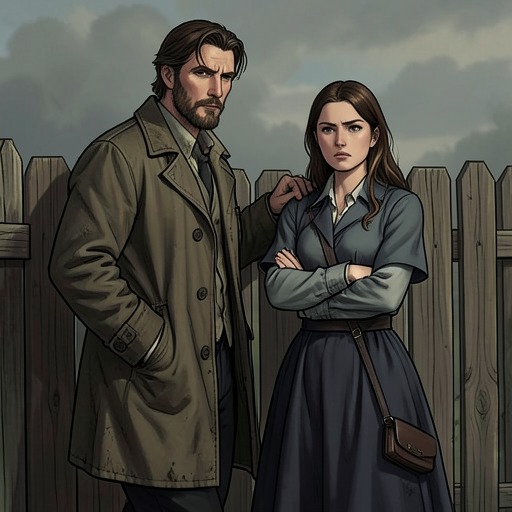
Tess meets Alec d’Urberville, a young man who identifies himself as Mr d’Urberville and asks whether she has come to see him or his mother. Tess makes clear that she came to see Mrs d’Urberville. When pressed to explain her business, she says that her mother sent her and that she had also thought of coming herself: the Durbeyfields belong to the same family, though their surname has worn down to Durbeyfield. The encounter places her claim before the very household whose wealth and name make her family hope for assistance.
To support the claim, Tess points to the family’s proofs of descent: antiquarians’ opinions, an old seal bearing a rampant lion and a castle, and a worn silver spoon marked with the same castle. The spoon is so ordinary in the family’s present life that her mother uses it to stir pea soup. Alec confirms that the castle and lion match his family’s crest and arms, then acknowledges that the Durbeyfields say they are the oldest branch and have lost their horse in an accident. Tess’s evidence establishes a curious contrast: the old signs survive in domestic use, while the new bearers of the name possess the estate and the means to offer employment.
The offer of employment
Tess does not meet Mrs d’Urberville in the encounter described, but a letter subsequently offers a practical route into the household. Written in the third person, it says that her services would be useful in managing the lady’s poultry farm, that a comfortable room would be provided, and that the wages would be liberal if the family agreed. The offer presents employment, not an explicit acknowledgment of kinship or a gift of money. Tess recognizes that distinction and questions whether she ought to go; her mother reads the proposal more hopefully, treating the work as a way of bringing Tess near the family and perhaps gaining its recognition.
The family’s need and the children’s hopes press on the decision. Tess’s mother and siblings imagine the benefits of her becoming a lady, including a new horse and money for household wants. Tess finally says that she will go. Her consent brings the visit’s immediate practical outcome: she accepts the prospect of paid work at the poultry farm, while the family invests the opportunity with hopes beyond what the letter actually promises.
Consequences and significance
The Slopes episode makes ancestry an unstable source of power. The Durbeyfields have the older and more authentic descent, but it is the Stoke-d’Urbervilles who own the property and can offer a room and wages. Tess’s family can present a crest and a spoon as proof, yet its immediate need is for the employment that the wealthy household controls. The inherited name opens a door only because it meets the interests of a family that adopted the name for social advancement.
The decision also lays the groundwork for later family recrimination. After Tess returns home, her mother complains that she has failed to secure marriage to Alec, and reproaches her for not turning the family’s supposed connection into lasting support. Tess answers that she was a child when she left home and that her mother did not warn her about the dangers she might face among men. This later exchange reveals how the original journey’s hopes exceeded its stated employment arrangement: the family had imagined social and financial rescue, while Tess’s own understanding of the visit had been more limited. Her departure for work is therefore both an act of responsibility toward her family and the beginning of a conflict between their expectations and her experience.