Bee Colony Community and Collective Loyalty
The Adventures of Maya the BeeBee Colony Community and Collective Loyalty defines the Bees’ life both in quiet daily routines and under attack. For Maya, the community is the security and recognition she has left behind; for the colony, it is also a practical system of shared labor, coordinated defense, and loyalty to the state. The contrast between Maya’s exposed independence and the Bees’ organized resistance gives belonging a double meaning: it protects individual members, while asking them to act for more than themselves.
Everyday Solidarity
In Maya’s recollection of a rainy day, the Bee-city (the hive) is quiet but not idle. Bees rest together, tend the cells, and feed the larvae; occasional messengers fly out to assess the weather and the direction of the wind. The queen moves through the hive, inspecting its different parts, laying eggs, and offering praise or criticism. Her attention is personal as well as official: she may pat a young bee on the head or ask about its experiences. Community is thus made visible through ordinary work and small gestures of recognition, as well as through the larger protection of the state.
The memory sharpens because Maya is alone. Outside the hive, she is cold, exposed to danger, and unsure how she will find food if the rain continues. The Canterbury bell offers little honey-juice, and its pollen will soon run out. She understands that life as a wanderer brings risks the sheltered colony helps its members withstand. Her longing is not merely for a place to sleep or a reliable food supply; she misses being one among many, respected and protected by a community.
That insight does not erase her pride in leaving. Maya also reflects that her travels have given her more experiences than most Bees are likely to have in a lifetime, and she considers experience worth sacrifice. The narrative therefore holds two values together: independence has enlarged her understanding, but it has also shown her what solitary life lacks. The hive’s solidarity matters most when set against the real costs of life beyond it.
Organization Under Threat
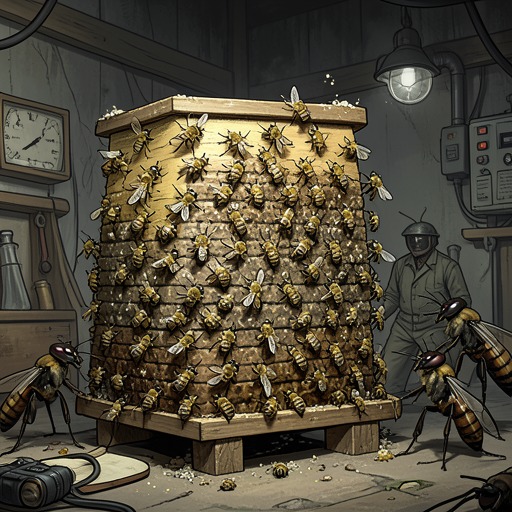
The Hornets’ planned attack turns the colony’s habits of cooperation into an explicit defense system. Their queen orders an assault on Bee-city in the castle park before dawn, with instructions to plunder the hive and take prisoners; capturing Helen VIII alive is promised as a route to knighthood. Against this organized threat, the Bee kingdom mobilizes rapidly. The hive is full of excitement, but the preparations are orderly: regiments assemble, soldiers take their assigned places, and volunteers help defend the entrance. Scouts are sent out to check the enemy’s approach, and two return with warning that the Hornets are near.
The Bees prepare the entrance as a group. Wax-generators work in silence to narrow it, raising two thick partitions that would cost even the strongest Hornets time to break through. Soldiers form three ranks, while officers arrange reserves behind them. Helen VIII takes an elevated position from which she can survey the defense, and her aides carry messages and instructions. These details make the colony’s collective strength more than a declaration of loyalty: it depends on distinct tasks, advance warning, construction, command, and disciplined placement.
When the Hornets begin to enter, Helen VIII directs the Bees to let them advance individually until she gives the signal. The front ranks are to attack in groups while the lines behind them protect the entrance, dividing the invaders rather than allowing them to press forward together. The plan uses the narrow passage and the depth of the hive to turn the Bees’ coordinated positions into an advantage. Once the order to defend the realm is given, the attack begins. A young officer rushes forward first and dies in the opening clash; his willingness to risk himself inspires the others. The episode presents courage as contagious, but not as a substitute for collective tactics.
Loyalty and the Battle’s Cost
The Hornets have greater individual size and strength, and their protective armor blunts the Bees’ attacks. The Bees’ defense instead relies on numbers, reserves, and cooperation. When an exhausted Hornet moves farther inside, the Bees feign weakness and allow the advance; fresh soldiers then defend the entrance and confront the intruder. This repeated maneuver keeps the passage from becoming an open route for the Hornet force. The defense is dangerous and costly: the fighting spreads through the hive’s streets and corridors, and Bees are killed or wounded. The Hornets, too, are gradually overcome, in part because the power of their stings diminishes over time.
An older Hornet identifies the difference behind the military outcome: the Hornets may be more powerful, but the Bees are unified and loyal, and no individual turns traitor or places private advantage ahead of the state. His assessment makes explicit what the battle has shown through action. The Bees do not prevail because danger is absent or because every member can defeat an opponent alone; they prevail through coordinated service to a shared defense. The Hornet leader ultimately calls off the attack and asks for the dead to be returned rather than continue a campaign that would destroy his own force.
Victory and Continuing Duty
Helen VIII does not treat the withdrawal as a reason to relax the defense. She orders the rear guard, wax-generators, and honey-carriers to remove the dead, while two fresh regiments remain on watch at the entrance in case the Hornets attempt another deception. The bodies are carried out, and the Hornets wait on a silver fir as their fallen are returned. By sunrise, twenty-one dead lie beneath Bee-city. The invaders have taken neither honey nor prisoners; they collect their dead and depart.
Victory does not mean that the Bees have escaped loss. The hive must dispose of its dead and care for its wounded, but before noon its regular work has resumed. The Bees neither celebrate nor publicly dwell on their grief; each carries pride and sorrow inward while returning to the tasks of the community. This ending echoes the rainy-day recollection: the colony persists through shared work, whether that means tending larvae in a quiet hive or repairing life after an attack. Collective loyalty is both the source of the Bees’ resistance and the discipline by which they continue after its cost has been paid.