Bees
The Adventures of Maya the BeeBees in the Nation of Bees are presented not merely as individual insects but as members of a structured community whose everyday solidarity becomes its greatest defense. Their society joins practical cooperation to political loyalty: shared work sustains the colony, the queen’s presence affirms its bonds, and, when the Hornets attack, disciplined collective action proves stronger than individual power.
Society and Everyday Life
The community’s routines emerge through Maya’s recollection of home on a rainy day. She imagines the Bees gathered inside, resting while continuing small tasks: repairing cells and feeding larvae. Rain quiets the hive, though messengers sometimes venture out to assess the weather and the direction of the wind. Even the pause in ordinary activity remains collective, shaped by the colony’s needs and the members’ shared enclosure.
The queen’s rounds give this social order a personal as well as administrative character. Maya remembers her moving from story to story, inspecting conditions, laying eggs, and offering praise or blame. A younger Bee might receive a pat on the head or be asked about new experiences. The queen’s attention makes authority visible as care and recognition, while the hive’s organized labor keeps that care connected to the community’s continuing life.
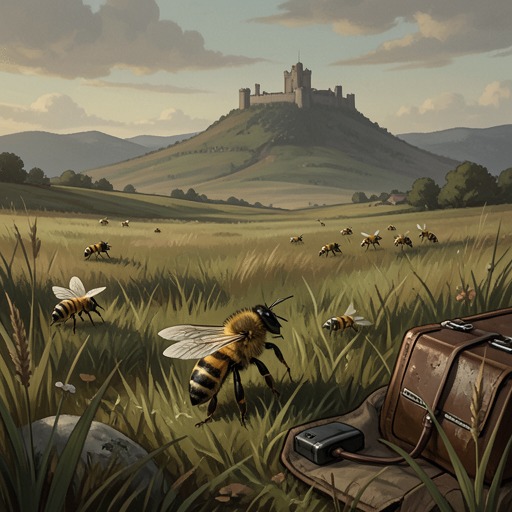
For Maya, membership means more than having a home. She remembers the respect accorded to each Bee and the powerful protection provided by the state. Away from that protection, she feels exposed to danger and uncertain of finding food; the available honey-juice and pollen are limited. Her homesickness therefore registers a change in security and belonging, not simply a preference for familiar surroundings. The community she left is a refuge because its members’ lives are interdependent.
Relations with Humans
The Bees’ relationship with humans is described as an established exchange of resources and protection. Cassandra teaches Maya that the Bees share honey, while humans leave enough for winter, provide shelter against cold, and guard them from animal enemies. She presents this arrangement as voluntary friendship and service, not simply as the submission of a weaker creature to a stronger one. The Bees benefit from human protection, and their honey is part of the reciprocal bond.
Cassandra also warns that a Bee community attempting to live without humans may be destroyed by animals drawn to its honey. Her account gives the relationship a practical foundation: protection matters because the colony and its stored resources are vulnerable. The narrator does not make this the only view of humans. Maya encounters skepticism about human goodness, and the mosquito notes that Bees have more dealings with humans than other insects. Maya, who has left her kingdom to explore, is consequently caught between inherited confidence in the arrangement and her own incomplete knowledge.
Belonging, Authority, and Boundaries
Maya’s return makes the community’s protections inseparable from its rules. At dawn she recognizes the silver fir shielding the Bee-city in the castle park from the west wind, then sees the red, blue, and green entrances of her homeland. She flies toward the red entrance, eager to reach her people and queen. Yet sentinels stop her on the flying-board. A Bee who enters another city without the queen’s consent commits a capital offense, and the guards threaten her when she tries to force her way in.
The episode sets homesickness against the colony’s insistence on ordered access. Maya’s urgency does not erase the rule, even though she is returning to her own community and intends to warn it of danger. The Bees’ society depends on coordination and authority, but those same structures can obstruct an individual at the moment she most needs to act. Her experience makes the cost of collective order concrete without undoing the protection and belonging she has missed.
Mobilization and Collective Defense
When the Hornets approach, the Bees’ organization shifts rapidly from ordinary work to defense. The hive fills with excitement, but the preparations are not confused: soldiers take their assigned places, volunteers respond to the queen’s call, and returning scouts report that the enemy is drawing near. The queen surveys events from an elevated position while aides carry messages. At the entrance, wax-generators work in silence, raising two thick partitions and reducing the opening by almost half. The physical barrier and the ranks assembled behind it turn collective labor into military preparation.
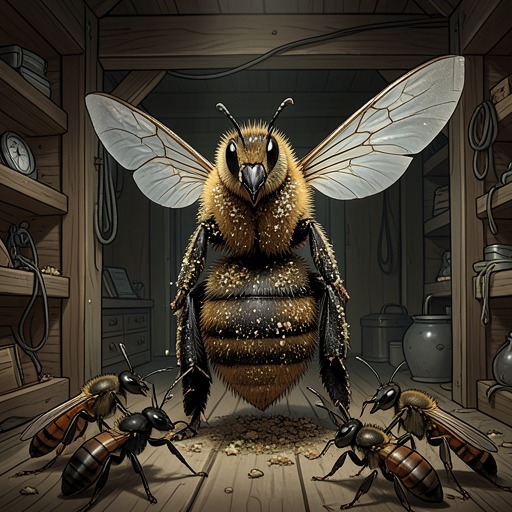
The queen’s strategy uses the entrance as a point of defense and makes reserves central to the plan. Soldiers stand in three closed ranks while officers arrange forces farther back. If an exhausted Hornet pushes inward, fresh Bees can meet it beyond the entrance; a momentary appearance of weakness draws an intruder into a position where rested defenders have the advantage. The Bees’ stings cannot pierce the Hornets’ breastplates, and the Hornets are larger and stronger, but the defenders can use numbers, timing, and familiarity with their own corridors.
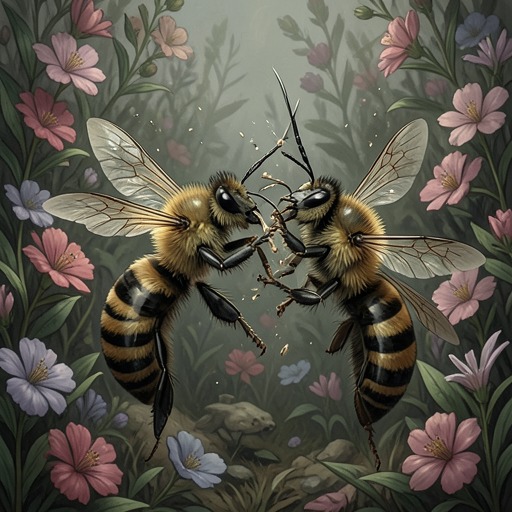
The battle exacts a severe cost, including the death of a young officer who rushes forward as soon as the order to defend the realm is given. His example intensifies the defenders’ resolve. As the fighting continues, the Hornets’ stings lose their effectiveness, while the Bees’ grief for the fallen strengthens their determination. The account thus connects sacrifice to the group’s survival, while showing that discipline and tactical advantage—not strength alone—shape the outcome. The Hornets within the hive are eventually overcome; the force outside has lost half its numbers and withdraws from continued fighting.
Political Meaning
The Hornets’ own assessment clarifies the Bees’ distinctive strength. An older Hornet observes that, although the Hornets are more powerful individually, the Bees form a unified nation whose members remain loyal to their people and state. In this account, unity is not an abstraction: it appears in the wax-workers at the entrance, the organized ranks, the reserves, the scouts, and the soldiers who accept danger for the colony.
The Bees therefore embody a political ideal built from interdependence. Their community’s care is evident in ordinary routines and in the queen’s attention; its discipline appears in rules and coordinated labor; its loyalty is tested in battle. The story gives these qualities practical consequences, rather than treating solidarity as a virtue without cost. Maya’s longing for home, the strictness of the entrance rule, and the sacrifices of the defense together show both the shelter and the obligations that belonging entails.