Cross spiders
The Adventures of Maya the BeeCross spiders are presented through Thekla, who identifies herself as a member of the group and makes her web the center of an encounter with Maya. The episode gives the spider a double role: she is a predator using a web to capture prey, but also a speaking character who treats the web as a possession and disguises her intentions behind polite assurances. Her scene turns the web from a delicate feature of the garden into a trap whose apparent softness conceals the captive’s danger.
Identity and Representation
Thekla names herself as belonging to Cross spiders. The account does not offer a broader description of the group’s habits or structure; its principal evidence comes from this individual and the web she has built. Her identity is therefore established in the midst of action, when she explains whom Maya is dealing with rather than appearing as a detached specimen in a natural-history description.
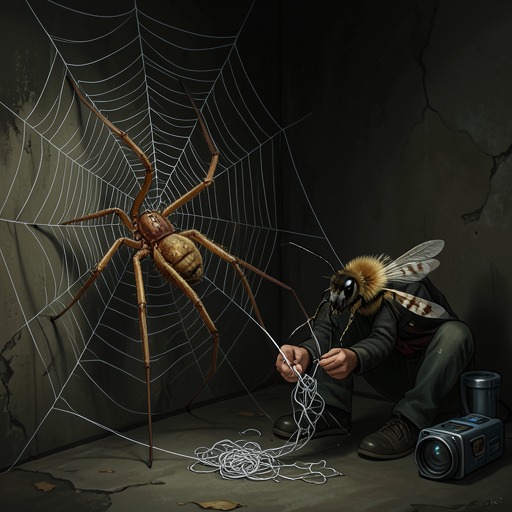
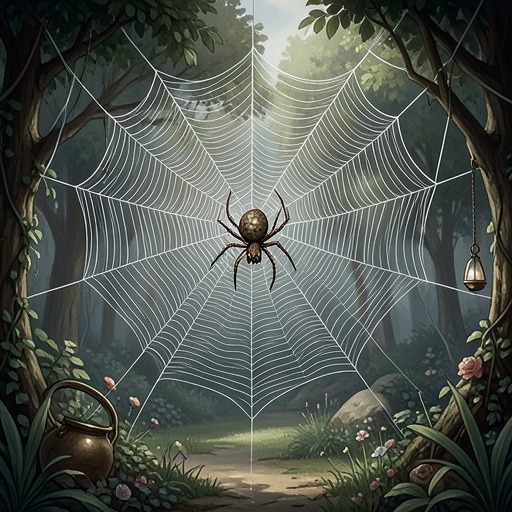
The spider is described as large in relation to Maya, with shining eyes and raised legs. She can move along a thread and approach the trapped bee while suspended beneath it. These details make her presence legible before she speaks: Maya sees a waiting predator, while Thekla’s controlled movement suggests that the web is familiar ground to her. The contrast between the spider’s position and Maya’s inability to fly gives the scene its immediate imbalance.
The Web and the Encounter with Maya
Maya becomes caught among fine, elastic, silvery threads while flying among blackberry vines. At first she experiences restraint without understanding its source; only when she sees threads crossing her body and binding her wings does the danger become clear. The web is yielding enough to hold her in the air, yet the more she struggles, the more entangled she becomes. Her size also strains the web: a suspension thread breaks, but that break does not free her, and another violent attempt leaves her more caught than before.
When Thekla comes close, she challenges Maya for damaging the net and disturbing a peaceful recluse. The complaint reverses the apparent moral arrangement: Maya is the captive, but Thekla speaks as the wronged owner whose property has been harmed. That pose does not last. Thekla offers to set Maya free if she will keep still, presenting herself as a helper at the very moment she is examining how securely her victim is caught. Maya accepts the promise, but Thekla has no intention of releasing her.
Predation and Deception
Thekla’s assurances are exposed by what she says and does next. She explains that Maya will die if left hanging long enough and that she intends to feed when the captive can no longer sting. The spider thus makes clear that the offer of rescue was a means of quieting resistance, not an act of help. Her remarks also connect the danger to the mechanics of the web: she resents the damage Maya has caused, but the captive’s helplessness is useful to her.
Thekla then fastens a newly spun thread and drags Maya away from the exposed part of the web. She says she is moving her into shade so that she will not dry out in the sunshine, and adds that a captive hanging in view might scare away other prey or attract sparrows that could rob the web. These practical-sounding explanations sit beside her openly predatory purpose. The shade offers no escape; it places Maya near the ground, out of sight, and entirely at Thekla’s mercy. The contrast between the spider’s courteous address and the function of each action makes deception central to her characterization.
Narrative Significance
The episode builds suspense by delaying recognition. Maya first feels an inexplicable restraint, then discovers the threads, and only later sees the spider waiting nearby. Each discovery changes the meaning of what came before: the soft suspension that seemed merely strange is a trap, and the spider’s offer of assistance is another part of it. The web’s beauty and delicacy therefore coexist with its practical force, without making it safe.
Thekla also gives the encounter a social dimension. She speaks of privacy, property, and peaceful seclusion, but uses those claims to rebuke a captive and justify her own conduct. The narrative does not confuse her politeness with kindness: her words invite trust, while her actions reveal an intention to keep Maya imprisoned. Against the Bees’ warnings that a spider’s web is dangerous and difficult to escape, Thekla’s particular behavior makes the danger concrete. She is not simply an obstacle in Maya’s flight; she is a calculating antagonist whose web, speech, and handling of her captive all serve the same predatory purpose.