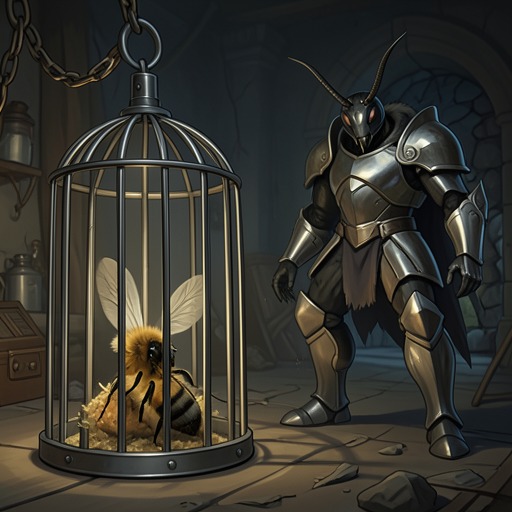
Maya Escapes from the Hornet Fortress
The Adventures of Maya the BeeMaya Escapes from the Hornet Fortress turns a private bid for survival into a race to warn the Bees: captured by an armored Hornet, Maya discovers that the fortress is preparing an attack and must escape before dawn. Her way out depends not on force, which has already failed, but on persuading a sentinel to honor a bargain. He lets her go without knowing that she carries news of the invasion, and Maya flies off with almost no time to spare.
Capture and Imprisonment
Maya’s captivity begins when a Hornet seizes her by the neck with such violence that she fears her joints have been broken. The attacker’s laugh and the clanking of his armor make the moment unforgettable. Maya fights back, turning to drive her sting into his breast; it skids off the Hornet’s armor instead of piercing it. He says that his queen prefers living Bees and carries Maya to the fortress as a prisoner. Against an enemy whose protection defeats her weapon, her courage cannot prevent her capture.
Maya wakes in half-darkness, disoriented by a pungent smell and the thought that she may be eaten. A thread of light through a narrow chink reveals the prison chamber in stages: its floor is strewn with dead insects, including an overturned rose-beetle, a large locust’s broken skeleton, and the wings, legs, and sheaths of slaughtered Bees. The walls are made not of wax like those of a bee hive, but of a dry, porous, gray material. The contrast between the familiar work of a hive and this chamber of remains makes the danger of the Hornet fortress visible in its very construction.
The Invasion Plan
Through the chink, Maya sees a crowded hall lit by captive glow-worms, with the Hornet queen presiding over a council. The queen confirms that the warriors will assemble one hour before dawn the next day and attack Bee-city in the castle park. They are to plunder the hive and take as many prisoners as possible; a warrior who captures Queen Helen VIII alive will be made a knight. The meeting turns Maya’s imprisonment into a crisis for the whole Bee community: the attack is timed to catch her people asleep, and she is the only witness to the plan in the fortress.
The news overwhelms her. Maya thinks of her country and her Bees, and fears that no one will warn them before they are attacked and massacred. Her plea for help is sharpened by the fact that she cannot act openly: she presses her hands to her mouth to stop herself screaming. After the council, the glow-worms are put out and devoured; the fortress grows quiet while Maya remains locked among the dead. The scene shifts from the queen’s public command to the lone captive who has understood its consequences, but has not yet found a way to carry that knowledge outside.
A Passage to the Exit
Once the watchman’s footsteps have faded, Maya works at the brittle partition, biting it away until the opening is wide enough for her body. She knows discovery would cost her life. From the hall she hears loud snoring, then moves through the subdued blue light that enters from the distant entrance. Keeping to the deep shadows along the walls, she reaches the high, narrow passageway leading out. A far-off star is visible beyond the opening, and for a moment escape seems as simple as flying through the portal.
A sentinel stands in the doorway, leaning against a column. His presence seems to end Maya’s hope of getting past: he is formidable, and she considers returning to her cell. Yet the sight of him complicates her fear. His golden cuirass gleams in the moonlight; he gazes out at the landscape with his head tilted forward and his chin resting on his hand. Maya reads sadness in his posture and reflects that he appears always ready to rob, fight, and die, never taking off his armor. Her response does not erase the danger he poses, but it gives her a reason to address him rather than retreat.
Maya tells the sentinel that he can put her back in her cell or set her free, and appeals to the sadness she has seen in him. He does not immediately answer. As the light in the passage dims and dawn approaches, she recognizes that the chance to negotiate is narrowing. When he asks where Loveydear lives, Maya deliberately hesitates before saying that she loves her life. The exchange makes her escape a bargain rather than an act of pity: the sentinel offers freedom in return for information, and Maya must decide whether to trust his promise.
The Bargain and Escape
Maya gives the sentinel directions to Loveydear: beyond the ancient linden-trees near the castle are meadows and a large lake; at its southern end, where the brook flows in, waterlilies spread across a sunny cove, and Loveydear lives among the rushes. She says Loveydear can be found there at noon. The sentinel trembles and struggles with himself as he listens. He recognizes the place from Loveydear’s wish to go where there were floating white flowers, and says Maya has told the truth. He then steps aside and lets her pass.
The bargain succeeds because the sentinel keeps his word, but it also reveals what Maya does not know: he thinks one Bee more or less makes little difference and has not realized that she overheard the council. Day is breaking. Maya calls goodbye and flies away without thanking him, not from indifference but because there is no time to spare. Her escape therefore ends on two linked consequences: she is free of the fortress, and she can carry the warning that may give the Bees a chance to prepare for the attack. The sentinel’s promise opens the way out; Maya’s knowledge gives that escape its larger urgency.