Maya Escapes the Hornet Fortress by Bargaining with a Sentinel
The Adventures of Maya the BeeMaya Escapes the Hornet Fortress by Bargaining with a Sentinel is the turning point that converts Maya’s captivity into a chance to warn her people: she reaches the fortress exit, but cannot pass its guard by stealth, so she secures her freedom through his concealed love for Loveydear. The escape is precarious rather than triumphant. Maya risks discovery at every step, and the sentinel’s decision to release her depends on a promise whose consequences he does not understand.
From the Cell to the Moonlit Hall
After the watchman’s warning voice and footsteps have passed, Maya begins widening the chink through which she had been peering. The partition’s brittle material is easy to bite away, but making an opening wide enough for her body takes time. She knows discovery would cost her life; even so, she squeezes through into the hall, where loud snoring sounds from the remote depths of the fortress.
The hall is dimly lit by blue light entering from the distant entrance. Maya recognizes it as moonlight and creeps toward the exit, close to the deep shadows along the walls. A high, narrow passage leads from the hall toward the light, and a far-off star is visible beyond it. The star gives her a direction and an image of freedom, but the passage itself offers no protection once she approaches its brighter stretch.
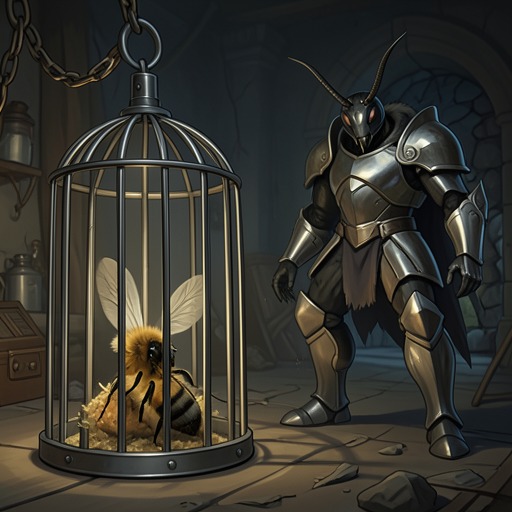
Maya advances softly, imagining that a single flight could carry her through the portal. Then she sees the sentinel in the doorway, leaning against a column. Her hope of slipping past him vanishes: she is rooted in place, with no obvious way around the formidable figure. Yet his posture complicates the threat. He gazes out at the moonlit landscape, chin resting on his hand, and the moon catches the gold of his cuirass. Maya reads sadness in his stillness, even as she understands that he is armed and dangerous.
A Guard Who Sees Her
A glint from the sentinel’s helmet tells Maya he has turned his head. She expects the end of her escape, but instead he quietly calls her over. Her surprise that he has seen her marks a change in the scene: the guard has the power to return her to captivity, yet he does not immediately seize or punish her.
Maya addresses that choice directly. She argues that an enemy need not always be wicked and explains that, while watching him gaze into the moonlight, she had forgotten his hardness and danger. His apparent sadness has led her to believe he cannot be wholly evil. The appeal is not proof that he is harmless; it is Maya’s attempt to treat the sentinel as a person capable of feeling, rather than as an impassable obstacle.
She then states the alternatives plainly. He can return her to her cell, where she will have to die, or he can set her free. The warrior draws himself upright, his armor clanking as he raises an arm that shines in the moonlight. The passage is already growing dimmer. Dawn is approaching, and Maya’s need to escape is tied to more than her own survival: she must warn her people of the coming attack.
The Bargain for Loveydear
Maya makes the personal stake in the bargain explicit when she refuses to betray the lovely dragon-fly, Loveydear, whom she describes as a close friend. The sentinel struggles visibly as dawn gathers: he breathes hard, and Maya sees his pale forehead and tragic eyes. He says it is time to rouse the soldiers, then breaks from that course, insisting that he does not want to harm Loveydear and loves her more dearly than his life. He asks Maya where he can find her again.
Maya does not answer at once. She first reminds him that she values her own life, making clear that information about Loveydear will have a price. The sentinel offers a specific exchange: if she tells him where Loveydear lives, he will set her free to fly wherever she wants. Though he trembles and speaks with difficulty, he pledges his word of honor as a brigand. Maya accepts his promise because every moment matters if she is to reach her people in time.
Her directions are precise. Beyond the ancient linden trees near the castle lie a sequence of meadows and then a large lake. At its southern end, in the cove where a brook empties into the lake, waterlilies float in the sunlight; Loveydear lives among the rushes nearby and can be found there at noon. The sentinel recognizes the place from Loveydear’s own description of wanting to go where white flowers float. His response confirms that Maya has located a real longing shared between them, not invented a destination merely to purchase her freedom. He groans, unable to separate joy at the prospect of finding her from the pain of the choice before him.
Release at Dawn and Its Stakes
The sentinel steps aside from the entrance and lets Maya pass. Day is breaking; he repeats that a brigand keeps his word, and Maya flies off without thanking him because there is no time to spare. The escape therefore ends not with a safe pause or a farewell, but with urgent forward motion toward the warning she must deliver.
The bargain also rests on an asymmetry of knowledge. Maya has overheard the deliberations in the council chamber and knows the danger to her people; the sentinel does not know she has that information. He tells himself that one small bee more or less makes little difference, imagining that hundreds of others remain. His decision frees the messenger whose warning may matter precisely because the planned attack is not yet known to him. The scene joins intimate feeling to public consequence: the sentinel’s love for Loveydear opens the way out, while Maya’s promise to preserve that love secures the freedom she needs to act.