Maya’s Relationship with Cassandra
The Adventures of Maya the BeeCassandra’s relationship with Maya is chiefly presented through memory, but its influence is concrete: she has taught Maya how to interpret danger, the Nation of Bees, and humanity. Away from the hive, Maya repeatedly measures new experiences against Cassandra’s lessons. Puck’s skeptical account of people challenges that inheritance, yet Maya does not abandon it simply because another creature disputes it.
Teacher and pupil
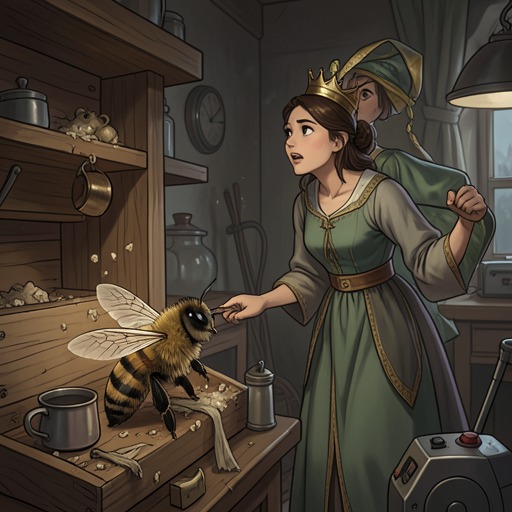
Maya identifies Cassandra plainly as her teacher when Puck asks who had given her ideas about human beings. That brief identification establishes a relationship of instruction whose importance becomes clearest after Maya has left home: Cassandra is absent from these encounters, but her explanations continue to guide Maya’s observations and decisions. Maya’s recollections are not presented as a record of formal lessons; instead, they return when experience makes their meaning urgent.
One early lesson concerns weather. On the first rainy morning of Maya’s life, she remembers Cassandra’s warning not to fly in the rain. Watching drops fall, Maya reasons that they must weigh down a bee’s wings, and the cold makes her miss the sunshine. The memory turns Cassandra’s advice into practical knowledge: Maya has encountered a condition she has never experienced, but her teacher has given her a framework for recognizing its danger. The lesson does not prevent her from looking out at the changed world; it helps her understand why she should be cautious within it.
The recollection also reveals the emotional reach of Cassandra’s teaching. Rain makes Maya think of the hive and its sheltering community, and the distance between independent exploration and protected belonging becomes newly apparent. Cassandra’s warning is therefore more than an instruction about flight. In Maya’s memory it belongs to a larger understanding of life in the colony, where bees share work, care for young, and depend on the hive’s protection.
Cassandra’s account of humanity
Cassandra has taught Maya to regard human beings as powerful but benevolent. In her account, their strength brings order and prosperity rather than abuse, and the bees respond by sharing honey and accepting human protection. The arrangement is reciprocal: people leave enough honey for the winter, provide shelter from cold, and guard the bees against animal enemies. Cassandra presents this friendship as unusual among insects and people, grounded in mutual benefit as well as trust.
Her teaching also gives Maya a warning about what can happen when that relationship is rejected. Cassandra says that a bee community returning to the wild and attempting to manage without human beings may perish because many animals seek its honey. A whole bee-city can be destroyed by a creature’s greed. This account links Maya’s ideal of human kindness to the colony’s practical vulnerability: the bees’ association with people is not merely admiration from a distance, but a form of protection on which their survival can depend.
Cassandra’s description extends beyond this mutual arrangement to the scale and variety of human life. Maya recalls her teacher’s accounts of immense cities, tall towers, houses that float on water, and vehicles that travel across the country on narrow rails faster than birds. These images have enlarged Maya’s sense of what humans can build and do. Her wonder at them marks a difference between a pupil who remains curious about the wider world and a teacher whose account has already given that world moral as well as material significance.
Puck’s challenge and Maya’s response
Puck directly contests the authority behind Maya’s picture of humanity. When he learns that Cassandra was her teacher, he dismisses her as a bee who overestimates people and says she does not understand their history. He replaces Cassandra’s human-centered account with a fly-centered one, treating the abundance of flies as proof that they are the world’s most important creatures. The exchange exposes a conflict between two ways of interpreting the world, not simply a disagreement over particular facts.
Maya cannot accept Puck’s assertions wholesale. She has imagined humanity in a more generous and beautiful way, and she resists letting his contempt reduce that image to something ridiculous. Yet she is not entirely sure how to act on Cassandra’s confidence: she remains hesitant to enter a human dwelling because she cannot know whether its owner would welcome her, and she does not want to impose. The tension makes her inheritance from Cassandra more than unquestioned belief. Maya retains the lesson while confronting the uncertainty of applying it in circumstances Cassandra’s remembered account does not resolve for her.
When Maya thinks again about Cassandra’s teaching, she decides that she wants to keep believing in it until she has convinced herself otherwise. That qualification matters. Her trust is neither blind obedience nor an immediate rejection prompted by Puck; it is a chosen provisional faith, held open to experience. Cassandra’s influence thus helps Maya resist cynical certainty while leaving room for her to judge what she encounters herself.
The teaching’s wider significance
Cassandra’s account presents the bee-human relationship as a compact of mutual aid: honey is shared, winter shelter is provided, and threats from other animals are kept at bay. The later defense of the hive offers a related, though distinct, picture of collective dependence. As the bees prepare for the Hornet attack, they mobilize without disorder, narrow the entrance with wax, and hold their positions together. An older Hornet explains their strength as the result of unity and loyalty to their people and state. The battle does not show Cassandra teaching Maya about this particular conflict; rather, it gives the colony-centered values in her remembered lessons a later narrative counterpart.
Cassandra’s role is therefore significant even though the relationship is mostly conveyed through what Maya recalls. Her teaching gives Maya a vocabulary for caution and a durable account of cooperation, while the encounters beyond the hive test the limits of that account. Maya’s attachment to her teacher’s view survives Puck’s mockery, but it develops into a position she must examine for herself. The relationship joins instruction to independence: Cassandra helps shape what Maya believes, and Maya’s life away from her teacher begins to determine how those beliefs will stand up to the world.