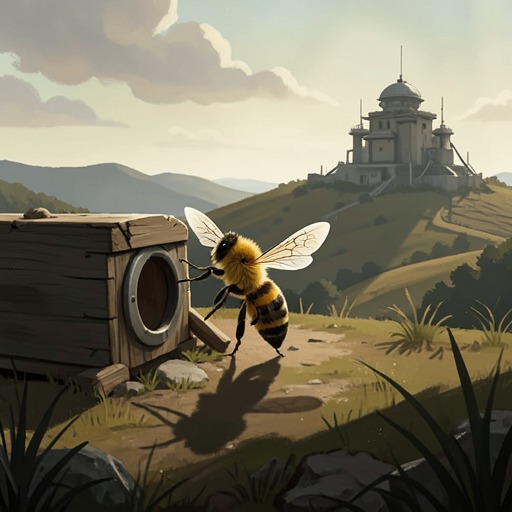
Nation of Bees
The Adventures of Maya the BeeThe Nation of Bees is a community of shared work and royal government whose unity becomes decisive when the Hornets attack. Under Helen VIII, daily life is organized around the hive, while the emergency defense demonstrates how quickly its members can turn common loyalty into coordinated action. Maya’s return, first as a deserter seeking pardon and then as the bearer of a warning, brings the community’s ideas of belonging and service into sharp focus.
Community and Everyday Life
The Nation of Bees is identified as the nation in the castle park, ruled by Helen VIII. Its home is a hive with distinct red, blue, and green entrances, set by the long stone wall near a silver-fir that shields the bee-city from the west wind. The entrances are more than landmarks in Maya’s return: they mark the threshold of a community whose protection she has lost and hopes to regain.
The hive’s ordinary life combines communal work with periods of quiet. During rain, Bees remain together inside, tending the cells and feeding the larvae; the hive grows still enough to seem Sunday-like. Messengers sometimes go out to report the weather and the direction of the wind. Even in this pause, the community remains attentive to practical needs: the work of maintaining the hive continues, and information from outside can still matter.
The Queen and the Exercise of Authority
Helen VIII’s rule is presented through both routine attention and decisive action. In ordinary life, she moves from story to story, testing conditions, laying eggs, and offering praise or blame. Her presence is personal as well as official: she may pat a young Bee on the head or ask about its new experiences. Maya remembers these small gestures as signs that the hive’s protections include recognition and care, not simply safety from the outside world.
When Maya returns at dawn with news of the planned Hornet attack, the Queen first approaches her directly, accompanied only by an aide and two ladies-in-waiting rather than by the full court. Seeing Maya’s distress, she softens her severe expression. Once she hears the warning, she keeps her composure while others react with alarm, calls the officers to her, and gives them rapid orders. Her authority is shown in the contrast between the surrounding dismay and her controlled response, and in how promptly the officers carry out her commands.
The Queen also makes the community’s judgment of Maya explicit. She thanks her for saving the Nation and says that her warning outweighs her earlier conduct. When the danger has passed and Maya asks pardon, Helen VIII puts an arm around her neck and appoints her to remain at her side, helping conduct affairs of state. The appointment gives Maya’s experiences outside the hive a public purpose: knowledge gathered while separated from her people is to serve their welfare. The Bees greet the decision with approval.
Collective Defense
The Hornet attack tests the Nation’s organization on a scale greater than the turmoil of the earlier revolution. At the Queen’s call for volunteers to defend the entrance, several Bees offer themselves; scouts sent to watch for the enemy return with news that the Hornets are approaching. The hive then shifts into a disciplined readiness. Soldiers form three closed ranks at the entrance, officers arrange reserves behind them, and the Queen watches from an elevated position while her aides move through the hive.
Preparation is not limited to the soldiers. Wax-generators work in silence to narrow the entrance, raising two thick partitions that reduce the opening by almost half. This defensive construction is intended to delay even powerful Hornets and buy time. The scene links the hive’s ordinary constructive labor to its wartime survival: the same capacity to work together on the cells becomes a means of protecting the whole community.
When the Queen gives the signal to defend the realm, the Bees attack as a mass rather than as isolated fighters. The first assault costs lives, but it also commits the defenders fully to the struggle. The Queen’s tactics use the narrow approach and fresh reserves: Bees at the entrance can appear exhausted, drawing an advancing Hornet inward, while a rested group remains ready to confront the next attacker. The fighting moves farther into the hive as the defenders hold and reinforce the entrance. Though the Hornets possess greater individual strength, their stings lose effectiveness over time; the Bees’ growing confidence in eventual victory and grief for their dead sustain their resistance. The invading group is ultimately overcome inside, and the Hornets outside withdraw after their numbers have been reduced by half.
Loyalty and Political Significance
An older Hornet identifies the source of the Bees’ strength as their unified nation and loyalty to the common good: each serves the state without putting personal interest first. The battle gives this assessment concrete form in volunteers, scouts, ranks, reserves, and workers building barriers. Unity is not merely a sentiment praised after the event; it is visible in the coordination that makes the defense possible.
For Maya, the Nation represents both the protection she missed while alone and a community to which she must earn her way back. Her return is initially blocked because entering another bee-city without the Queen’s consent is a capital offense. Yet once the danger is known, Helen VIII recognizes Maya’s warning and later restores her place through a new responsibility. The Nation’s conclusion is therefore not simply a return to the old order: Maya’s independent experience is brought into its government, and her service becomes part of the community’s future. The Bees’ approval of her appointment and her later respect among them affirm the story’s picture of a political community held together by shared work, loyalty, and the capacity to receive a returning member whose actions benefit all.