Puck
The Adventures of Maya the BeePuck is a fly who has grown up among human beings and made a private art of watching them. To Maya, he is both a comic storyteller and a source of practical knowledge: he describes the household in which he was raised, invents an elaborate interpretation of an old man’s habits, and explains how a small creature might enter and leave a human house. His confident accounts make him memorable not because they offer an objective account of humanity, but because they show how sharply observation and interpretation can diverge.
Identity and Introduction
Puck appears while Maya watches the grass and flowers. When she greets him and asks whether he is a fly, he answers with brisk impatience, gives his name, and says he is busy. His first exchange establishes a lively, self-possessed manner: he assumes Maya may want to drive him away, while she is simply pleased to make his acquaintance. The gap between his suspicion and her politeness quickly becomes a small comedy of mismatched expectations.
His physical antics extend that comic unpredictability. After Maya addresses him, Puck tries to pull his own head off. The gesture is presented as part of his peculiar conduct rather than explained, leaving him with an air of restless, almost impossible energy. He can move from brisk dismissal to lengthy conversation without losing his conviction that he is the one in control of the exchange.
Experience Among Human Beings
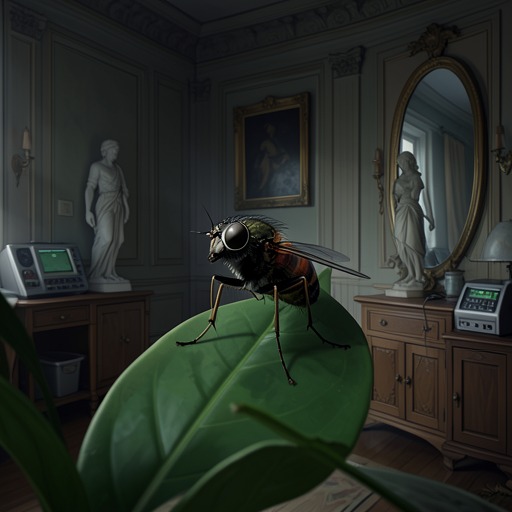
Puck grounds his authority in a specific upbringing. His mother laid the egg from which he came in the corner of a human room; he made his first attempts to walk on the window-shades and tested his wings by flying from Schiller to Goethe. These details place his knowledge not in abstract study but in a fly’s intimate, low-level proximity to domestic life. The room’s furnishings and inhabitants form his first world, and human behavior is something he has learned by living alongside it.
He says that understanding human speech took a long time. Even after learning it, he concludes that people usually want little, since they tend to say the same things day after day. His judgment is deliberately eccentric: Maya imagines human beings as makers of vast cities, towers, floating houses, and fast-moving vehicles, while Puck’s account reduces their conversation to repetitive household routine. Their disagreement turns on different scales of attention. Maya has heard of humanity’s grand constructions; Puck has listened to the recurring sounds of a room.
Puck is also skeptical that those sounds deserve to be called language. He describes human voices as harsh and unmelodious, comparing them unfavorably with sounds in nature. Yet he concedes that humans try to improve them: he once watched two boys blow through a blade of grass to produce a whistle, which he compares to a cricket’s chirping while judging its tone inferior. The concession is characteristically double-edged. Puck recognizes effort, but reserves the right to measure human achievement by standards that humans themselves may not share.
The Household as Comic Theatre
Puck’s fullest account concerns an elderly man in the room where he lives. The man keeps a sweet-smelling drink in a corner cupboard and, when he goes to fetch it, checks whether Puck is present. Puck reads the man’s gestures as a carefully staged invitation: a look toward the ceiling, a hand passed over the forehead, nose, and mouth, a blink, and the lowering of the shade. Once the man lies on a sofa and begins snuffling, Puck takes his portion from the glass and understands the sounds as the signal to begin their game.
The game is built around the man’s forehead. Puck identifies the furrows there as channels of thought, reasoning that they must move when a person thinks; he also interprets the changing folds and the hollow over the nose as signs of annoyance. He then runs along the furrows while the man swats at the air, unable at first to locate him. Puck waits until the hand comes close before darting aside, then watches the man search for him again. He says they sometimes keep this up for half an hour, until the man jumps up, curses, and Puck retreats to the ceiling.
The scene makes Puck an amusing interpreter, but not an infallible one. He confidently assigns meaning to the man’s gestures and facial lines, converting an ordinary human routine into a performance designed for his amusement. His account is vivid because it takes the fly’s viewpoint seriously; its humor comes from the certainty with which he mistakes his own reading for the whole story. Puck’s independence of perspective is therefore also a source of comic distortion.
Advice to Maya and Narrative Role
Maya asks Puck how she might get into a human being’s house. He first gives the simplest possible answer—fly in—then responds to her concern about danger with a more useful instruction. She should wait until a window is open and, if she cannot find her way out, fly toward the light; the sunlight through windows will help her locate an exit. The advice is practical and concrete, unlike the elaborate conjectures in his stories, and gives his experience a direct use in Maya’s exploration.
The conversation ends with Maya saying she has things to attend to and leaving for the meadows to gather nourishment. She jokes in farewell about Puck recovering from the effects of the ice age. Later, when Maya recounts her adventures in the royal hall, she includes Puck among the remarkable creatures she encountered. His appearance is brief and he does not return to guide her, but his combination of observation, eccentric theory, and usable advice gives the encounter a distinctive place in her education beyond the hive.