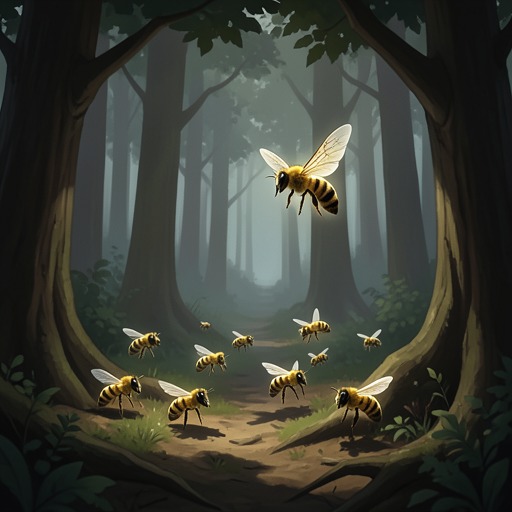
Song of the Bee Soldiers
The Adventures of Maya the BeeSong of the Bee Soldiers is the ancient collective song Maya hears in the moments before the battle against the Hornets. Its brief stanza binds sunlight, daily labor, loyalty to the Queen, and unity into a shared declaration. The song reaches Maya not as a staged performance but amid signals, marching, and military commands; carried into her dreams, it makes the hive’s preparations sound like the expression of a whole community.
Text and Images
The song’s four lines read: “Sunlight, sunlight, golden sheen, By your glow our lives are lighted; Bless our labors, bless our Queen, Let us always be united.” The stanza moves from an image of light to the conditions of collective life. Sunlight makes life possible; labor gives that life its everyday form; the Queen embodies the political order the Bees ask the song to bless; unity turns these separate elements into a common pledge.
The repeated appeal to blessing gives the lyrics the character of a shared affirmation rather than a personal confession. Their vocabulary is plain and public: the speaker names what sustains life and work, then joins those goods to loyalty and togetherness. The song does not describe a particular warrior or recount a past victory. Instead, its plural voice offers a compact statement of what the community stands for as it faces danger.
The Song Before Battle
Maya hears the song on the eve of the attack, after the Queen reassures her that among the thousands in the city there is not one who would hesitate to sacrifice his life for the Queen and the country. The Queen kisses Maya on the forehead and sends the ladies-in-waiting to see to her rest. Deeply moved, Maya is led away; from her room she hears distant signals and the assembly of high dignitaries around the royal chambers, followed by a deep drone that shakes the hive.
The ladies-in-waiting whisper that the soldiers are coming. Maya’s last waking impressions are the tramp of soldiers passing her door and the officers’ resolute commands. In that charged interval, she carries the old song into her dreams, its words echoing from a great distance. The scene places the song beside the machinery of mobilization without claiming that the soldiers sing it as they march: the text presents it as the remembered refrain through which Maya receives the sounds of a community preparing to fight.
A Voice for Collective Defense
The song’s promise of unity is given practical force by the preparations that follow. The hive is stirred by anger against its ancient enemy, yet the mobilization is orderly: each soldier knows his duty and takes his place. Volunteers defend the entrance, returning scouts report the Hornets’ approach, and soldiers form three ranks while reserves assemble behind them. Wax-generators work in silence to narrow the entrance, raising two thick partitions that reduce the opening by almost half. The Queen watches from an elevated position inside the hive.
Against those concrete details, the lyric’s blessing of labor is more than an ornamental image. The defense depends on coordinated work by different members of the community, not on a solitary champion. The song’s final wish, that the Bees remain united, anticipates the discipline on display in the hive: individual tasks acquire their meaning as parts of a common defense. Its invocation of the Queen likewise belongs to a political community under immediate threat, rather than standing apart from the practical decisions that organize the response.
Meaning in the Aftermath
The battle ends in victory, but the aftermath complicates the song’s sunny language. The Hornets withdraw without taking honey or prisoners, leaving twenty-one dead outside the city; inside, fallen Bees lie in streets and corridors and near the brooders and honey-cupboards. The wounded must be cared for and the dead disposed of. Before noon, the Bees return to their regular tasks, carrying pride and grief quietly rather than celebrating or suspending their work.
The song is not repeated in this aftermath, and the narrative does not say that it causes the Bees’ courage or their discipline. Its significance lies instead in the contrast it makes legible: the shared blessing of labor and unity survives contact with grief, but it does not erase the cost of defending the community. Heard on the threshold of battle and carried into Maya’s dreams, Song of the Bee Soldiers gives the Bees’ collective loyalty a memorable verbal form, while the silent work after victory shows what that loyalty demands.