Spiders
The Adventures of Maya the BeeSpiders are portrayed both as a source of danger and as individual creatures with distinct habits and temperaments. Thekla’s web nearly traps Maya in a fatal predicament, giving force to the warning that spiders are dangerous predators; Hannibal, a Daddy-long-legs spider, offers a contrasting encounter. Together, these episodes make spiders more than a single threatening category: their webs, hunting, vulnerability, and encounters with humans all contribute to the book’s wider picture of a world where creatures meet across unequal forms of power.
Identity and Forms
The book presents spiders through at least two named kinds. Thekla identifies herself as a member of the family of Cross spiders, while Hannibal introduces himself as belonging to the general family of spiders, specifically the species Daddy-long-legs. These distinctions matter in the story: Thekla is associated with a working web and the capture of prey, whereas Hannibal appears without a web nearby and approaches Maya in conversation. The episodes do not make the two interchangeable representatives of one fixed character type.
Hannibal is also presented as a spider who has lost a leg. Maya expresses sympathy, and he arranges his remaining legs so they are not easily counted. He says that a human being was involved in what happened, describing people as careless in how they handle spiders. His account begins with his life as a night hunter in a green garden-house, where ivy and broken windowpanes made it convenient to crawl in and out. The evidence introduces the circumstances he is about to recount, but does not establish the full details of how he lost his leg.
Thekla’s Web and Maya’s Capture
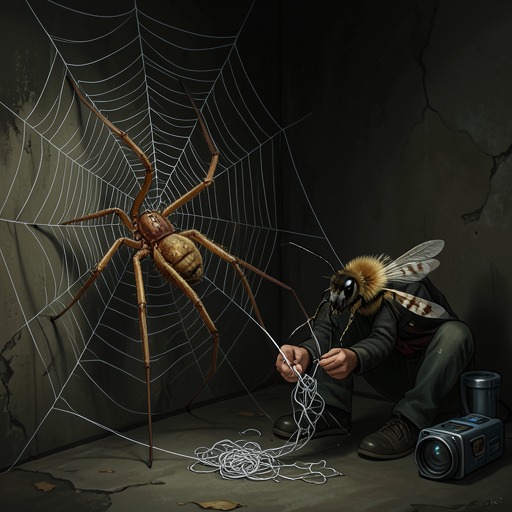
Maya encounters the web among blackberry vines while flying toward the jasmine. At first, its nearly invisible, elastic threads restrain her without an obvious blow: they cross her body, bind her wings, and make flight impossible. When she struggles, she becomes more tightly entangled. A heavier supporting thread eventually snaps during one desperate attempt, but the web remains a trap rather than a route to escape. The scene makes the web’s flexibility central to its effectiveness: what seems delicate can still hold a much larger creature fast.
Maya’s fear intensifies when she sees Thekla nearby, waiting under a blackberry leaf. The memory of Cassandra’s warning—that a bee caught by a spider may die in its power—now has immediate force. Maya gives the battle-cry known to other beasts, but Thekla does not retreat. Instead, she offers to free her, presenting herself as a helper while examining how securely Maya is caught. The contrast between the promise and the spider’s conduct marks Thekla as deceptive, not merely as a predator acting openly.
Thekla repairs some torn strands, then uses a newly spun thread to pull Maya out of the exposed part of the web. She takes her into the shade close to the ground, explaining that the shelter will keep Maya from drying in the sun and that a conspicuous captive might scare off other prey. Thekla names herself as a Cross spider and makes clear that Maya’s name does not alter her usefulness as food. She intends to leave her captive suspended until she is too weak to sting, then feed. Thekla’s practical attention—to the damaged web, the stone used to secure a thread, the shade, and the risk that sparrows might disturb the web—shows a predator managing both prey and hunting place.
Hannibal and Contrasting Encounters
Maya’s meeting with Hannibal begins in windy conditions, as he clings to a tree and politely remarks on the strong draught. His appearance as a spider immediately recalls the ordeal in Thekla’s web, and Maya considers the possibility of flying away. Yet Hannibal has no wings, and his web is elsewhere; he gives no sign of trying to capture her. He instead asks permission to come closer, using a large branch as shelter from the wind. The scene lets Maya’s caution remain understandable without making every spider encounter repeat Thekla’s attack.
Hannibal’s manner is reflective and sociable. After Maya notices his missing leg, he offers to explain what happened and frames the story as an instance of human carelessness. His setting—a garden-house overgrown with ivy and fitted with broken panes—also presents a spider’s dwelling as part of the ordinary human-made landscape. The narrative thus connects a spider’s circumstances to a human presence, while leaving the details of the incident itself to Hannibal’s unfinished account in the available passage.
Narrative and Ecological Significance
Thekla’s episode gives the general fear of spiders a concrete basis: a web can immobilize an insect, and struggling can make the danger worse. But the book complicates that fear through Hannibal, whose species identity does not by itself predict hostility. Maya’s response to him is shaped by what happened in Thekla’s web, so the two encounters also show how experience informs her judgment of unfamiliar creatures. The contrast is not a claim that spiders are harmless; it is a distinction between the specific behavior of a captor and the different presence of a spider who meets Maya without attacking her.
These scenes also place spider behavior within the book’s broader pattern of close interdependence among creatures. A web is both a spider’s constructed environment and a means of obtaining prey; the Blackberry vine supplies the setting for Thekla’s trap, while shade and the possibility of sparrows affect how she keeps her captive and protects her web. Hannibal’s account, by contrast, turns attention to the vulnerability of a spider in relation to people. Through these different encounters, spiders occupy several roles at once: hunters, inhabitants of shared spaces, and creatures that may themselves be harmed. The result is a more varied portrait than Maya’s initial fear alone would suggest.