The Prohibition against Stinging Humans
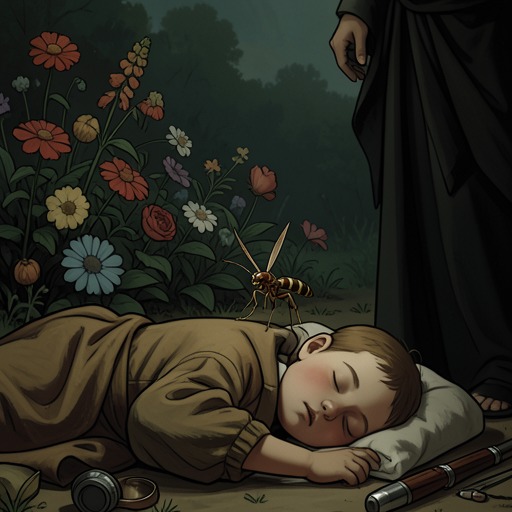
The Adventures of Maya the BeeThe Prohibition against Stinging Humans is presented as a consequential rule of bee life: Maya believes that stinging a human being will kill her. Its force becomes clearest when she encounters a mosquito feeding on a sleeping child. Faced with the possibility of stopping the harm, she withdraws instead, making the prohibition a constraint on action rather than an abstract custom.
The Rule and Its Stakes
Maya’s understanding of the prohibition comes through Cassandra’s warning. At the sight of the mosquito and the sleeping child, she recalls that stinging a human being means death for the bee. The rule therefore carries an immediate personal cost: intervention could protect the child, but Maya understands that it would cost her own life.
The scene does not establish a formal law, its origin, or any system of punishment. What it does establish is the warning as Maya remembers and acts upon it. The prohibition is powerful because its consequence is understood to be fatal, not because the passage describes authorities enforcing it.
Maya’s Choice
Maya cannot bear to remain and watch the mosquito hurt the child, yet she does not attack. She makes off quickly, caught between concern for the sleeping human and the survival limit she associates with stinging. The decision is not presented as indifference: the distressing prospect drives her away, while the remembered warning rules out the action she might otherwise take.
The encounter also leaves her longing to understand human beings unresolved. Maya remembers the incident in detail, but it does not make her abandon that curiosity. Instead, she resolves to be bolder and continue pursuing her goal. The prohibition thus shapes her exploration without ending it: she must seek knowledge of humans while recognizing that one kind of intervention may be fatal.
Scope and Contrast
The bees’ later defense against the hornets clarifies what the rule does not mean. As the hive prepares for attack, soldiers take their places behind a narrowed entrance, and the bees fight the invading hornets with their stings. In the fighting, a young bee officer dies after striking an opponent, while the bees continue their defense. These scenes present stinging in combat with another insect as part of the colony’s wartime action, not as a violation of the human-specific prohibition.
The distinction is between the prohibited human target and the hornet enemy, not between stinging and non-stinging conduct in general. The battle’s deadly cost does not erase that distinction: the bees accept losses in defending the hive, while Maya’s earlier hesitation turns on the particular danger Cassandra associated with stinging a human.
Individual Risk and Collective Duty
The rule’s personal stakes contrast with the bees’ collective defense. The hive mobilizes in disciplined ranks, and its soldiers act in service of the community; an older hornet recognizes the bees’ unity and loyalty as a source of strength. The battle consequently frames individual sacrifice as part of shared defense, whereas Maya’s encounter with the child is an isolated choice under a specific survival constraint.
Together, these episodes keep two limits distinct. The prohibition governs Maya’s remembered risk in relation to humans; it does not make the bees pacifists or prevent them from defending their society against hornets. Its narrative significance lies in the conflict it creates between Maya’s impulse to respond to a human scene and the fatal consequence she believes that response would carry.