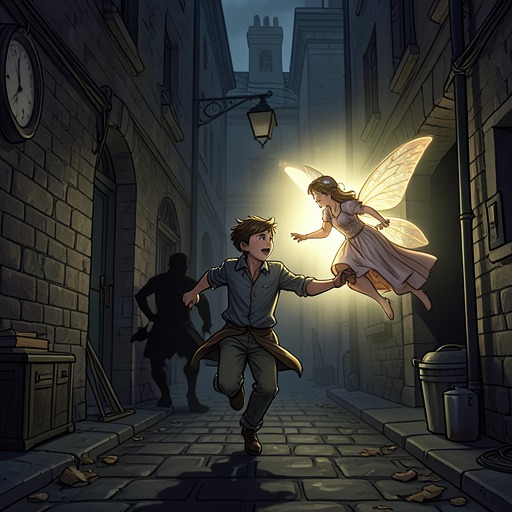
Assassins pursue and hang Pinocchio
The Adventures of PinocchioThe episode in which the Assassins pursue and hang Pinocchio turns a reckless dismissal of warning into a sustained fight for survival. Pinocchio’s four gold pieces, hidden in his mouth, make him unable to answer his attackers; his wooden body then becomes both his defense and the reason they resort to hanging him. The chase ends with him suspended from the Giant Oak Tree, apparently dead, after his final thought turns to his father.
Background and Ambush
The danger follows Pinocchio’s refusal to heed the Talking Cricket’s advice. As he sets out again, he tells himself that warnings and scolding are part of adults’ efforts to control children, and that Assassins are a story invented by parents to frighten those who run away at night. He imagines that he could challenge such men or simply outrun them. The confidence is dramatic because the threat he dismisses is already close: a rustle comes from behind, and two large figures wrapped in black sacks leap at him from the darkness.
The Assassins demand his money or his life. Pinocchio has put all four gold pieces under his tongue, so he cannot speak and tries instead to show with his head, hands, and body that he has nothing. His concealment protects the coins from immediate theft but leaves him unable to explain himself. When the attackers seize him and demand that he produce the money, silence reads to them as defiance, and they respond with force.
Resistance and the Chase
One Assassin grabs Pinocchio by the nose while the other takes his chin, pulling him from side to side to make him open his mouth. When that fails, the smaller one tries to pry his jaws apart with a long knife. Pinocchio bites down on the attacker’s hand, tears it off, and spits it out—only to discover that it is a cat’s paw, not a human hand. The sudden revelation gives his escape a grotesque, almost comic turn, while making clear that the pursuers are not ordinary robbers.
Pinocchio uses the moment to wrench himself free and run across the fields, with the Assassins chasing him like dogs after a hare. After about seven miles, nearly exhausted and believing himself lost, he climbs a giant pine and waits to see what will happen. His pursuers try to climb after him, but slip and fall. Rather than abandon the pursuit, they collect wood at the tree’s base and set it alight. As the pine sputters and burns, Pinocchio sees the flames climbing and jumps down to avoid being roasted. The fire drives him back into the open and renews the chase.
At dawn, his way is barred by a deep pool of water the color of muddy coffee. This obstacle marks another narrowing of his options: his flight has carried him through darkness, across fields, and up a burning tree, but it has not shaken his pursuers. The account later returns to the confrontation with the Assassins, now armed with two long, sharp knives. The sequence emphasizes not a clean escape but an attritional struggle in which each failed attempt to capture him provokes a more dangerous one.
From Blades to the Noose
The Assassins strike Pinocchio twice across the back. The knives break into a thousand pieces against his very hard wooden body, leaving the attackers holding only their handles. His material nature, which has made him vulnerable to manipulation throughout his adventures, here defeats weapons that would injure a human child. Yet the reversal does not end the danger: unable to cut him, the Assassins decide to hang him instead.
They tie his hands behind his shoulders, slip a noose around his neck, and throw the rope over a high limb of the Giant Oak Tree. They pull until Pinocchio is suspended high above the ground, then sit on the grass to wait for his last breath. After three hours his eyes remain open, his mouth remains shut, and his legs are still kicking harder than before. His survival frustrates the Assassins once more, but they leave with a threat to return in the morning, expecting to find him dead and his mouth open. Their mockery makes the hanging a deliberate ordeal: they treat his inability to die as one more inconvenience to be answered later.
Apparent Death and Narrative Turn
As death seems to approach, Pinocchio hopes that someone will come to rescue him, but no one appears. He thinks of his poor old father and calls for him. Those are his last words in the scene: he closes his eyes, opens his mouth, stretches out his legs, and hangs as if dead. The open mouth is a stark reversal of the earlier struggle, when the gold pieces kept him from speaking and the Assassins could not force his lips apart. Now the coins no longer define the final image; the gesture of calling for his father does.
The episode’s suspense rests on the difference between apparent death and confirmed death. The Assassins believe they have left Pinocchio to die, and the scene ends with his body motionless on the rope; the following chapter announces that the Maiden with Azure Hair sends for the poor Marionette and calls doctors to determine whether he is dead or alive. The chase therefore closes not with a settled outcome but with a cliff-edge question, turning Pinocchio’s reckless disbelief into a crisis that demands rescue.