City of Simple Simons
The Adventures of PinocchioThe City of Simple Simons is a town Pinocchio visits while following the promise of the Field of Wonders, and the setting turns that promise into a sharper picture of deception. Its streets are crowded with creatures stripped of the very things that once distinguished or sustained them; meanwhile, an occasional fine coach carries wealthy passengers past them. When The Fox and The Cat steal Pinocchio’s four gold pieces, the city’s courthouse offers no remedy: the victim is sent to prison. The town’s defining contrast is therefore not simply abundance beside want, but the distance between apparent authority and justice.
Identity and Narrative Approach
The City of Simple Simons is introduced as a destination named by The Fox and The Cat when they urge Pinocchio to travel with them instead of going home. He initially refuses, recalling that his father is waiting and that disobedience has already made him unhappy. That refusal does not end the matter: later, he goes with the pair and reaches the town after walking for at least half a day. The repeated appearance of the destination gives the city a place in the story’s chain of choices: first a tempting alternative to returning home, then the setting where the promised wealth proves to be a trap.
The narrator presents the town through a direct address to child readers and through a vivid catalogue of its inhabitants. This mode makes the place legible as a scene of consequences rather than as a neutral stop on a journey. The creatures’ visible losses invite the reader to notice what has been taken from them, while Pinocchio’s own loss of money soon gives the pattern a personal and immediate form.
Poverty and Display
On entering the city, Pinocchio sees hairless dogs yawning with hunger, sheep shorn and trembling in the cold, and chickens without combs begging for a grain of wheat. Butterflies have sold their colors and can no longer use their wings; peacocks without tails are ashamed to appear, and pheasants hurry away grieving for their lost golden and silver feathers. Each figure is marked by a deprivation that can be seen. The list makes poverty bodily and specific: hunger, cold, impaired movement, shame, and the irreversible loss of beauty all occupy the streets together.
The spectacle has a deliberate counterpoint. Through the crowd of paupers and beggars, beautiful coaches pass from time to time, carrying a Fox, a Hawk, or a Vulture. The passage does not explain how these passengers acquired their wealth, but places their comfort against the surrounding want. Pinocchio, tired of waiting, asks where the Field of Wonders is. The town thus lies on the route to the promised place of riches, even as its streets display a population living with loss and scarcity.
The Swindle and the Courthouse
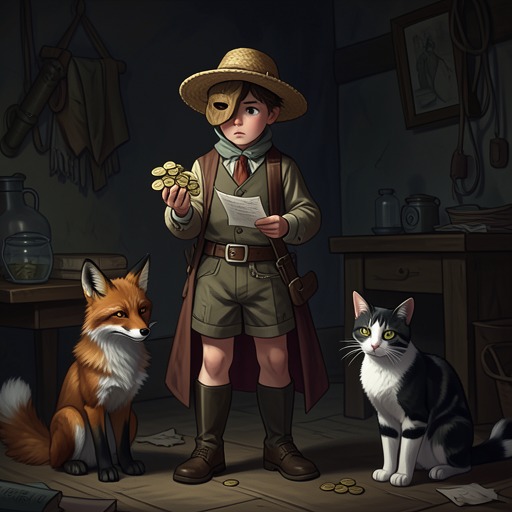
The contrast between promise and consequence becomes personal when The Fox and The Cat take the four gold pieces Pinocchio has buried while he is away. A Parrot tells him what happened; Pinocchio refuses to accept the news until he digs furiously at the earth and finds the hole empty. He then runs to the city and reports the robbery to the magistrate, giving the robbers’ names and descriptions and asking for justice.
The magistrate, an elderly Gorilla wearing gold-rimmed spectacles whose lenses are missing, listens with apparent patience and emotion. He seems moved by Pinocchio’s account, almost to tears. Yet when the Marionette finishes, the Judge rings a bell, summons two Mastiffs dressed as Carabineers, and orders them to take the supposedly pitiful complainant to prison. The abrupt reversal makes the hearing more than a failed investigation: the official display of sympathy leads directly to punishment of the person who has been robbed. Pinocchio tries to protest, but the officers cover his mouth and hustle him away.
Imprisonment and Narrative Significance
Pinocchio remains in prison for four months. His release comes about through an event unrelated to his complaint: the young emperor wins a great victory, and the celebrations include an order to open every prison door. The narrator addresses the children directly in explaining this fortunate coincidence, underscoring how little Pinocchio’s case itself has done to free him. When he asks the jailer whether he can leave along with the other prisoners, the jailer initially tells him that he cannot. The supplied account establishes the town-wide opening of the prison doors but does not give the rest of that exchange.
The City of Simple Simons joins an episodic journey to a social tableau and an institutional reversal. Its impoverished street animals make deprivation visible; the passing coaches set wealth apart from that crowd; and the courthouse turns a plea for redress into confinement. Pinocchio’s arrival follows his decision to travel with The Fox and The Cat rather than return directly to his father, but the city’s justice system compounds the harm instead of correcting his misplaced trust. The eventual opening of the prison doors depends on imperial celebration, not on the truth of his report. In this way, the town links the personal cost of the swindle to a broader comic and unsettling picture of authority.