Everything in this world may be of some use
The Adventures of Pinocchio“Everything in this world may be of some use” is Geppetto’s compact defense of practical resourcefulness in Pinocchio. Spoken while a hungry Pinocchio resists eating pear cores, the maxim makes a concrete point about waste; across the story, its force also lies in the contrast between Geppetto’s measured attention to what can help and Pinocchio’s tendency to reject warnings until their consequences become clear.
Meaning and First Use
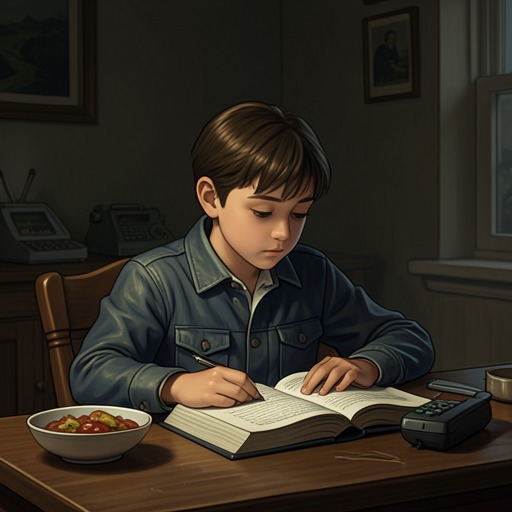
The saying appears during a meal of three pears. Geppetto peels the fruit and lays the skins in a row on the table. Pinocchio eats a pear, then tries to throw away its core; Geppetto stops him and insists, “Everything in this world may be of some use!” When Pinocchio protests that he will not eat the cores, Geppetto calmly answers, “Who knows?” The skins and cores remain beside one another on the table, making the lesson an immediate question of whether hunger may leave any part of the fruit unnecessary.
Pinocchio eventually eats the skins and cores, one after another, despite making a wry face at first. After the last mouthful, he says that he feels fine. Geppetto then explains that one should not be too fussy or dainty about food, because nobody knows what life may hold in store. The maxim thus comes with a direct, bodily consequence: what Pinocchio rejects becomes food when he is hungry. Geppetto’s lesson is neither abstract nor grand; it is practical advice shaped by scarcity and uncertainty.
Resourcefulness and the Story’s Materials
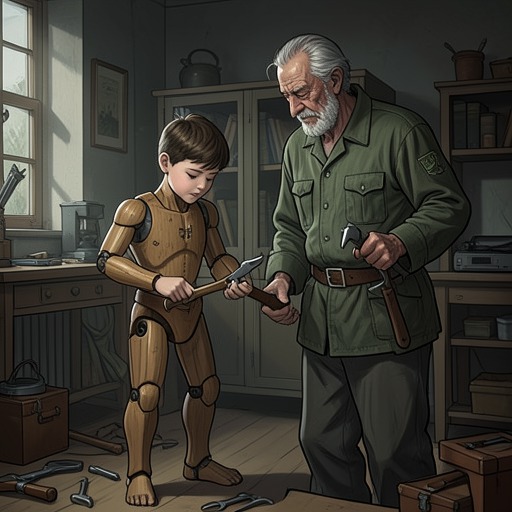
The maxim’s plainness resonates with the story’s opening image: before Pinocchio is carved, he is an ordinary block of firewood, not an expensive piece of wood. The narrator even anticipates children expecting a king in a familiar opening, only to redirect them toward this common material. The contrast gives ordinary things narrative potential without claiming that every object has the same importance: the piece of wood proves extraordinary, while the pear scraps matter because hunger makes them useful.
The maxim’s method is to resist deciding too early that something has no value. Geppetto keeps the cores rather than discarding them, and the meal shows why that small act matters. In this scene, use is discovered through circumstance: Pinocchio’s appetite changes what counts as acceptable food. The episode makes the saying memorable by letting an object’s possible value be tested in action rather than merely asserted.
Advice, Resistance, and Consequence
Pinocchio’s response to Geppetto’s lesson contrasts with his attitude toward other advice. As he sets out again, he recalls that he ignored the Talking Cricket and speculates that misfortune may await him, yet he still dismisses the danger of the Assassins as a story parents invented to frighten children. He imagines confronting them confidently and assumes he can run away if they do not retreat. The episode shows how readily he can recognize the existence of warnings while refusing to let them govern his choices.
After a schoolmate is struck during the boys’ fight, Pinocchio stays behind while the others run. He wets a handkerchief in the sea and tries to bathe the injured boy’s head, then breaks into sobbing and reproaches himself for not going to school and for listening to bad companions. His regret gives the story’s lessons about attention and judgment a harsher consequence than the pear scene: failure to heed advice can expose others, as well as the disobedient child, to danger. Set beside that remorse, Geppetto’s maxim favors practical openness, while Pinocchio’s recurring mistake is to dismiss what he does not want to hear.
An Idea Reframed by Later Discoveries
The saying is spoken in the pear episode, not repeated as a catchphrase throughout the story. Its broader resonance instead comes from the pattern of reversals around it: Pinocchio repeatedly discovers that circumstances are not as he assumed. Near the end of the evidence presented here, after saying goodbye to the Tunny, he walks through greasy, slippery water toward a growing light. The light reveals a table set for dinner, a candle stuck in a glass bottle, and an old man eating live fish. Pinocchio recognizes Geppetto and rushes into his arms, crying, “Oh, Father, dear Father! Have I found you at last? Now I shall never, never leave you again!”
This reunion does not restate Geppetto’s words about the pear cores, but it gives the maxim a fitting narrative echo: what appears strange or unpromising may still lead to something essential. The story’s emphasis remains concrete—food that hunger makes worth eating, advice whose consequences Pinocchio learns through experience, and a light that leads him to his father. Geppetto’s saying endures as a modest rule of attention: do not discard a possible use before life has shown what it may be.