Fire Eater
The Adventures of PinocchioFire Eater is the Director of the Marionette Theater, a figure whose frightening appearance and command over the performers make him seem merciless, but whose actions reveal a capacity for pity and generosity. His change of heart turns a threat of execution into an occasion for Pinocchio to save Harlequin, and his gift of five gold pieces offers practical help to Pinocchio and Geppetto.
Identity and Appearance
Fire Eater is introduced as the theater’s Director, arriving while a performance is underway and the Marionettes have abandoned their act to celebrate Pinocchio. His presence immediately changes the mood: the crowd falls silent, and the Marionettes tremble. The description gives his authority a grotesque, theatrical form. His beard is black and reaches from his chin to his feet; his mouth is as wide as an oven, his teeth resemble yellow fangs, and his eyes glow like red coals. In his huge, hairy hands he carries a whip made from twisted green snakes and black cats’ tails.
The contrast between this appearance and his later conduct is central to his characterization. The scene initially invites fear through what can be seen—the huge figure, the whip, and the silent stage—but then complicates that impression. Fire Eater is not harmless: he has the power to punish the performers and issues a lethal order. Still, his appearance does not reliably predict the degree of cruelty he will show. The narrative makes that gap explicit when he feels pity for Pinocchio despite looking so frightening.
Authority in the Theater
Fire Eater’s first response to the commotion is to demand an explanation from Pinocchio and to put off dealing with him until the performance ends. Afterward, in the kitchen, he sees a lamb turning on a spit and calls for more wood. He decides that Pinocchio, who looks to him like well-seasoned wood, will make suitable fuel. Harlequin and Pulcinella hesitate when told to bring Pinocchio, but a look from their master makes them obey. They return carrying the struggling Marionette, who cries that he does not want to die and calls on his father to save him.
The episode establishes that Fire Eater’s authority is not merely ceremonial. He directs the theater’s performers and can make them carry out his commands even when they resist. His decision to use Pinocchio as firewood treats a living, frightened figure as material for completing dinner. Yet the motive the scene gives is concrete and domestic: he wants the lamb well cooked. That ordinary appetite makes the threat more disturbing, while also setting up the contrast between the meal he intends to finish and the compassion that interrupts his plan.
Mercy and Pinocchio’s Offer
Pinocchio’s fear moves Fire Eater. Seeing him struggle and plead, the Director first wavers, then gives a loud sneeze. Harlequin reads the sneeze as evidence that Fire Eater feels sorry for Pinocchio and tells him that he is saved. The bodily gesture functions as a visible sign of a change that Fire Eater has not yet expressed in words: pity has begun to overcome his resolve.
That reprieve does not end the danger. Fire Eater orders two wooden officers to tie up Harlequin and throw him onto the fire instead, explaining that he has spared Pinocchio and still needs his dinner cooked. When Harlequin collapses in fear, Pinocchio throws himself at Fire Eater’s feet and begs for mercy for his friend. He then stands, casts away his cap of dough, and offers to take Harlequin’s place, insisting that his best friend should not die in his stead. The offer makes the Director’s choice more than a response to Pinocchio’s own distress: he must confront the boy’s willingness to accept the fate he had just escaped.
The other Marionettes weep at Pinocchio’s words, as do the wooden officers. Fire Eater initially remains hard, but gradually softens and sneezes four or five times before opening his arms. His response reverses the earlier command to sacrifice one of the performers. The scene does not erase his power or his appetite; rather, it shows that an act of courageous concern can alter how he uses that power. Pinocchio’s offer to die for Harlequin is also the decisive act that saves his friend.
Generosity and Narrative Role
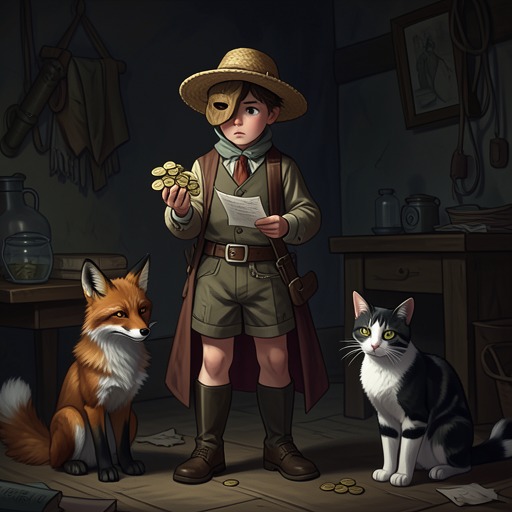
Afterward, Fire Eater asks whether Geppetto earns much. Pinocchio explains that his father has no money left in his pockets and sold the only coat he owned—despite its darns and patches—to buy a schoolbook for his son. Fire Eater responds with pity and gives Pinocchio five gold pieces, asking him to deliver them to Geppetto with his kind regards. Pinocchio thanks him, kisses the Marionettes in turn, and sets off homeward.
The gift extends Fire Eater’s change of heart beyond the immediate crisis. He does not only spare Pinocchio and Harlequin; on learning the cost of Geppetto’s sacrifice, he offers material assistance to the family. His generosity follows Pinocchio’s description of a father who has given up his own coat so his child can study. In this way, the episode connects Fire Eater’s pity to the care already shown by Geppetto and to Pinocchio’s return journey with the money.
Fire Eater’s brief role is shaped by a sequence of reversals: the theater’s terrifying master is moved by a frightened Marionette; the intended victim offers himself for a friend; and the man who threatened Pinocchio becomes a benefactor to his father. The story does not present him as consistently gentle—his orders are dangerous and his authority is real—but it distinguishes appearance from action and leaves room for mercy to change the outcome. That transformation makes his episode both a test of Pinocchio’s courage and the source of an unexpected aid on the way home.