Geppetto
The Adventures of PinocchioGeppetto is Pinocchio’s father, a poor woodcarver whose love is expressed through making, sacrifice, and an extraordinary search for his missing son. He turns a strange block of wood into a Marionette, gives up his coat to provide Pinocchio with a schoolbook, and endures years of separation before the two find each other inside The Terrible Shark. Their final escape reverses the story’s early imbalance: the father who first shaped Pinocchio is ultimately carried to safety by the son who has learned to care for him.
Identity and First Appearance
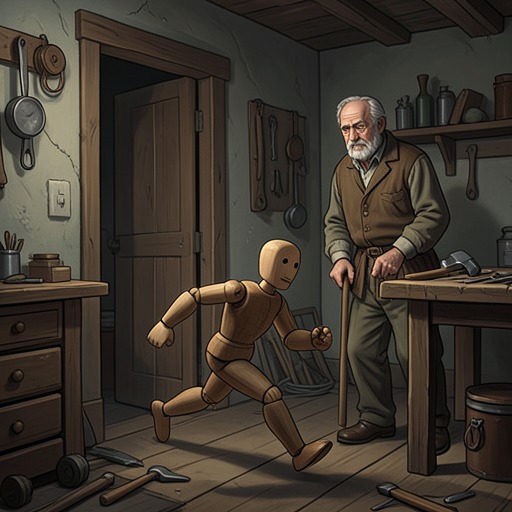
Geppetto enters the story as a small, dapper old man with a volatile temper and a yellow wig the neighborhood boys tease him about by calling him Polendina. His first meeting with the enchanted wood takes place in the workshop of Mastro Antonio. The block has already startled and baffled the carpenter, and when Mastro Antonio tries to hand it over, it jerks from his grasp and strikes Geppetto’s thin legs. Geppetto protests the rough gift, but the two old men soon reconcile, shake hands, and promise to remain friends.
The wood is not an expensive material but a common block of firewood, making Geppetto’s intended creation both practical and improbable. He asks Mastro Antonio for it so he can carve a Marionette able to dance, fence, and turn somersaults. The project is a craftsman’s undertaking, but the material has already shown a will of its own; Geppetto’s plan to shape it therefore begins under the sign of a comic, uncanny resistance.
Craft, Poverty, and Fatherhood
Geppetto carries the wood home and begins carving Pinocchio in a small, orderly room furnished with little more than an old chair, a rickety bed, and a worn table. The painted fireplace and steaming pot on the wall suggest a comfortable meal that the household cannot actually provide. Against this background of scarcity, Geppetto’s craft is not merely a profession: it is the means by which he tries to make a companion and a future for himself and his son.
His devotion becomes especially concrete when Pinocchio needs a schoolbook. Geppetto leaves home wearing an old coat patched and darned many times, then returns in his shirtsleeves with the book. He has sold the coat to buy it, although the day is cold. The exchange gives Pinocchio a chance to study, but it also makes the cost of that opportunity visible: the child’s education is purchased through the father’s own comfort and warmth.
The sacrifice sharpens the consequences of Pinocchio’s subsequent choices. Pinocchio’s recollection of the schoolbook becomes part of the account he gives Geppetto when they meet again: on the very day his father sold the coat for him, he ran away instead of going to school. The remembered act of care thus stands beside the son’s repeated misadventures, making their reunion a reckoning with both the distance between them and the love that persisted through it.
Search and Separation
Geppetto does not abandon the search when Pinocchio disappears. He wanders around Europe for four months looking for him; when he cannot find him, he resolves to cross the ocean and continue searching in the New World. At the shore he is building a little boat for the crossing. The scale of the craft against the distance he hopes to travel conveys the persistence of his effort without making it easy or safe.
The search ends in disaster at sea. Geppetto recognizes Pinocchio near the shore and wants to reach him, but rough water and whitecaps overturn the boat. The Terrible Shark comes upon him in the water and swallows him. Geppetto later tells Pinocchio that he has been shut inside the creature for two long years, a confinement that feels to him like two centuries. His capture is therefore the consequence of a rescue attempt interrupted by the sea, not a retreat from his search.
Reunion and Escape
Inside the Shark, Pinocchio follows a faint light through greasy, slippery water to a table lit by a candle set in a glass bottle. There he finds an old man, white-haired and eating live fish. The grotesque meal marks Geppetto’s survival under abnormal conditions, while the small pool of light turns the encounter into a scene of recognition. Pinocchio rushes into his father’s arms and promises never to leave him again; Geppetto, rubbing his eyes, first has to make sure that the son before him is truly his own.
Their reunion allows each to give an account of the separation. Pinocchio recounts the chain of dangers and mistakes that followed his flight, including the loss of the schoolbook’s purpose and the long route that eventually brought him to the sea. Geppetto explains how his boat was overturned and how the Shark swallowed him. The exchange restores the missing history between father and son: Pinocchio’s wandering and Geppetto’s search, though experienced apart, have been moving toward the same meeting.
Escape depends on cooperation. After an initial effort fails, Pinocchio carries Geppetto on his back and swims out while the Shark sleeps. Geppetto, once the adult who made and provided for Pinocchio, must entrust his safety to the child. The reversal is physical as well as emotional: the son bears his father through the water, turning the dependence created by childhood into an act of care.
Change and Narrative Significance
At the story’s end, Pinocchio wakes to discover that he has become a real boy and runs to find Geppetto. His father has changed too: he appears years younger, wears new clothes, and is again at work as a woodcarver, decorating a picture frame with flowers, leaves, and animal heads. Geppetto attributes the change in their house to Pinocchio. The return to carving closes a circle opened by the first wooden Marionette, but the craft now belongs to a household renewed by the son’s transformation.
Geppetto’s role links the story’s magical premise to its emotional stakes. He shapes Pinocchio from wood, yet cannot control the course of the life he has made; the son repeatedly departs from the future his father tries to secure through school and care. Geppetto’s coat, the small boat, and the candlelit table inside the Shark mark successive forms of that care: provision, pursuit, and survival. By the conclusion, Pinocchio’s responsible action answers those earlier gifts, and the father and son are restored together in a home where Geppetto can once more work.