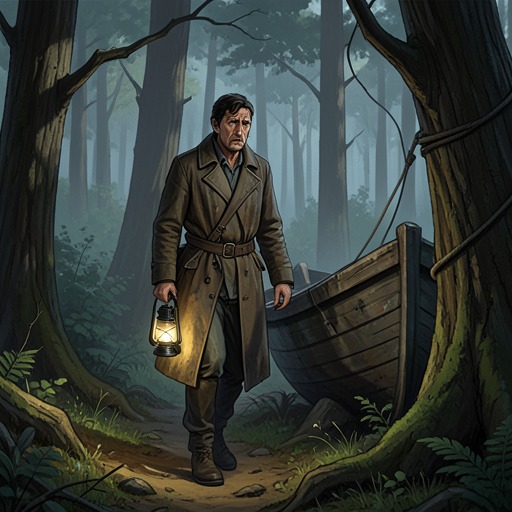
Geppetto sells his coat to buy Pinocchio a schoolbook
The Adventures of PinocchioGeppetto sells his coat to buy Pinocchio a schoolbook in a brief domestic scene that makes paternal care visible as a material sacrifice. The exchange turns an ordinary object—the old, patched coat—into the price of Pinocchio’s hoped-for education, and the book’s arrival brings their poverty into the open rather than concealing it. Pinocchio’s response, an embrace and repeated kisses, marks his immediate recognition of what his father has given up.
Background and Need
The scene follows Pinocchio’s effort to present himself as ready for school. Having just admired his appearance in fine clothes, he hears Geppetto remind him that clothes do not make a man unless they are neat and clean. Pinocchio agrees, then points out that school requires something more important: an A-B-C book. His request is practical and modest, but it exposes the difference between looking prepared and being able to go to school.
When Pinocchio asks about the money, he learns that neither of them has any. The narrator observes that even mischievous boys understand what poverty means when it becomes immediate. Pinocchio, usually happy, grows sad and downcast. The book is thus not simply another item for his school supplies: its absence places his wish to attend school against the family’s lack of money, and makes Geppetto’s next action necessary.
The Sale and Its Revelation
Geppetto’s decision comes abruptly. He jumps up from his chair, puts on his old coat, full of darns and patches, and runs out without another word. The narration gives no account of the sale itself; instead, it lets the change in his appearance disclose the cost. When he returns, the A-B-C book is in his hands, while the coat is gone. He is left in his shirtsleeves on a cold day.
Pinocchio asks where the coat has gone and why Geppetto sold it. Geppetto answers that he sold it because it was too warm. The explanation is plainly at odds with the cold day and his bare arms, but Pinocchio understands it at once. Geppetto does not describe the sale as a sacrifice or ask for gratitude; the small, evasive answer protects the child from having to face the full hardship directly. The contrast between the absent coat and the newly acquired book makes that hardship legible anyway.
Father and Son
The decisive turn in the scene is Pinocchio’s recognition. He cannot restrain his tears, jumps onto his father’s neck, and kisses him over and over. His reaction shifts the exchange from a practical problem—how to obtain a schoolbook—to an expression of mutual attachment: Geppetto has acted for his son, and Pinocchio sees the love contained in the act. The scene gives that feeling a physical form through the coat’s absence, the book in Geppetto’s hands, and the child’s embrace.
The episode also places material care ahead of appearances. Pinocchio has just described himself as looking like a gentleman, while Geppetto has told him that fine clothes alone do not make the man. The old coat, patched and worn, matters here not as a sign of status but as something Geppetto can give up. In exchange, he secures the book Pinocchio needs to pursue the education he has asked for. The scene’s tenderness therefore rests on a concrete inequality: the child receives what he needs because the father relinquishes what he owns.
Later Resonance
Pinocchio’s later distress after a schoolmate is struck gives the schoolbook request a painful echo. At the seashore, while trying to rouse Eugene, he cries that it would have been better if he had gone to school and blames himself for listening to boys who were a bad influence. This later regret does not erase the earlier act of care; instead, it recalls what was at stake when Geppetto went out in the cold and returned without his coat. The schoolbook represented a chance to choose school, though Pinocchio’s conduct repeatedly leads him away from that choice.
The father’s sacrifice also resonates with their eventual reunion. After escaping from the Shark, Pinocchio finds Geppetto seated by a candle stuck in a glass bottle, eating live fish. Filled with sudden happiness, he throws his arms around the old man’s neck and promises never to leave him again. The gesture recalls the earlier embrace after the coat sale, but now follows separation and danger. Across the two encounters, the narrative returns to physical acts of reunion and affection to show the enduring bond between them.
Narrative Significance
The event’s force depends on restraint. Geppetto does not announce the price of the book, and the narrator does not stage the sale; the reader, like Pinocchio, infers the sacrifice from what has disappeared and from the cold in which Geppetto stands. That delayed recognition makes the child’s understanding the scene’s emotional culmination. The answer about the coat being too warm briefly disguises hardship, but cannot disguise the care that produced the book.
Within Pinocchio’s larger story, this is an early, concrete measure of Geppetto’s devotion and of the opportunities his son is given. The book enables Pinocchio’s intended journey to school, while the coat’s loss establishes that this opportunity has been purchased through his father’s deprivation. The scene does not make Pinocchio’s later choices obedient or lasting; its significance lies in showing that before those choices go astray, his father has already answered his wish with an act of costly, unspoken love.