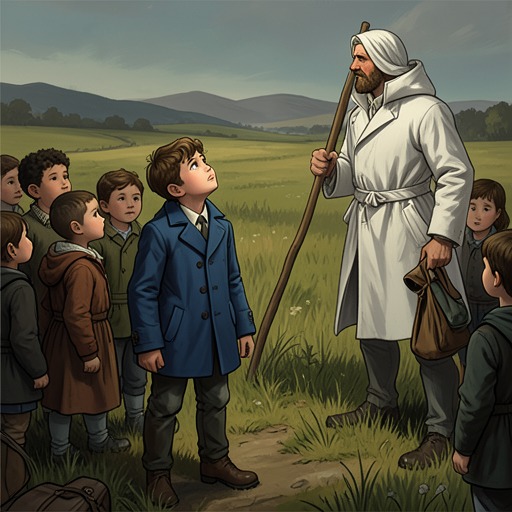
Good Conduct Is Required to Become a Real Boy
The Adventures of PinocchioGood Conduct Is Required to Become a Real Boy is the condition The Fairy with Azure Hair sets for Pinocchio’s hoped-for transformation from Marionette to human child. It defines that change not as a matter of wishing, but as the possible reward for a sustained change in conduct: obedience, study, work, honesty, and attendance at school. The rule gives the story’s recurring adventures a moral measure, while Pinocchio’s uneven progress keeps that measure from becoming a simple, immediate exchange.
The Fairy’s condition
The rule takes shape when Pinocchio asks whether he can grow into a man. The Fairy explains that Marionettes do not grow: they are born Marionettes, live as Marionettes, and die as Marionettes. Pinocchio protests that he is tired of being one and wants to become like everyone else. The Fairy does not declare the change impossible; she makes it conditional. He can deserve it if he tries to act like a well-behaved child.
The standard is then made concrete. Good children obey, love study and work, tell the truth, and go gladly to school. Pinocchio answers each requirement by acknowledging its opposite in himself: he does not obey, is lazy and idle, lies, and dislikes school. His admissions give the Fairy’s instruction a sharp baseline. The condition is not vague goodness but a set of habits that the story has already shown him resisting.
Conduct measured against consequences
Pinocchio’s earlier defiance makes obedience more than a polite formality. After disregarding the Talking Cricket’s advice, he dismisses the danger of the Assassins as a story invented by parents to frighten children who run away at night. He imagines that he can confront them or simply run off if they prove real. His confidence depends on refusing to credit warnings; the danger that follows gives the lesson a plot consequence, not merely a parental maxim.
The episode involving his schoolmate Eugene exposes another part of the rule: the cost of bad company and neglected schooling. After the other boys flee at the sight of Eugene lying pale and apparently dead, Pinocchio stays, wets his handkerchief in the sea, and bathes the boy’s head. In his distress, he insists he did not strike Eugene, worries about facing his mother, and recognizes that he should have gone to school rather than listened to the boys. He also recalls that both his teacher and mother had warned him against bad company, and admits that he stubbornly does as he wishes and then suffers for it. The scene combines remorse with an act of care: Pinocchio has not yet mastered the discipline the Fairy requires, but he can recognize the harm of his choices and remain beside someone in danger.
The Fairy’s later explanation of work makes the condition broader than classroom obedience. When Pinocchio objects that work tires him, she warns that people who speak that way may end in prison or a hospital, and argues that rich or poor alike must do something in the world. In her account, happiness cannot be found without work, and laziness is an illness that must be cured early. The rule therefore joins moral character to practical effort: Pinocchio must not only stop doing wrong, but learn to sustain useful work and study.
A promise put to the test
The Fairy’s words move Pinocchio to promise that he will work, study, and do what she tells him. He connects that effort to his own desire to become a boy, while the Fairy confirms that the responsibility now rests with him. Her condition makes the promise meaningful but not sufficient by itself: it is Pinocchio’s conduct afterward, rather than the words alone, that can establish whether he deserves the change.
That distinction matters because his resolve is repeatedly vulnerable to distraction. Earlier, the Marionettes recognize him as their brother and cheerfully carry him around the stage, but their celebration nearly costs him his life when Fire Eater appears. The episode places Pinocchio’s impulsive arrival inside a theater where bodies are lifted, displayed, and controlled; excitement and danger meet before he has learned to govern his choices. Later, the public announcement of his circus performance presents him under the name of the famous donkey called Pinocchio. These episodes do not replace the Fairy’s stated test, but they keep the gap between wanting a new identity and living up to it visible.
The promised change and its limits
After another act of forgiveness, Pinocchio promises to study and behave, and this time he keeps his word for the remainder of the year. He passes first in all his examinations, and his excellent report prompts the Fairy to tell him that his wish will come true the next day: he will cease to be a Marionette and become a real boy. The result is framed as a concrete record of sustained effort, not an untested claim of reform. The planned celebration—two hundred cups of coffee-and-milk and four hundred slices of toast buttered on both sides—makes the promised transformation a public, joyful occasion as well as a private reward.
The announcement is prospective: it tells Pinocchio what is due to happen, not that the transformation has already taken place. His later appearance as a donkey in a public performance, where he recognizes The Fairy with Azure Hair by the Marionette pictured on her medallion, further prevents the condition from reading as an instant or permanent guarantee. The story’s long movement between promise, relapse, and renewed effort gives the rule its force. Being told what goodness requires is only the beginning; Pinocchio has to keep choosing it amid temptations and consequences.
Narrative significance
The rule also organizes the story’s direct address to young readers. From its opening, the narrator acknowledges the children’s expectations and corrects them; later, Pinocchio himself recalls the warnings of adults only after he has suffered for ignoring them. Advice is thus placed in tension with the lively appeal of escape, company, spectacle, and adventure. The reader is invited to recognize both the attractions that lead Pinocchio astray and the consequences that make the warnings intelligible.
By making transformation conditional on repeated behavior, the Fairy’s rule links becoming a real boy with becoming responsible. Its requirements encompass obedience and truthfulness, but also the everyday disciplines of school and work. Pinocchio’s first-place examinations offer a clear sign that he has met the test for a time; the broader sequence of reversals shows why one good promise cannot stand in for a lasting change. The rule is both the story’s moral standard and its engine of suspense: Pinocchio wants the new life, but must show, through conduct, that he can live it.