Island of the Busy Bees
The Adventures of PinocchioThe Island of the Busy Bees is both a refuge from the sea and a test of how Pinocchio will live once he reaches safety. He lands there at dawn after swimming through a violent night in search of his father, but the island offers no effortless comfort: its streets are full of people at work, and hunger leaves him choosing between labor and begging. The place brings his dependence and resistance into sharp relief, then becomes the setting for his reunion with The Fairy with Azure Hair.
Setting and Arrival
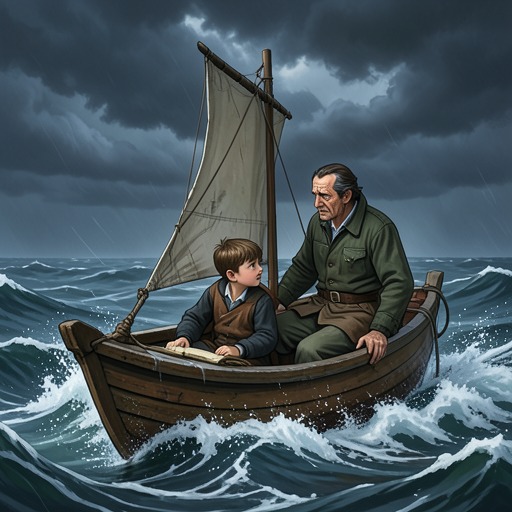
The island first appears as a stretch of sand in the middle of the sea, sighted at dawn after Pinocchio has swum through the night hoping to find his father and save him. Rain, hail, thunder, and lightning have made the crossing perilous. When he tries to reach land, the waves toss him about like a twig or a bit of straw; at last, a tremendous wave throws him onto the shore. The force of the landing nearly breaks his joints, but he gets to his feet and celebrates having escaped with his life. The island is therefore introduced not through settled description but as a precarious refuge won through the sea’s violence.
After thanking the fish who has helped him, Pinocchio hurries along a path, repeatedly looking back at small sounds because he fears the Terrible Shark may be following. Half an hour later he reaches the country called the Land of the Busy Bees, an alias for the island. The movement from exposed shore to inhabited streets changes the immediate danger: the sea and its pursuer recede, but the demands of life on land come into view. The island is not simply a safe destination; arrival begins another test.
A Country Organized Around Work
The streets present an emphatic picture of collective industry. People hurry from task to task, and everyone appears to have something to do. The narration stresses the absence of idle men and tramps, even suggesting that a search with a lantern would fail to uncover one. This is not a landscape of leisure waiting to reward Pinocchio’s escape. Its defining feature is the visible presence of work, everywhere he looks.
Pinocchio immediately recognizes the challenge and protests that he was not born to work. His declaration meets a practical counterforce: he has gone twenty-four hours without food and is hungry. The options left to him are starkly simple—work or beg. The island’s social order thus becomes personal and unavoidable. What appears at first as his dislike of the place is also a refusal of the effort its residents treat as ordinary, and hunger quickly tests whether that refusal can hold.
Hunger, Charity, and the Island’s Social Rule
Pinocchio is ashamed to beg because his father taught him that begging should be reserved for the sick and the old, who have lost the ability to earn their bread. In that teaching, poverty deserving pity is tied to incapacity; those who can work should do so, and hunger does not excuse idleness. The island gives this principle a concrete setting. Its busy streets and working people make the distinction between inability and unwillingness difficult for Pinocchio to ignore.
He nevertheless begs from at least twenty passersby in less than half an hour. Each rebukes him for asking instead of looking for work and earning his bread. Their repeated answer turns the streets into a public confrontation with the choice he has been avoiding. But the island’s people are not shown only as a chorus of refusal. Burning with thirst, Pinocchio asks a little woman carrying two water jugs for a drink, and she sets the jugs down before him and agrees with pleasure. Her immediate kindness contrasts with the rebukes and opens a different kind of encounter: help is available, but it does not erase the question of how he will support himself.
The Fairy’s Return and the Island’s Role
The woman who gives Pinocchio water is revealed to be The Fairy with Azure Hair. When he cries, she finally admits her identity, and he recognizes her through his love for her. The revelation makes the island a place of reunion as well as arrival: after his ordeal at sea and his anxious search for his father, Pinocchio encounters the Fairy in an everyday act of kindness, carrying water through the working streets.
These events give the island a double significance. Its shore saves Pinocchio from immediate peril, while its social landscape confronts him with the consequences of resisting work. At the same time, the water offered by the Fairy introduces tenderness into a setting defined by busyness and self-support. The island links physical survival, moral instruction, and family attachment without making them identical: escaping the waves gets Pinocchio to land, but safety there does not exempt him from choosing how to live.