Pinocchio and the Talking Cricket’s relationship
The Adventures of PinocchioPinocchio and the Talking Cricket’s relationship is a small but decisive arc from contemptuous resistance to acknowledged wrongdoing and practical reconciliation. Pinocchio first treats the Cricket’s counsel as an intrusion, even after having thrown a hammer at him; much later, reunited with the Cricket in a moment of need, he accepts the reminder of that harm and promises to remember the lesson of reciprocal kindness.
Counsel Rejected
When Pinocchio resumes his journey after ignoring the Talking Cricket’s advice, he grumbles that everyone scolds, advises, and warns boys, and objects that even the Cricket seems to want to act as a parent. His complaint reveals that the conflict is not simply about one warning: he resents the authority behind advice and treats it as an attempt to control him. He calls the Cricket bothersome and convinces himself that the Assassins do not exist, imagining that parents invented them to frighten children who leave home at night. He even boasts that he could confront the supposed Assassins or run away if they refused to leave. A rustle among the leaves interrupts this bravado. The sequence places his dismissal of the Cricket’s warning immediately before danger appears, making the ignored counsel part of the story’s cause-and-consequence pattern.
The later reunion gives the earlier hostility a specific history. The Talking Cricket recalls that Pinocchio once threw a hammer at him in an attempt to kill him. Pinocchio does not dispute the charge. His past violence therefore remains present in their relationship, not as a forgotten incident but as a wrong that must be named before forgiveness can be offered. The account presents the Cricket’s remembered injury plainly, while allowing Pinocchio’s changed response to show how far his attitude has shifted.
Warnings and Regret
Another crisis makes Pinocchio confront the cost of ignoring warnings about bad company. After his schoolmate Eugene is left pale and unresponsive, the other boys flee. Pinocchio stays, wets his handkerchief in the sea, and uses it to tend Eugene. In his distress, he insists that he was not the one who struck him, then reproaches himself for listening to the boys and disregarding warnings from his mother and teacher. He calls himself stubborn and proud, and wishes he had gone to school instead. This scene does not identify the Talking Cricket as the source of those particular warnings; its relevance to their relationship is that Pinocchio’s remorse echoes the earlier pattern of hearing advice and choosing against it. His experience gives the Cricket’s counsel a wider place in a recurring conflict between warning and impulsive refusal.
Reconciliation at the Cottage
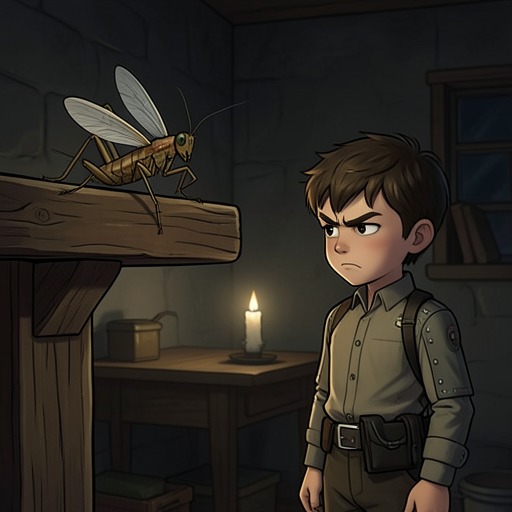
The relationship changes when Pinocchio and Geppetto find a little hut and discover the Talking Cricket sitting on a ceiling beam. Pinocchio greets him politely as a dear friend, a marked contrast with his earlier description of the Cricket as bothersome. The Cricket immediately recalls the hammer. Pinocchio answers that the Cricket is right and says he deserves to be struck in return, but asks that his poor old father be spared. His response acknowledges responsibility without trying to excuse the earlier attack; his plea also shows that, in this encounter, he is thinking about Geppetto’s safety as well as his own.
The Talking Cricket refuses retaliation and offers to spare both father and son. He explains that he wanted to remind Pinocchio of the old trick so that Pinocchio might learn that people should be kind and courteous to others if they hope to find kindness and courtesy when trouble comes. The lesson is linked directly to the history between them: the Cricket does not erase the past, but turns its recollection into a principle that can guide their present encounter. Pinocchio accepts the rebuke, agrees that the Cricket is right, and says he will remember what he has been taught.
Mutual Help and Narrative Significance
Forgiveness is followed by an ordinary, practical exchange. Pinocchio asks how the Cricket acquired the pretty little cottage, and the Cricket explains that a little Goat with blue hair gave it to him the previous day. The conversation moves from remembered harm to the circumstances of the shelter where Pinocchio and Geppetto have arrived. That shift matters: the Cricket’s response is not limited to condemning Pinocchio or delivering a moral. He receives the father and son, while Pinocchio approaches him with courtesy and asks a question rather than rejecting his presence.
The relationship thus connects Pinocchio’s earlier resistance to the book’s later emphasis on kindness returned in times of need. The Talking Cricket’s counsel initially provokes defiance; his memory of the hammer could have made the meeting an occasion for blame or revenge. Instead, he makes forgiveness conditional on understanding a lesson, and Pinocchio openly accepts that lesson. Their renewed connection is not presented as a claim that the earlier wrong never happened. It rests on naming it, accepting responsibility, and choosing help over retaliation.