Pinocchio burns off both feet
The Adventures of PinocchioPinocchio burns off both feet after a night of hunger and misjudgment turns an ordinary attempt to get warm into a serious bodily injury. The episode makes his wooden body physically vulnerable, while linking his immediate suffering to the chain of choices that leaves him alone, exhausted, and unable to recognize danger before it is too late.
Causes and Circumstances
The sequence begins with Pinocchio’s hunger overcoming his fear of going out at night. The street is pitch-black, thunder rolls, lightning flashes, and the wind raises clouds of dust as he hurries to the village. There he finds the doors and windows shut and the streets deserted. In desperation, he rings at a house, hoping someone will answer. The encounter offers no help: an old man, mistaking the visitor for a boy disturbing people at night, tells him to hold out his hat and pours ice-cold water from the window. Pinocchio has no hat, and the water drenches his head, shoulders, and wooden body.
He returns home worn out by cold, weariness, and hunger. Too weak to remain standing, he sits on a little stool and puts both feet on the stove to dry them. The gesture is practical but perilous: exhausted, he falls asleep before moving away from the heat. The episode’s cause is therefore not fire alone, but the convergence of hunger, a fruitless search for help, exhaustion, and inattention. Pinocchio’s attempt to relieve one discomfort exposes him to another.
The Burning and Its Discovery
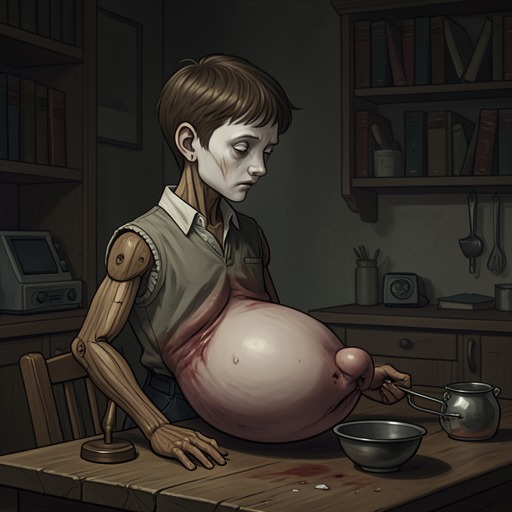
While Pinocchio sleeps, his wooden feet slowly blacken and turn to ashes. He snores as though nothing has happened, unaware of the damage. The gradual burning is especially stark because the danger proceeds without waking him: the body is being consumed while its owner remains comfortable in sleep. The scene establishes that Pinocchio’s wooden form is not impervious to ordinary heat; a stove, used for warmth, can destroy part of him.
At dawn, a loud knock at the door wakes him. Still half asleep, Pinocchio jumps up to answer and immediately falls headlong. Until that failed attempt to stand, he has not discovered that his feet are gone. The contrast between the simple action he intends—getting to the door—and the fall that reveals the injury turns the loss into a sudden recognition. His damaged body is no longer an unseen consequence of the night; it now prevents him from moving as he expects.
Geppetto’s Response
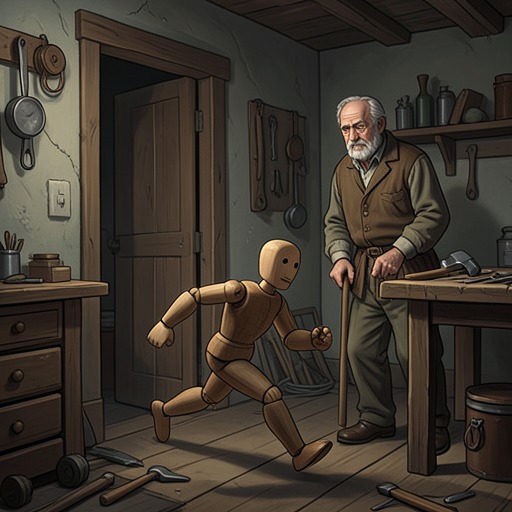
Geppetto is outside, calling for the door to be opened. When Pinocchio cannot stand, he explains that he cannot get up and fears he will have to walk on his knees. Geppetto initially takes the cries for another prank. Unable to enter through the door, he climbs up the side of the house and gets in through a window. His first anger changes when he sees Pinocchio stretched on the floor and realizes that the feet are truly gone.
Geppetto’s reaction is not punishment. He lifts Pinocchio from the floor, fondles and caresses him, and weeps as he asks how the feet were burned. The scene shifts from a mishap caused by Pinocchio’s choices to a moment of parental care: Geppetto’s response is shaped by what he sees, and his tenderness replaces his suspicion. The contrast also makes the injury consequential beyond its physical effects. Pinocchio cannot simply rise and meet his father; Geppetto must come to him and lift him.
Pinocchio’s account of the night gathers several earlier troubles into one explanation. He describes the thunder and lightning, his hunger, and his return from the house where he was drenched. He also recounts killing the Talking Cricket with a hammer after resisting its rebuke, and the chick’s escape from the pan. His explanation is emotionally charged, but it does not hide the choices that preceded the accident: he had rejected advice, remained hungry, and gone out into the storm. The burned feet are the immediate physical consequence of the stove, while his account places that consequence within a wider run of misadventures.
Consequences and Narrative Significance
The episode makes vulnerability visible through a concrete loss. Pinocchio is a wooden figure, but that material does not protect him; it is precisely his wooden feet that burn. The ordinary domestic object meant to provide warmth becomes the source of injury when he falls asleep with his feet against it. The scene thus makes his body more than a comic feature: it imposes a direct limit on what he can do, and the fall at the door gives that limit an immediate practical form.
The event also turns misfortune into a point of contact between Pinocchio and Geppetto. Pinocchio’s earlier conduct has kept him from the help he sought, and the failed search leaves him alone with the stove. Yet when Geppetto discovers the damage, the scene centers care rather than blame. The sequence ends not with the fire but with recognition: Pinocchio’s unexplained cries become evidence of real injury, and Geppetto responds with sorrow and affection. The episode’s force lies in that reversal, from an exhausted puppet unknowingly losing his feet to a father seeing his child’s suffering and holding him.