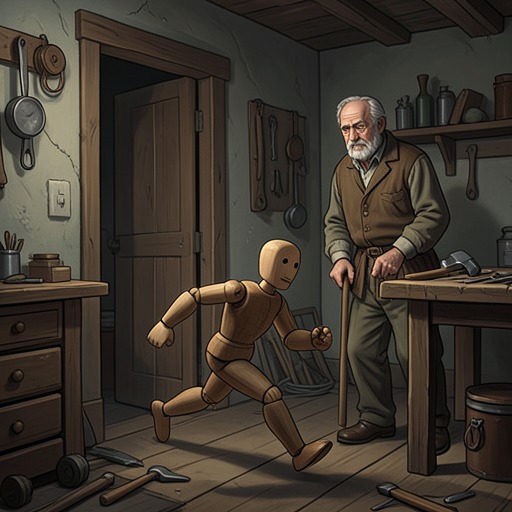
Pinocchio burns off his feet
The Adventures of PinocchioPinocchio burns off his feet after a night of hunger and poor decisions leaves him exhausted at home. The injury is both a literal consequence of falling asleep beside the stove and a turning point in his dependence on Geppetto: unable to stand, Pinocchio must face the harm that has come to him and accept his father’s care.
Background and Immediate Causes
The episode follows Pinocchio’s flight from home and his refusal to heed the Talking Cricket’s advice. As hunger worsens, he regrets having run away and recognizes that Geppetto’s presence might have spared him from going without food. He sets out into the night hoping someone in a nearby village will give him bread, but the search brings no meal. When he asks for help at a house, an old man mistakes him for a boy disturbing people at night. Pinocchio is told to stand beneath a window with his hat held out; he has no hat, and instead receives a shower of ice-cold water over his head and body.
The return home leaves him soaked, tired, and still hungry. His immediate concern is to dry himself: with too little strength left to remain standing, he sits on a stool and puts his feet on the stove. The choice is practical in the moment but dangerous. Exhaustion overtakes him before he can move away from the heat, so the attempt to get warm becomes the cause of a lasting injury.
The Injury
Pinocchio falls asleep with his feet against the stove. As he sleeps, the wooden feet begin to burn; the damage is gradual, as they blacken and turn to ashes. The narration makes the harm especially stark by setting the slow destruction of his feet against his peaceful, unaware sleep. He continues to snore as though the burning were happening to someone else, and does not wake to protect himself.
At dawn, a knock at the door and Geppetto’s voice wake him. Still unaware that his feet are gone, Pinocchio jumps up to open the door. He staggers and falls headlong to the floor. His failed attempt to stand is the moment the injury becomes apparent to him: what had happened unseen during sleep now governs his movement and leaves him unable to get to the door on his own.
Geppetto’s Return and Response
Geppetto first thinks Pinocchio’s cries and tears are another prank. He climbs in through a window, but his anger gives way to sorrow when he sees Pinocchio on the floor without feet. He picks him up, fondles and caresses him, and asks how the feet were burned. The change in his response matters: what might have looked like another trick is unmistakably real, and the father’s first reaction to that reality is tenderness.
Pinocchio tries to explain the night, but the account comes out as a jumble. He recounts the storm, his hunger, his quarrel with the Talking Cricket and the hammer he threw, the Chick’s escape, the old man’s water, and his decision to warm his feet at the stove. He also admits that he fell asleep and woke to find them gone. The sequence ties the accident to the choices and misfortunes of the night, while his confused delivery shows how little control he has over the consequences once they gather around him. Geppetto understands only that Pinocchio is hungry.
Hunger, Care, and Consequence
Geppetto draws three pears from his pocket. They had been meant for his own breakfast, but he gives them to Pinocchio willingly and asks him to stop weeping. Pinocchio then asks Geppetto to peel them before he eats. The exchange turns the episode from an account of injury into a scene of care: Geppetto answers his child’s immediate need with the food he had kept for himself, even while Pinocchio remains dependent and demanding.
The burned feet make visible the cost of Pinocchio’s flight and hunger without turning the episode into a simple punishment scene. His own actions helped bring him into danger, but the harm also comes through circumstances he cannot manage: the night, the cold water, his exhaustion, and the fire. Geppetto’s return does not undo the injury; instead, it restores a human bond at the moment Pinocchio is most helpless. The scene’s decisive contrast is between Pinocchio’s solitary attempt to survive and the father who arrives with food and compassion.