Pinocchio follows Lamp-Wick to Toyland
The Adventures of PinocchioPinocchio follows Lamp-Wick to the Land of Toys in a pivotal reversal: after promising The Fairy with Azure Hair that he will return home before dark and keep his word, he yields to his closest friend’s invitation to a country devoted to play and free of study. The journey begins not with ignorance of what he ought to do, but with a clear choice to turn away from it.
The Invitation and the Promise
The Fairy has allowed Pinocchio to invite his friends to a party the following day, on the condition that he return home before dark. He answers that he will be back in an hour and insists that, unlike other boys, he keeps his word. The Fairy cautions that boys make promises easily and forget them just as easily; Pinocchio replies that he is different. His confidence makes the coming reversal especially pointed: the promise is recent, explicit, and made in response to a direct warning.
He leaves the house singing and dancing, then invites his friends in a little more than an hour. Some accept at once; others need coaxing, but all agree when they hear that the toast will be buttered on both sides. The detail gives the preparations a playful, ordinary energy, while also showing Pinocchio carrying out his immediate task with unusual speed. His search for Lamp-Wick, however, takes three visits: the boy is absent each time.
Lamp-Wick’s Appeal
Lamp-Wick is the friend Pinocchio loves most among his schoolmates. His real name is Romeo, but everyone calls him Lamp-Wick because he is long and thin and has a woebegone look. The narration also identifies him as the laziest boy in school and its biggest mischief-maker. Pinocchio’s affection for him therefore places the invitation in tension with the Fairy’s hope that Pinocchio will become a good boy: the companion he most wants to find is also associated with idleness and trouble.
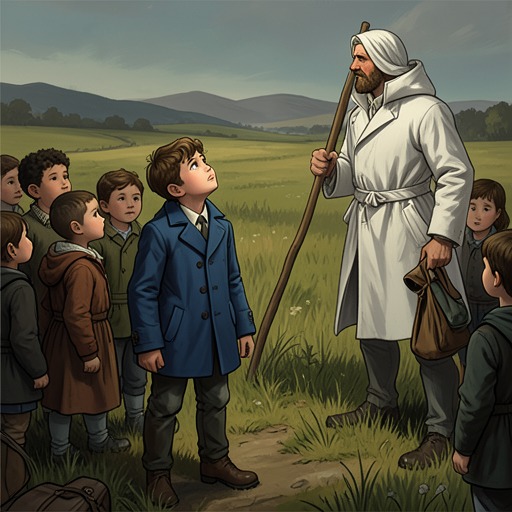
When the friends meet, Lamp-Wick describes the destination as a real country, the best and most wonderful place in the world, and names it the Land of Toys. Its great attraction is plain in the exchange: boys there never have to study. The offer answers Pinocchio’s desire for a life without lessons, but it also gives that desire a physical destination and a departure time. The pair plan to leave at midnight.
The Reversal at Night
Pinocchio does not accept immediately. He says he has promised The Fairy with Azure Hair that he will become a good boy and wants to keep his word. With the sun setting, he says he must hurry home before night. For a moment, his choice matches the promise he made: he recognizes both the obligation and the practical deadline, and begins to leave Lamp-Wick rather than follow him.
Lamp-Wick continues to press the appeal of the journey, including the prospect of making as much noise as they like from morning to night. Pinocchio sighs several times before changing his mind and asking to go too. The pause matters: his decision is not presented as an accidental diversion but as a wavering between the Fairy’s instruction and the pleasures his friend offers. The Land of Toys wins not by disproving the promise, but by making disobedience seem more attractive.
As the night grows darker, a small light appears in the distance, accompanied by a faint, bell-like sound, soft and muffled like a far-off mosquito. Lamp-Wick recognizes the approaching signal. When he again presents the prospect of a country where boys never study, Pinocchio exclaims over how wonderful it sounds. The distant light and sound give the temptation an approaching vehicle and an immediate threshold: the imagined freedom is about to become a ride he can join.
Departure and Arrival
The Little Man says the seats are full, but offers Pinocchio his own place as coachman. Pinocchio accepts and obeys without another word. The concession turns a crowded wagon into an opening for him; instead of going home as he promised, he takes the offered role and joins the journey. Toward dawn, the wagon reaches the much-longed-for Land of Toys.
The country’s streets make its promises visible. Its population consists entirely of boys, from about eight to fourteen years old. Groups play marbles, hopscotch, ball, tag, and blindman’s buff; others ride bicycles or wooden horses, perform tricks, imitate animals, or stage a parade of cardboard soldiers. Small wooden theaters fill the squares, while charcoal writing on house walls celebrates the Land of Toys and rejects arithmetic and school. The place is not merely a private escape for Pinocchio and Lamp-Wick: it is an entire society arranged around play and the refusal of lessons.
The next chapter’s heading marks the consequence as five months of play and promises a great surprise when Pinocchio wakes. That interval gives the midnight choice a longer reach than a single missed curfew: his departure from the Fairy’s plan carries him into a sustained life without study. The episode also recalls Pinocchio’s earlier tendency to dismiss warnings, while contrasting with his later remorse after a schoolmate is gravely injured in a fight; then, he recognizes that he listened to bad companions and wishes he had gone to school. Here the warning is still in front of him, and he briefly voices the right course before reversing it. The journey thus makes the conflict between promise and temptation concrete, carrying Pinocchio from an afternoon of invitations into the very country his friend has held out as an escape from responsibility.