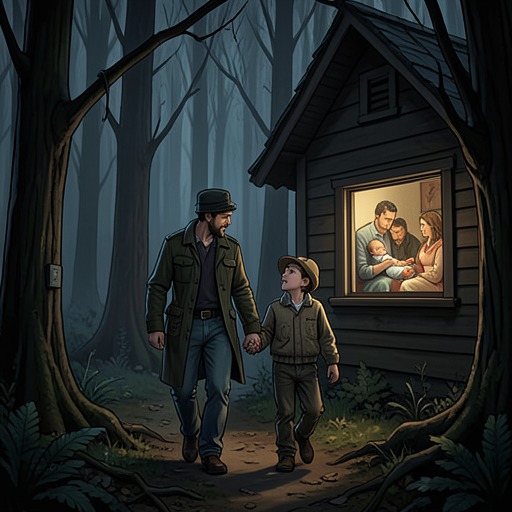
Pinocchio learns of the Fairy’s death and dives into the sea to save his father
The Adventures of PinocchioPinocchio learns of the Fairy’s death and dives into the sea to save his father is a turning point built from two successive shocks: an inscription makes Pinocchio believe that The Fairy with Azure Hair has died because he abandoned her, and news from a pigeon reveals that Geppetto has been searching for him across Europe. When Geppetto’s boat vanishes in heavy water, Pinocchio answers the separation not with another promise alone but with a dangerous attempt to reach his father himself.
The Return and the Empty House
Freed from the dog collar that had weighed on him, Pinocchio runs across fields and meadows toward the road to The Fairy with Azure Hair’s house. The speed of his return matters: the scene first gives him a clear destination, then replaces it with absence. From the road he recognizes the valley where he had encountered The Fox and The Cat and the Giant Oak Tree where he had been hanged, but he cannot see the house he seeks. When he reaches its former site, the cottage has disappeared; only a small marble slab remains.
That familiar landscape makes the loss more than a change of address. The valley holds the marks of earlier danger, while the vanished home had represented the possibility of returning to someone who cared for him. Pinocchio has come back, but the setting offers no welcome and no explanation beyond the inscription. His urgent journey therefore ends in a confrontation with what he believes cannot be undone.
The Inscription and Pinocchio’s Grief
The slab declares, “HERE LIES THE LOVELY FAIRY WITH AZURE HAIR WHO DIED OF GRIEF WHEN ABANDONED BY HER LITTLE BROTHER PINOCCHIO”. Its wording assigns Pinocchio responsibility for the death: it names him as the one who abandoned her and describes grief as the cause. The claim is presented through a memorial inscription, not through a witnessed account of her final moments. At this point, however, Pinocchio reads it as truth.
He collapses and covers the cold marble with kisses. His crying lasts all night; by dawn his tears have dried, but hard sobs still shake his wooden frame. The physical persistence of his grief gives the scene its force: he cannot restore the house or reach the person he believes is dead, and his body expresses the distress that his words cannot resolve. He asks why The Fairy with Azure Hair died instead of him, whom he calls bad, and begs her to tell him where his father is. His sorrow turns at once toward the second absence: Geppetto is lost, and Pinocchio fears having no one to provide food, shelter, or new clothes.
News of Geppetto
The pigeon’s arrival interrupts Pinocchio’s night of mourning with news that makes his father’s absence immediate. Asked whether he knows Geppetto, the bird confirms that he left him three days earlier on the shore of a large sea. Geppetto had been wandering around Europe for four months, searching for Pinocchio; having failed to find him, he had decided to continue the search in the New World by crossing the ocean in a little boat.
This report changes the scene’s direction without diminishing the grief that precedes it. Pinocchio’s question about his father had been voiced beside the slab as part of his despair; now he learns that Geppetto is alive and actively looking for him. The distance is still formidable: the shore lies more than fifty miles away, and Geppetto is preparing to cross the ocean rather than waiting at home. The news makes reunion conceivable, but only through a journey that is already dangerous.
The Sea and the Rescue Attempt
At the shore, Pinocchio searches until he spots a small boat tossed among the waves and recognizes Geppetto. From a high rock, exhausted from looking, he waves with his hand, his cap, and even his nose. Geppetto appears to recognize him and waves back, but the heavy sea leaves him unable to manage the oars. A huge wave then hides the boat. The people on shore wait for it to reappear, but it is gone.
Pinocchio’s response is immediate: he runs to the sea and dives in, crying, “I’ll save him! I’ll save my father!” The fisher folk turn back at the desperate cry and watch him swim into the rough water. Because he is made of wood, he floats easily and swims like a fish; he disappears and reappears as he moves farther from land, until he is lost from view. The onlookers can only pray and return home. The scene ends with the attempt, not its success: neither Pinocchio nor Geppetto is shown reaching safety here.
Reversal and Narrative Significance
The episode joins a false certainty of death to a real and unresolved danger at sea. The inscription persuades Pinocchio that The Fairy with Azure Hair is dead, but a later circus performance overturns that belief: he sees her in a box, recognizes her, and notices a medallion bearing the picture of a marionette. The earlier grief remains part of Pinocchio’s experience, while the later recognition reveals that the inscription did not tell the truth about her fate.
The attempted rescue of Geppetto has a different status. The pigeon’s news supplies a concrete reason to hurry, the vanished boat makes the danger visible, and Pinocchio enters the water even though the scene does not show him catching up. His wood, previously a sign of his nonhuman body, now enables him to float and keep swimming in rough water. The event thus moves him from a return motivated by remorse into an act of filial rescue, while leaving the outcome open for the story’s continuation.