Pinocchio’s circus career and return to wooden form
The Adventures of PinocchioPinocchio’s circus career and return to wooden form are the consequences of his transformation into a donkey and a sharp reversal of the public spectacle built around that transformed body. Sold first as an attraction and then as scrap material for a drum, he passes from coerced performance to apparent destruction; the fish that strip away his hide instead reveal the wood beneath and restore him to his puppet form.
From Toyland to the Circus
The episode begins after the Little Man has taken Pinocchio and Lamp-Wick to a market far from the Land of Toys. He grooms the boys’ new donkey bodies, combing their coats until they shine, then sells them separately. Lamp-Wick goes to a farmer whose donkey has died the previous day; Pinocchio is bought by a circus owner who hopes to train him for an audience. The split gives their shared transformation different outcomes, although the narrator says that Lamp-Wick’s later fate is unknown.
The Little Man’s gentle manner conceals a profitable trade. He seeks out boys who dislike books and school or want to run away from home, takes them to the Land of Toys, and lets them play for months without work. When they become donkeys, he sells them. The narrator says that this business has made him a millionaire in a few years. Pinocchio’s sale is therefore not an isolated misfortune but one link in a deliberate cycle: temptation, transformation, and sale.
His new owner does not buy him for the work of an ordinary donkey. He expects Pinocchio to earn money as a trained performer and tells him he must learn to jump and bow, dance a waltz and a polka, and stand on his head. Pinocchio has little choice in the matter. Training takes three months and many lashings before the owner considers him ready. A brief, bitter contrast accompanies the work: Pinocchio chews straw, finds that it tastes nothing like rice or macaroni, and tries to bear his hardship as a lesson for disobedient boys who refuse to study.
A Body Put on Display
The circus advertises Pinocchio as a famous donkey, making his name part of the attraction. The manager appears before the audience in a black coat, white knee breeches, and patent-leather boots, and introduces the animal with a grand claim: that the donkey has performed before the kings, queens, and emperors of Europe. This is the manager’s publicity, not an independently confirmed history. The packed house and eager children in the audience establish the success of the advertisement before Pinocchio has even completed his act.
In the performance, the donkey’s body is both his instrument and the property of others. The manager’s commands set the routine; the audience watches for the feats it has been promised. The narrative makes the gap between showmanship and control visible: Pinocchio has spent months being trained through punishment, and his public success depends on submitting his body to acts chosen for him. The ring becomes the point where that imposed skill fails. He tries several times to go under it rather than through it, but at his master’s look he finally jumps. His hind legs catch in the ring, and he falls in a heap.
The injury ends the performance and changes his value to the circus. Pinocchio can barely limp back to the stable. The next morning, a veterinarian declares that he will be lame for the rest of his life. When the manager asks what use he has for a lame donkey, he orders the stable boy to take Pinocchio to market. The audience’s excitement and applause have given way to a calculation: once the trained animal cannot perform, the owner no longer wants him.
The Fairy in the Audience
Before the accident, the circus ring briefly connects Pinocchio’s public role to his history with the Fairy. After a staged fall, applause rises as he gets back to his feet. He lifts his head and sees a beautiful woman in a box wearing a long gold chain with a large medallion bearing the picture of a puppet. Pinocchio recognizes both the image and the woman as the Fairy, and tries to call out to her as his own Fairy.
The recognition is private even as it occurs in public. The crowd sees the donkey in the show, while Pinocchio understands the medallion as an image of himself and sees the Fairy as a loved one who has found him. He is overcome and weeps, but the manager does not notice; instead, he cracks his whip and orders the next feat. The scene places Pinocchio’s attachment beside the circus’s indifference. His emotional response does not stop the performance, and the accident follows while the manager continues to direct him.
Sold for His Skin
At the market, a buyer offers four cents for Pinocchio, although the manager had asked four dollars. The buyer explains that he does not want a working donkey: he wants the animal’s tough-looking skin for a drumhead, because he belongs to a village musical band and needs a drum. Pinocchio is thus reduced first to an unusable performer and then to material for an object. The sharp difference between the asking price and the offer underscores how little his former owner values him once his circus career is over.
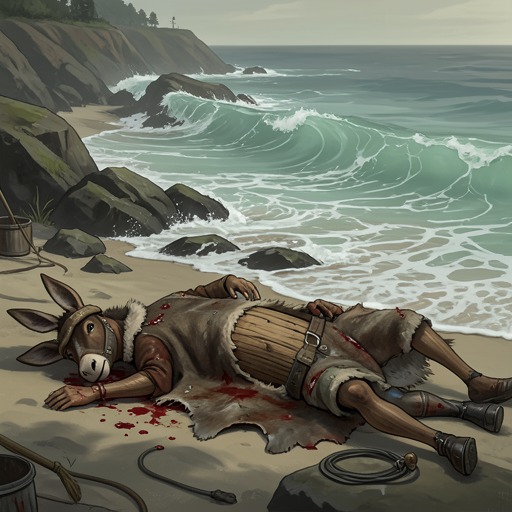
After paying, the buyer takes Pinocchio to a high cliff above the sea. He ties a stone around his neck, attaches a rope to one hind foot, and pushes him into the water, intending to wait until he drowns and then skin him. The account does not soften the practical purpose of this act: the buyer expects a dead donkey whose hide he can use. After fifty minutes, he pulls the rope, expecting to retrieve a corpse. Instead, a living wooden puppet wriggles at the surface.
Pinocchio explains that he had once been a wooden puppet and was about to become a real boy, but ran away because of laziness, hatred of books, and the influence of bad companions. He recounts becoming a donkey, being sold to the circus, and becoming lame in a fall during a performance. His account joins the circus mishap to the danger at the cliff: the buyer has encountered the last stage of a chain of consequences Pinocchio now understands as a result of his earlier choices.
The Hide Falls Away
Pinocchio attributes his survival to the Fairy, whom he describes as his mother and as someone who continues to watch over him despite his failures. He says she sent a thousand fish when he was in danger of drowning. Mistaking him for a dead donkey, the fish eat his ears, nose, neck, mane, legs, back, and tail. Their feeding strips away the donkey’s hairy coat, but when they reach the wood underneath, they cannot bite through it. They scatter, leaving Pinocchio alive and restored to puppet form.
The transformation is at once comic and perilous: the buyer’s plan succeeds only in removing the disguise of the donkey body, not in producing the drumhead he wants. When he threatens to sell Pinocchio as dry firewood to recover his money, Pinocchio accepts the threat and then escapes with a sudden leap into the sea. The episode closes this phase of his circus life not with rehabilitation by his owner but with his own flight from another attempted sale.
The return to wooden form does not end Pinocchio’s danger. As he swims toward land, the Terrible Shark swallows him, carrying the story into a new ordeal. Yet the circus episode has already reversed its central spectacle: the body trained, displayed, injured, and priced by other people proves not to be what they think it is. The donkey’s hide can be stripped away; the puppet survives beneath it.