Pinocchio’s five months of work
The Adventures of PinocchioPinocchio’s five months of work turn an urgent reunion with Geppetto into a daily practice of care. For more than five months, he rises at dawn to earn milk for his ailing father, finds further ways to support their household, and studies at night; the interval makes diligence visible as repeated labor rather than a sudden change of heart.
The Routine Begins
After parting from the Tunny, Pinocchio follows a distant light and finds Geppetto at a small dinner table, lit by a candle in a glass bottle. The old man is eating live fish, and Pinocchio, overcome with joy, embraces him and says he will never leave him again. Their reunion supplies the immediate emotional context for the work that follows: Geppetto is old and in need of support, and Pinocchio’s promise acquires meaning through what he does each day.
The practical routine takes shape at Farmer John's Farm. When Farmer John laughs at the suggestion that Pinocchio had donkeys in his school, Pinocchio feels ashamed and hurt, but does not answer; he takes his glass of milk back to Geppetto. From then on, for more than five months, he gets up as dawn breaks and draws water in exchange for a glass of warm milk. Geppetto grows stronger and better day by day, making the repeated morning task a direct form of care as well as a source of income in kind.
Work That Sustains the Household
The milk is only one part of Pinocchio’s effort. He learns to make baskets from reeds and sells them, using the money to help himself and Geppetto avoid starvation. He also builds a strong, comfortable rolling chair so that his father can go out for an airing on bright days. These acts extend his labor beyond earning: he makes useful things, attends to Geppetto’s comfort, and helps restore a measure of security to their household.
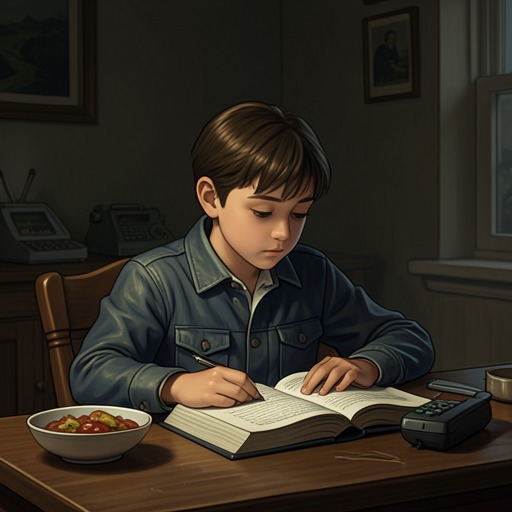
The work is organized around the day’s hours. Pinocchio draws water in the early morning and studies by lamplight in the evening. His income lets him buy a secondhand book with some pages missing, from which he learns to read quickly. With no ink, he writes using blackberry or cherry juice and a long stick sharpened to a fine point. The makeshift tools and damaged book give his study a concrete, improvised character: learning is no longer an obligation he evades but an effort he fits around the work that keeps his father fed.
Change Across the Five Months
The episode contrasts Pinocchio’s new habits with his earlier recognition of how badly he had judged advice and schooling. After Eugene was struck during the boys’ fight, Pinocchio lamented that he should have gone to school and admitted that he had listened to bad companions despite warnings. Here, study returns in a different form: he obtains his own book, teaches himself to read, and persists alongside his daily work. The change is expressed through routine and consequence rather than through another promise.
Little by little, his diligence succeeds in both work and study. He earns enough to keep Geppetto comfortable and happy, while also saving fifty pennies toward a new suit for himself. The sum records a modest personal hope within a period chiefly devoted to his father’s needs. Pinocchio’s five months are therefore both a measure of time and a measure of conduct: dawn labor, practical ingenuity, evening study, and care for Geppetto recur until responsibility becomes part of his ordinary life.