Pinocchio’s moral reformation
The Adventures of PinocchioPinocchio’s moral reformation is the change from impulsive defiance to dependable care, made visible through work, study, and generosity rather than through a single promise. The story tests that change in concrete terms: he rises before dawn to support Geppetto, gives away his savings for The Fairy with Azure Hair, and keeps working when the new clothes he had hoped to buy must wait. His transformation into a real boy follows this sustained conduct, making moral change both an inward lesson and an outward alteration of his life.
Identity and Early Resistance
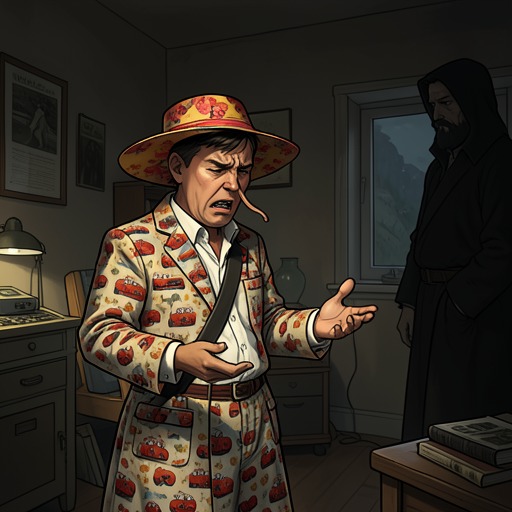
For much of his story, Pinocchio treats warnings as obstacles to his freedom. After ignoring the Talking Cricket’s advice, he reassures himself that the Assassins are only a tale invented by parents to frighten children who run away at night. He imagines that he can face them boldly or escape if necessary. The confidence is immediately undercut by a rustle in the leaves behind him: the danger he has dismissed is already approaching. His reasoning captures the early pattern of his behavior—he recognizes that others warn him, but assumes that consequences will not reach him.
The same gap between hearing advice and acting on it becomes painfully clear after Eugene is struck and lies pale and motionless. Pinocchio remains when the other boys flee, wets his handkerchief in the sea, and bathes Eugene’s head. He insists that he was not the one who hit his schoolmate, yet his sobbing turns toward his own choices: he laments not going to school, listening to the boys who led him away, and ignoring his mother’s warning about bad company. This is a moment of recognition, not a completed reform. His words name stubbornness and pride as recurring failures, while the scene leaves open whether he will sustain the change he now wishes he had made.
From Impulse to Sustained Work
The later change is measured in repeated acts, not remorse alone. After finding Geppetto, Pinocchio begins rising every morning at dawn and going to the farm to draw water. He receives a glass of warm milk for his father, whose health improves day by day. He also learns to make baskets from reeds and sells them so that the two of them can keep from starving. The labor is practical and regular: each morning’s work meets an immediate need, and each basket adds to their means of survival.
Care extends beyond earning food. Pinocchio builds a strong, comfortable rolling chair so that Geppetto can go outdoors on bright days. In the evening, he studies by lamplight with a secondhand book missing some pages. He teaches himself to read quickly; for writing, he whittles a fine point on a long stick and uses blackberry or cherry juice in place of ink. These details make his education part of the same discipline as his work. He is no longer merely wishing for a different life: he applies what he has earned and what materials he can find to build one.
For more than five months, this routine continues. Pinocchio gradually succeeds in both study and work, earns enough to keep his father comfortable, and saves fifty pennies. The money has a personal purpose: he means to buy a coat, a cap, and shoes. His progress is therefore not represented as effortless self-denial. He has worked toward a modest reward for himself, and the choice that follows will cost him something he has reason to want.
Generosity and Care for The Fairy with Azure Hair
When Snail tells Pinocchio that The Fairy with Azure Hair is ill and has no money for food, he gives Snail all fifty pennies. He had been about to spend the savings on clothes, but he puts that plan aside and asks that the money be taken to the Fairy. He even says that he would sell the rags he is wearing to help her further. His care for Geppetto has not exhausted his capacity to care for others; instead, he accepts a new obligation and resolves to work for the Fairy as well.
The choice has an immediate practical consequence. That night Pinocchio stays up until midnight and makes sixteen baskets instead of the usual eight. The doubled output links generosity to renewed effort: giving away his savings does not end with a display of feeling but changes how much he is willing to do. The Fairy’s response comes in a dream. She praises his kind heart, forgives his earlier mischief, and recognizes his care for parents who are old and sick, even while distinguishing that care from perfect obedience or behavior. The blessing acknowledges the specific change shown in his actions rather than erasing his earlier failures.
Transformation and Narrative Significance
The story has already placed Pinocchio’s body under forms of discipline that do not amount to moral reform. As a donkey, he is trained by a master to jump, bow, dance, and perform; the training takes three months and many lashings before he is declared ready for a public show. At the performance, he recognizes The Fairy with Azure Hair in a box by the medallion around her neck, which bears the picture of a Marionette. The episode contrasts a body made to perform under another’s control with the later pattern of work he undertakes for people he loves. Physical training can make him perform tricks; it cannot by itself account for the choices that mark his reformation.
After leaving Tunny, Pinocchio follows a faint light and finds Geppetto at a little table lit by a candle in a glass bottle. The old man is eating live fish, and Pinocchio, overcome with happiness, embraces him and vows not to leave him again. The reunion gives his subsequent labor its immediate human focus: Geppetto is no longer an absent father to be sought but an aging parent whose needs Pinocchio can answer every day.
When Pinocchio wakes after the Fairy’s dream, he has become a real boy and finds himself in a beautifully furnished room with a new suit, hat, and shoes. Geppetto, too, appears younger, neatly dressed, and at work carving a picture frame decorated with flowers, leaves, and animal heads. He explains that the change in their home comes from Pinocchio becoming good and kind. The old wooden Marionette remains nearby, limp against a chair, a visible contrast with the boy who has earned this new life through sustained care. The ending presents reform as reciprocal: Pinocchio’s conduct improves his father’s circumstances and transforms their home, while his own transformation follows from the same change in how he treats others.