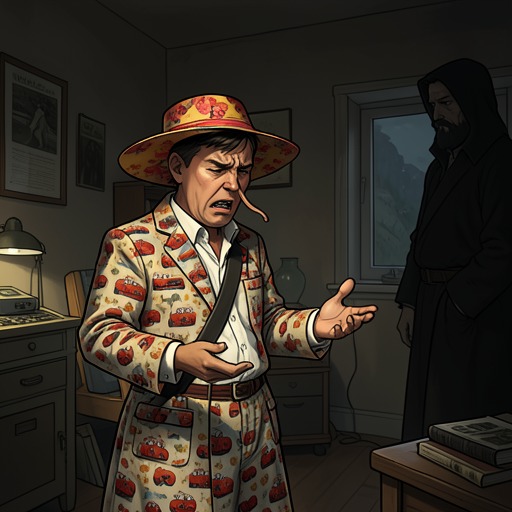
Pinocchio’s nose grows after he lies
The Adventures of PinocchioPinocchio’s nose grows after he lies in a scene where a concealed handful of gold coins becomes impossible to hide behind words. Questioned by The Fairy with Azure Hair about the money entrusted to him, Pinocchio invents successive explanations; each falsehood lengthens his nose until the growth itself prevents him from leaving the room. The episode makes deception visible and bodily: instead of resolving his predicament, each new lie tightens it.
The Question About the Gold
The scene begins when The Fairy with Azure Hair asks Pinocchio to explain how he came to fall into the hands of the Assassins. Pinocchio recounts a chain of events involving the five gold pieces Fire Eater had given him for his father, his encounter with The Fox and The Cat, and the promise that the money could become two thousand at the Field of Wonders. He describes stopping at the Inn of the Red Lobster, waking to find his companions gone, and meeting the Assassins on the road. In his account, he concealed the coins under his tongue, resisted an attempt to take them, and was eventually caught and hanged.
The Fairy’s next question is narrower: where are the gold pieces now? Pinocchio answers that he lost them. The narration explicitly identifies this as a lie and supplies the fact he is trying to conceal: the coins are in his pocket. The contrast between the simple question and the elaborate danger of his earlier account shifts the scene from recounting an adventure to testing whether Pinocchio will tell the truth about what remains in his possession.
Lies Made Visible
The first false answer has an immediate physical consequence. Pinocchio’s nose, already long, grows by at least two inches. When The Fairy asks where he lost the money, he says that it was in the nearby wood; his nose lengthens again. The Fairy responds that anything lost there can be found, leaving Pinocchio’s invented story with a practical problem as well as a visible mark.
He then changes his explanation once more, saying that he swallowed the coins when he took his medicine. This third lie makes his nose longer still. The growth is no longer merely an exaggerated sign: it interferes with his movement. Turning right, Pinocchio strikes the bed or windowpanes; turning left, he hits the walls or the door. If he raises his nose, he nearly puts out The Fairy’s eyes. The false accounts accumulate in sequence, and the bodily consequence accumulates with them, converting evasive speech into an obstacle he cannot ignore.
Exposure and Confinement
The Fairy watches and laughs, while Pinocchio, alarmed by the size of his nose, asks why she is laughing and how she knows he is lying. She explains that lies are quickly recognized and distinguishes between lies with short legs and lies with long noses. Her response names the comic logic already enacted: Pinocchio’s particular lies do not disappear into speech but project outward, growing conspicuous enough to expose their maker.
His attempted escape supplies the scene’s final reversal. Ashamed, Pinocchio tries to get out of the room, but his nose has grown too long to pass through the door. The lie that was meant to conceal the coins has therefore left him trapped in the very place where he was questioned. His concealment fails not because The Fairy searches his pocket in this passage, but because his own changing body makes evasion visible and escape physically impossible.
Narrative Significance
The episode builds its effect through repetition and escalation: a question, a denial, a longer nose, another question, another denial, and a still more obstructive growth. The repeated exchange gives the consequence a clear cause, while the precise measurements and collisions keep the magic concrete. Pinocchio’s nose is both evidence of dishonesty and an impediment produced by it; his attempt to manage each falsehood only worsens the predicament.
The scene also turns an inward moral failing into public, comic spectacle. Pinocchio cannot keep his lies private because they alter his appearance, and he cannot simply run from the embarrassment because the alteration blocks the doorway. The Fairy’s explanation gives the incident a memorable rule, but the action itself carries the lesson: each added fabrication deepens the exposure it was meant to prevent. The trapped ending makes that irony physical, leaving Pinocchio unable to move freely until the deception is no longer something he can pretend has no consequence.