Talking Cricket
The Adventures of PinocchioThe Talking Cricket is a resident of the room where Pinocchio first encounters him, and a recurring voice of advice whose counsel Pinocchio repeatedly resists. His story moves from warning to death, then to a ghostly return and an act of forgiveness: the Cricket’s final assistance gives practical form to the kindness he has urged Pinocchio to show others.
Identity and First Encounter
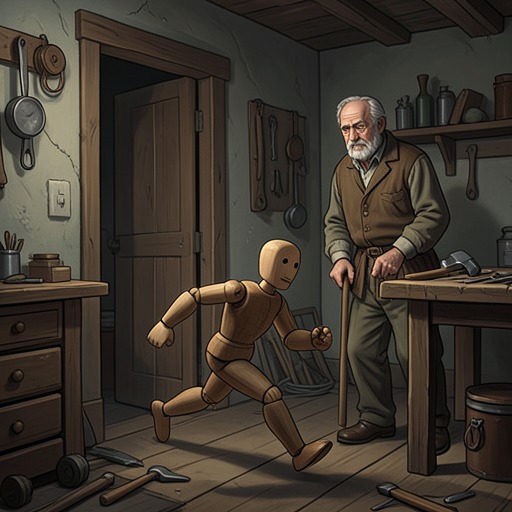
Pinocchio finds the Talking Cricket crawling up the wall of the room and learns that he has lived there for more than a hundred years. The Cricket is therefore not a passing stranger but an established presence in the place Pinocchio has claimed as his own. Their first exchange quickly sets out their opposing expectations: Pinocchio orders him to leave, while the Cricket refuses to go until he has delivered what he considers an important truth.
That truth concerns the consequences of disobedience and running away from home. The Cricket warns that children who reject their parents’ guidance will not find happiness and may regret their choices as they grow older. Pinocchio responds by announcing his intention to leave at dawn. He resents the prospect of school and prefers outdoor play and mischief, making his refusal a concrete choice rather than a misunderstanding of the Cricket’s warning.
The Cricket extends his advice beyond the immediate conflict. He cautions that a life devoted to avoiding study and responsibility may end in degradation and ridicule. His warning anticipates the later transformation of Pinocchio into a donkey, while his role at this early point is less to restrain Pinocchio than to articulate the consequences that the puppet refuses to consider.
Rejection and Death
The confrontation turns fatal when the Cricket calls Pinocchio a wooden-headed Marionette. Enraged, Pinocchio takes a hammer from the bench and throws it at him. The blow kills the Cricket. The episode makes Pinocchio’s impatience consequential: the adviser whose warning he had dismissed is silenced not by argument but by violence.
The Cricket’s death does not end his influence on Pinocchio. Later, when Pinocchio encounters him again as a ghost, the Cricket advises him to return home and give the four gold pieces he still has to his father, who has been weeping because he has not seen his son. Pinocchio instead insists that the coins will soon multiply into a fortune. The Cricket answers with a warning against promises of overnight wealth, identifying their makers as fools or swindlers, and again urges him to go home.
Pinocchio ignores this second appeal too. In a later reflection, he recognizes that he did not listen to the Cricket and wonders what misfortunes may now await him. This recollection gives the Cricket’s counsel a continuing presence in the story: even when Pinocchio chooses against it, he remembers the warning and can connect his own decisions to the troubles that follow.
Counsel Recalled in Crisis
After a schoolmate named Eugene is struck during a fight among the boys, Pinocchio stays beside him while the others flee. In his distress, Pinocchio admits that going to school would have been better and blames himself for listening to bad companions. He recalls warnings from his teacher and mother, and recognizes his own stubborn habit of hearing advice but doing as he wishes.
This moment does not establish that the Talking Cricket was present at the fight. Instead, it echoes the pattern he had identified from their first meeting: Pinocchio receives warnings, rejects them, and later confronts their consequences. The Cricket’s significance lies partly in how clearly his initial counsel gives that recurring pattern a voice. Pinocchio’s remorse shows that resistance has not erased the lesson; it has made the lesson harder to evade.
Return, Forgiveness, and Practical Help
Much later, Pinocchio and Geppetto look up and find the Talking Cricket sitting on a beam in the cottage. Pinocchio now addresses him politely. The Cricket recalls the hammer attack, making their history explicit, and Pinocchio accepts responsibility, saying he deserves to be struck in return but asking that his father be spared.
The Cricket refuses to punish either of them. He explains that his reminder is meant to teach a reciprocal principle: people should treat others with kindness and courtesy if they hope to receive kindness and courtesy when they are in trouble. The exchange reverses their first encounter. Once, Pinocchio ordered the Cricket out and answered advice with anger; now he acknowledges the old harm, asks for mercy for his father, and accepts the lesson.
When Pinocchio asks how the Cricket came to own the cottage, the Cricket explains that it was given to him the previous day by a little Goat with blue hair. Pinocchio realizes that this was The Fairy with Azure Hair and breaks down in tears. The Cricket’s account thus helps connect the immediate shelter with the Fairy’s unseen care, while his presence gives father and son somewhere to turn in their difficulty.
The help is practical as well as moral. After Pinocchio makes a bed of straw for Geppetto, he asks where he can find milk for his father. The Cricket directs him to Farmer John, who has cows and can provide what he needs. In this final role, the Cricket does not merely repeat an abstract warning: he offers guidance that lets Pinocchio care for Geppetto.
Narrative Role
The Talking Cricket links advice to consequence across Pinocchio’s changing circumstances. His first warning concerns obedience, home, and study; his later counsel concerns returning the remaining coins to Geppetto and distrusting sudden riches; his final lesson concerns kindness returned in times of trouble. Pinocchio does not follow these instructions consistently, but their recurrence makes his choices and later regret legible.
The contrast between the Cricket’s death and his eventual forgiveness is central to that function. The story does not erase Pinocchio’s act or present reconciliation as though the harm never occurred: the Cricket specifically recalls the hammer. Yet he chooses to spare both Pinocchio and Geppetto, turning remembered injury into an occasion for teaching and assistance. By the end, the adviser Pinocchio once tried to silence has become a source of shelter, direction, and a model of the kindness he urged Pinocchio to practice.