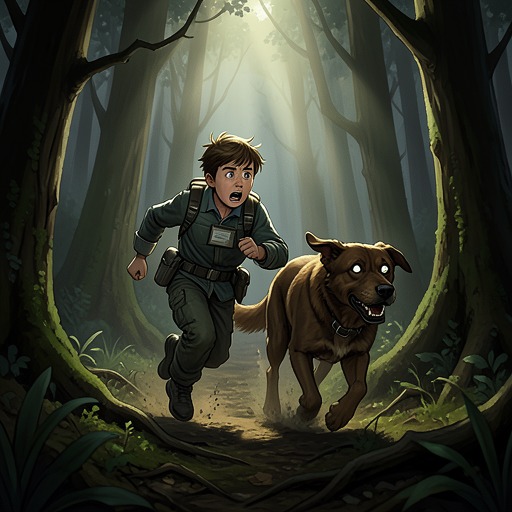
The Green Fisherman captures Pinocchio, and Alidoro rescues him
The Adventures of PinocchioThe Green Fisherman captures Pinocchio, and Alidoro rescues him in an episode that turns a lesson about reciprocal kindness into a life-or-death rescue. Pinocchio enters the scene seeking shelter and warmth; within moments he is bound for the frying pan, saved only when a hungry dog recognizes his voice. The reversal makes the danger concrete and gives Pinocchio’s earlier kindness to Alidoro an unexpected, practical consequence.
The shore and the net
After saying goodbye to Alidoro, Pinocchio swims close to shore. He spots smoke rising in a spiral from a cave and hopes to dry his clothes and warm himself there. As he climbs among the rocks, however, something lifts him higher. He finds himself caught in a huge net among fish of many kinds and sizes, all struggling to get free.
The fisherman who comes out of the cave is described as so strange that Pinocchio takes him for a sea monster. Grass covers his head in place of hair; his skin, eyes, and long beard are green, and his overall appearance is compared to a giant lizard. The grotesque figure belongs to a scene that quickly shifts from the apparent promise of shelter to the threat of being treated as food.
A speaking catch
When the Green Fisherman pulls Pinocchio from the net, he cannot identify him. He turns the puppet over and decides that he must be a crab. Pinocchio protests that he is a Marionette, but the Fisherman treats this as a reason to relish the catch rather than release it. Even when Pinocchio points out that he can speak and think, the Fisherman insists on treating him as a fish.
The Fisherman’s offer to let Pinocchio choose how he will be cooked makes his supposed courtesy part of the threat. Pinocchio asks to be set free and allowed to return home; the request has no effect. Instead, the Fisherman says he will fry him with the other fish, then binds him hand and foot with a stout cord and throws him into a tub. He rolls the catch one by one in flour before frying it. The mullets, bass, whitefish, flounders, and anchovies go first; Pinocchio is kept until last.
As the danger closes in, Pinocchio again connects his predicament with his decision to neglect school and follow his playmates. That regret echoes his earlier recognition that he ignored warnings against bad company. Here the lesson is not detached from the action: the consequence is a bound body in the tub, awaiting the pan. When the moment comes, fear leaves him unable to beg aloud, and he can plead only with his eyes.
Alidoro recognizes him
A large dog, drawn into the cave by the smell of boiling oil, appears while the Green Fisherman is holding Pinocchio. The Fisherman orders the dog away and draws back his foot to kick him. The dog, hungry and refusing to retreat, turns on the Fisherman and bares his teeth. Pinocchio calls to Alidoro for help. Recognizing the voice from the flour-covered bundle, Alidoro leaps forward, takes Pinocchio gently in his mouth, and races out through the door.
The Green Fisherman chases them, but a fit of coughing forces him to stop and return. Alidoro reaches the road leading to the village and sets Pinocchio softly on the ground. The manner of the rescue matters: Pinocchio has been tied up and handled as food, while Alidoro carries him carefully, preserving the difference between possession and care even in the physical handling of Pinocchio’s body.
Returned kindness
Pinocchio thanks Alidoro, who answers that no thanks are necessary: Pinocchio saved him once, and now the favor has been returned. Alidoro also describes a chain of immediate circumstances behind his arrival: he had been lying on the sand, nearly dead, when the appetizing smell of fried fish led him toward the cave. He reached it just in time to hear Pinocchio’s appeal.
The episode gives visible force to the principle that kindness is repaid. Pinocchio’s earlier rescue of Alidoro is not forgotten; it becomes the means by which the dog recognizes and saves him. Yet the return is not a calculated exchange arranged in advance. Alidoro is drawn to the cave by hunger, and the recognition happens only when Pinocchio calls out. The sudden change—from an apparent refuge, to capture, to rescue—keeps the adventure’s comic grotesquerie close to genuine peril, while showing that an earlier good deed can matter when its maker is powerless to help himself.