The Tunny rescues Pinocchio and Geppetto
The Adventures of PinocchioThe Tunny rescues Pinocchio and Geppetto at the moment their escape from the sea is about to end in drowning. Pinocchio’s earlier example has taught the Tunny how to leave the Shark, and now the fish returns that lesson as practical aid: carrying father and son to shore, then receiving Pinocchio’s gratitude with an unfamiliar tenderness of its own.
The crossing and recognition
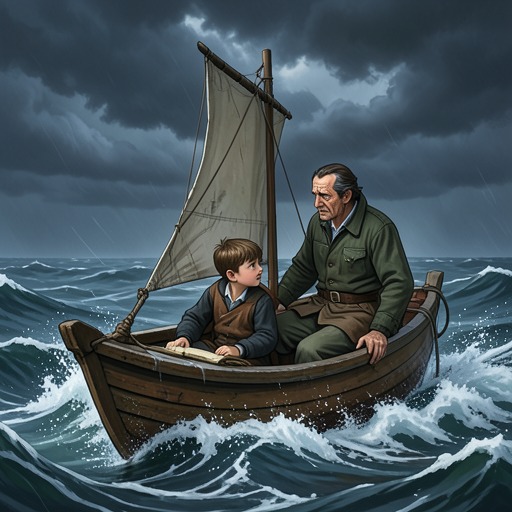
The rescue follows Pinocchio’s reunion with Geppetto inside the Shark. After leaving the Tunny behind, Pinocchio walks through the darkness toward a distant light and finds his father at a little dinner table, eating live fish by candlelight. Their reunion gives way to another danger when the two take to the water and struggle toward a shore that Geppetto cannot see. Pinocchio tells his father that he can make out the land, but the reassurance conceals how badly the swim is going for him.
As they continue, Pinocchio’s strength ebbs, his breathing grows labored, and the shore remains far away. He has been trying to appear calm and contented; that performance fails when he calls weakly for Geppetto’s help and says that he is dying. The confession marks the peril plainly: this is no longer simply a difficult crossing, but a moment in which both father and son may drown.
A voice from the sea interrupts their crisis. Pinocchio recognizes that its owner knows his voice, and the speaker identifies himself as the Tunny, his companion inside the Shark. The reunion is also a recognition scene: the fish is not a stranger arriving by chance, but a fellow captive whose history is bound to Pinocchio’s. The danger briefly gives way to astonishment and renewed possibility as the Tunny identifies himself and explains how he came to be free.
A rescue learned by example
The Tunny says he imitated Pinocchio: Pinocchio showed him the way out, and after Pinocchio had gone, the Tunny followed. That account makes the rescue reciprocal without making the two actions identical. Pinocchio’s earlier escape supplied an example the Tunny could follow; now the Tunny can use his strength and size to bring Pinocchio and Geppetto to land. The lesson has traveled from one captive to another and returns as help at a moment of extreme need.
Pinocchio asks the Tunny to help them, appealing to the fish’s love for his little Tunnies and warning that father and son are lost without his aid. The Tunny agrees at once and offers his tail as something they can hold while he leads them to safety. Geppetto and Pinocchio instead climb onto his back. The change from the offered tail to a ride on the Tunny’s back is practical and immediate: exhausted swimmers no longer have to keep themselves afloat or maintain their grip while the fish carries them.
The narrative stresses the difference between the burden the Tunny might have been expected to bear and what he says he can manage. He asks whether they are too heavy, and the Tunny replies that they are as light as seashells. The fish is described as the size of a two-year-old horse, a concrete measure that makes his capacity to support both travelers clear. The journey to shore, which Pinocchio and Geppetto could not finish under their own strength, is completed with the Tunny’s help.
The shore and the farewell
When they reach land, Pinocchio is the first to jump down. He immediately helps his old father, making the rescue’s first consequence not merely survival but the restoration of his ability to care for Geppetto. He then turns back to thank the Tunny, acknowledging that the fish has saved his father and that ordinary words cannot adequately repay the deed. Pinocchio asks to embrace him as a sign of lasting gratitude.
The exchange ends in a gesture rather than further danger. The Tunny puts his nose out of the water; Pinocchio kneels on the sand and kisses him affectionately on the cheek. The fish, unaccustomed to such tenderness, weeps like a child. Embarrassed by his own response, he quickly turns, dives into the sea, and disappears. The dawn has come by the time the rescue is complete. Geppetto is still so weak that he can hardly stand, so Pinocchio offers him an arm and helps him onward.
Significance of the rescue
The episode turns a chain of perilous events into an exchange of aid. The Tunny’s account makes clear that Pinocchio’s escape from the Shark did not concern him alone: another captive watched, followed, and ultimately survived by copying what Pinocchio had done. In the present crisis, that earlier example becomes the means by which Pinocchio and Geppetto reach land. The rescue therefore links escape to imitation and assistance, rather than treating survival as an isolated achievement.
The scene also gives Pinocchio a specific, visible role in his father’s survival. When his own strength fails, he asks for help on behalf of both of them; once they are safe, he is the first to get down and support Geppetto. His gratitude toward the Tunny is equally physical: he kneels and kisses the fish, whose tears and embarrassed retreat answer that kindness without undoing the fish’s strength or the danger they have just passed through. The ending offers a quiet counterpoint to the desperate swim: rescue is secured, Geppetto is supported, and the Tunny is thanked before the day has fully begun.