The enchanted piece of wood
The Adventures of PinocchioThe enchanted piece of wood is an ordinary block of firewood whose unexpected voice interrupts its intended use and makes it the material beginning of Pinocchio. Before Geppetto carves it into a Marionette, the wood speaks, laughs, and reacts to being worked; its transformation turns a piece of timber into the story’s central character and sets its adventures in motion.
Identity and Intended Use
The story opens by overturning the expectation of a grand beginning: rather than a king, there is a common, inexpensive block of wood. It is thick and solid, the sort of firewood put on a winter fire to warm a cold room. Its plainness matters. Mastro Antonio first sees it as useful material, and, pleased to have found it, intends to make a table leg. The wood enters the story not as a treasured possession but as something meant to be cut and shaped for household use.
That practical purpose changes when Mastro Antonio raises his hatchet and hears a small voice pleading with him to be careful. He searches the room, looking under the bench, inside the closet, among the shavings, and out into the street, but finds no one. The scene makes the wood’s ordinary appearance and extraordinary behavior impossible to reconcile: the apparent object speaks, while the carpenter cannot locate any other speaker.
Signs of Agency
Mastro Antonio tries to dismiss the first voice as imagination and returns to work with a plane. As he draws it back and forth over the wood, the same voice speaks again, this time giggling and protesting that the plane tickles. The change from a plea against a blow to laughter at the touch gives the wood a responsive presence: it does not merely utter a warning but reacts differently to different kinds of handling. Mastro Antonio is so startled that he falls to the floor.
The episode presents the wood’s animation through the carpenter’s repeated attempts to work on it and explain away what he hears. The hatchet and plane are ordinary tools, but their familiar purposes are disrupted: the first threatens to strike a speaker, and the second makes that speaker laugh. The narrative gives no ordinary source for the voice. Instead, Mastro Antonio’s searches and fright establish the gap between what he can see—a block of timber—and what he can hear.
From Mastro Antonio to Geppetto
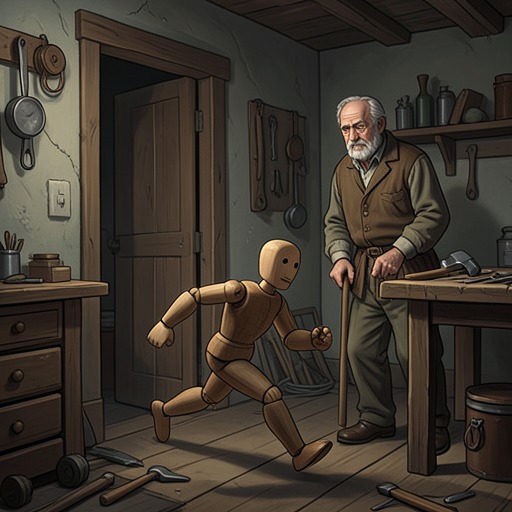
When Geppetto asks Mastro Antonio for wood to make a Marionette, the carpenter goes to give him the very piece that had frightened him. As he does so, it jerks out of his hands and hits Geppetto’s thin legs. Geppetto objects to the roughness of the supposed gift, while Mastro Antonio swears that he did not cause it. The wood thus carries its unexplained activity beyond the first workshop encounter: it affects a second person and immediately gives rise to disagreement between the two men.
Geppetto takes the wood home and begins carving it into a Marionette. His house is a small, neat ground-floor room with a tiny window beneath the stairs and simple furniture: an old chair, a rickety bed, and a tumble-down table. Against this modest setting, he chooses the name Pinocchio and works on the puppet’s hair, forehead, and eyes. As he carves the eyes, he sees them move and stare fixedly at him. The wood’s change into a figure is therefore not presented as the creation of an inert puppet; the first features Geppetto makes already appear to look back.
The Wood’s Afterlife as Pinocchio
Once carved, the wood is no longer treated as a separate object: its story continues through Pinocchio. The puppet’s later actions give the opening transformation a continuing narrative consequence. Early on, Pinocchio dismisses the Talking Cricket’s advice and imagines that warnings about Assassins are inventions by parents to frighten children who go out at night. He is confident he can confront danger—or run away from it—and is soon interrupted by a rustle behind him. The wood that once resisted being struck has become a character who resists counsel, with consequences extending well beyond the workshop.
After a fight involving his schoolmates leaves Eugene pale and motionless, Pinocchio stays behind while the other boys run away. He wets a handkerchief at the sea and tries to bathe Eugene’s head, sobbing and calling for him to wake. In his distress, Pinocchio recognizes that he should have gone to school and blames himself for listening to bad company instead of the teacher’s warning. This scene echoes his earlier rejection of the Talking Cricket’s advice: his own words now connect stubbornness to regret, rather than treating warnings as empty attempts to control him.
Narrative Significance
The opening’s direct address to child readers strengthens the contrast between the expected fairy-tale beginning and the humbler one the narrator supplies. The wood’s magic arrives not through a royal setting or an elaborate explanation, but through a voice heard while a carpenter prepares a piece of firewood. Its unexplained speech makes the object the first disruption of ordinary life; Geppetto’s carving then carries that disruption forward as Pinocchio’s animated body.
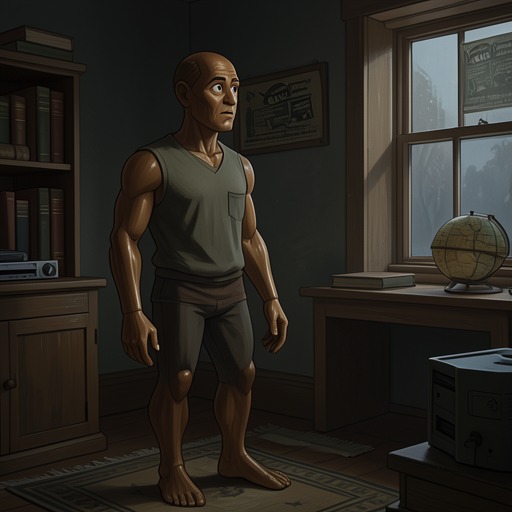
The material’s course also frames a movement from being handled to acting, speaking, and forming relationships. At first, Mastro Antonio intends to shape the wood for a table; later, Geppetto makes it a Marionette and becomes the father whom Pinocchio calls for after escaping the Shark. When Pinocchio finally reaches the old man, he embraces him and says he will never leave him again. The wood’s decisive significance lies in this transformation: what was introduced as firewood becomes a son, and the story’s adventures grow from the moment that ordinary material refuses to remain silent and passive.