Andalusia
The AlchemistAndalusia is the southern Spanish region where Santiago begins his journey as a shepherd, and it serves as the story's point of departure, a landscape of familiar fields and pastures that he must leave behind to pursue his Personal Legend. It is the world he knows intimately—its terrain, its villages, its people—and the place he must ultimately transcend in order to find his treasure. The region is defined by its history of Moorish conquest and its distinctive culture, and it provides the initial contrast between the settled life of a shepherd and the unknown expanses of Africa and the desert.
Identity and Landscape
Andalusia is the region of southern Spain where Santiago has spent two years as a shepherd, leading his flock through its countryside in search of food and water. He knows all the cities of the region and has traveled its roads many times. The girl he meets, the merchant's daughter, is described as "typical of the region of Andalusia, with flowing black hair, and eyes that vaguely recalled the Moorish conquerors," linking the landscape to its history of Moorish occupation. The region's summer heat is so intense that all of Spain sleeps during the midday hours, and Santiago must carry his jacket through the heat because it had protected him from the cold of the dawn. The fields of Andalusia are where Santiago learned to read omens from the ground and sky, discovering that the presence of a certain bird meant a snake was nearby, and that a certain shrub was a sign of water.
Santiago's Life as a Shepherd
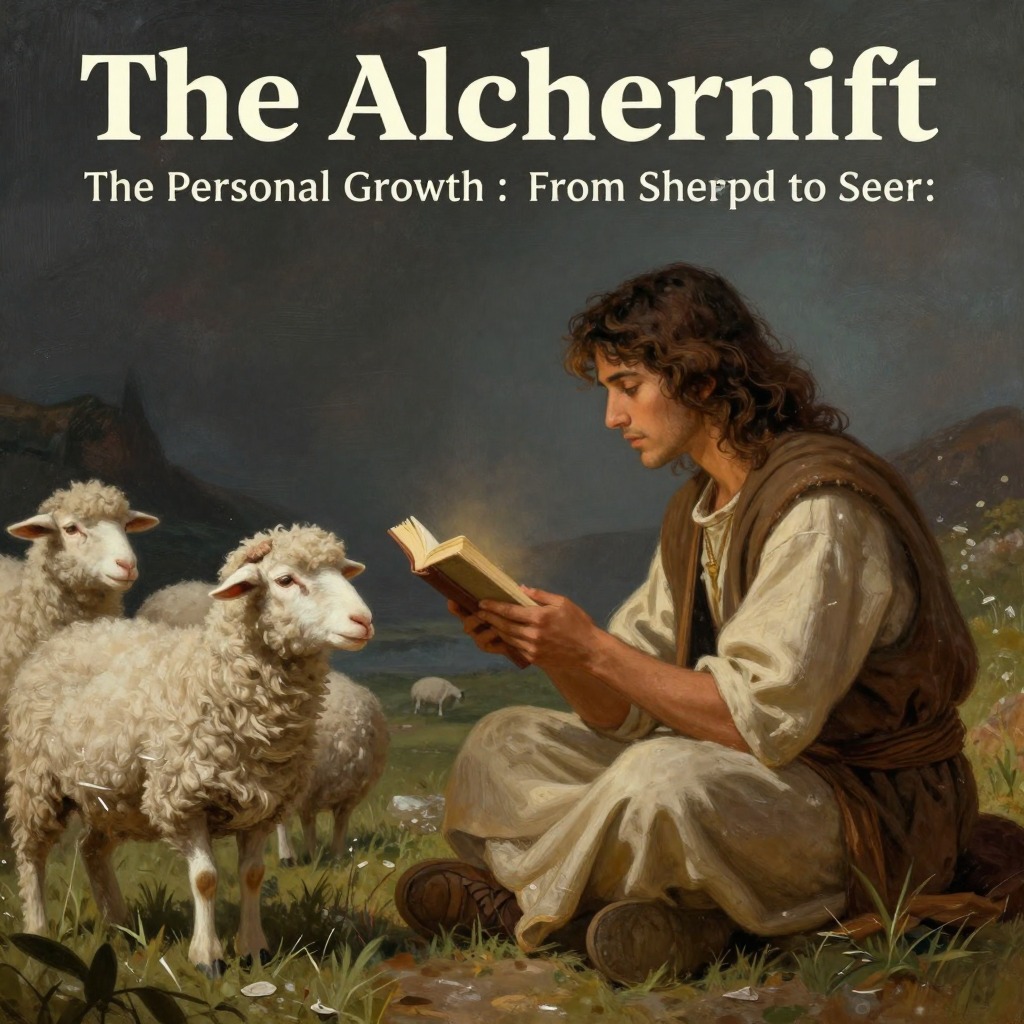
Santiago's life in Andalusia is defined by his relationship with his sheep. He leads them through the countryside, calling each by name, and sometimes reads to them from his books or tells them of his loneliness or happiness. The sheep are content with just food and water, and in exchange they give their wool, their company, and occasionally their meat. Santiago reflects that the sheep never have to make decisions, and that they trust him so completely they have forgotten how to rely on their own instincts. He has learned everything about shepherding in two years: how to shear sheep, how to care for pregnant ewes, how to protect them from wolves, and what is the fair price for every animal. He knows which ones are lame, which one is to give birth two months from now, and which are the laziest.
The Decision to Leave
Santiago's decision to become a shepherd was itself a rebellion against his family's expectations. His parents, a simple farm family, had wanted him to become a priest, and he had studied Latin, Spanish, and theology at a seminary until he was sixteen. But he wanted to know the world, and told his father he would become a shepherd. His father gave him three ancient Spanish gold coins to buy his flock, and Santiago could see in his father's gaze a desire to travel that had been buried under decades of struggling for water, food, and a fixed home. From the fort in Tarifa, the highest point in the region, Santiago can see Africa in the distance, and he feels the levanter wind that had brought the Moors from the Levant to occupy all of Spain. It is from this vantage point that he makes his final decision to sell his sheep and cross the strait.
Contrast with the Desert
Andalusia is repeatedly contrasted with the desert that Santiago will later cross. The fields of Andalusia are familiar and predictable, while the desert is vast, silent, and dangerous. The camel driver tells Santiago that the desert is so huge and the horizons so distant that they make a person feel small and should remain silent. Santiago reflects that the sheep, now in the fields of Andalusia, are probably used to their new shepherd and have forgotten him. The levanter wind that once brought the Moors to Spain also carries the smell of the desert and of veiled women, and Santiago feels jealous of the freedom of the wind. Later, when he is in the desert, he remembers that the wind from Andalusia is called the levanter because people believe it brings the sands of the desert and the screams of the Moorish wars.
Narrative Significance
Andalusia functions as the "striated space" of settled life, the world of known paths and predictable routines that Santiago must leave behind to enter the "smooth space" of the desert. It is the place of his childhood, his family, his first love, and his initial identity as a shepherd. The region's history of Moorish conquest and its proximity to Africa make it a natural threshold for his journey. Santiago's entire quest is framed by his departure from Andalusia and his eventual return to its abandoned church, where the treasure was buried all along. The region thus serves as both the starting point and the destination of his circular journey, the place where the Personal Legend begins and ends.