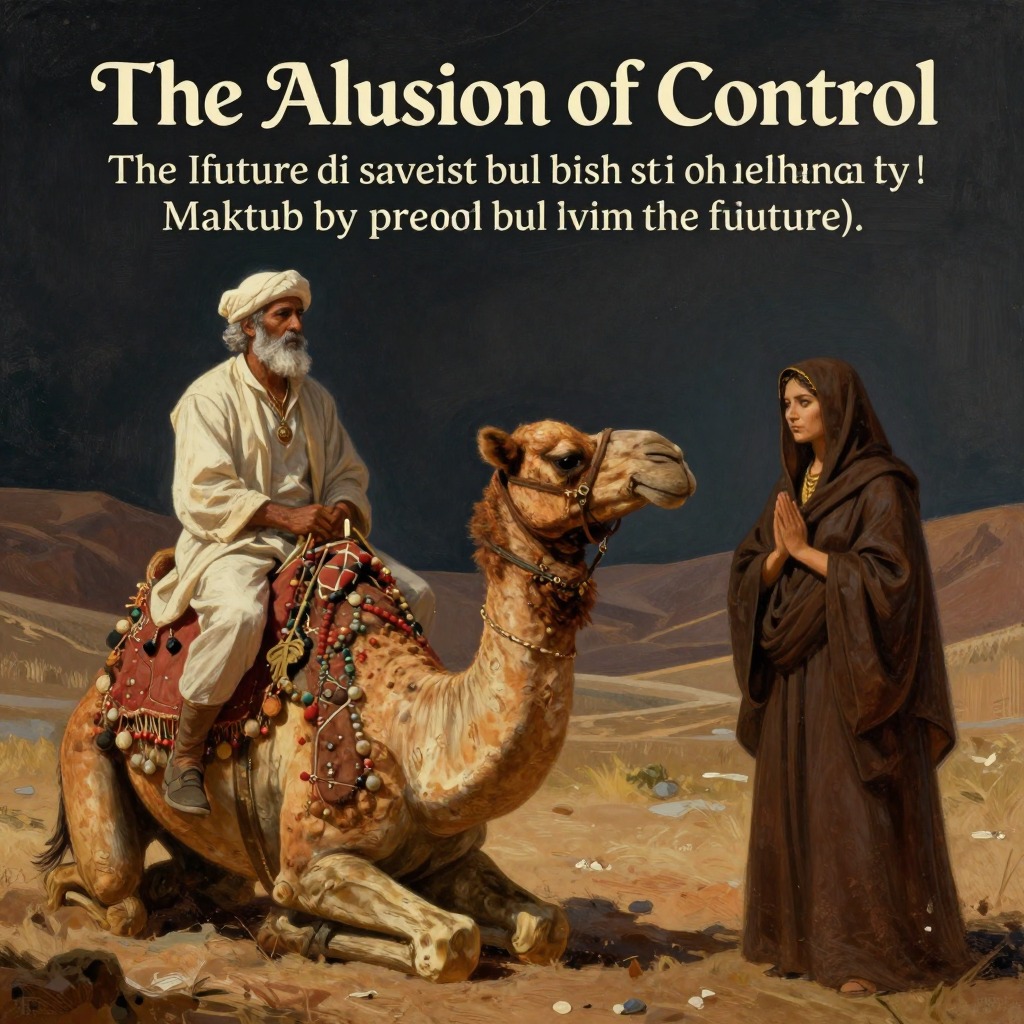
Maktub
The AlchemistMaktub, an Arabic word that translates roughly as "It is written," appears throughout The Alchemist as a compact expression of the novel's governing worldview. The phrase is first introduced by the crystal merchant, who uses it to explain his reluctant acceptance of change and the inevitability of certain events. When Santiago proposes selling tea in crystal glasses, the merchant resists, then finally yields, saying "Maktub" as he smothers the coals in his hookah, acknowledging that some forces cannot be held back. The word thus enters the story as a marker of surrender to a larger design, a verbal gesture that signals the end of resistance and the beginning of trust in the universe's plan.
The Crystal Merchant's Use of Maktub
The crystal merchant employs Maktub most poignantly when Santiago announces his intention to leave the shop. The boy has saved enough money to buy sheep and return to Spain, but the merchant, with quiet certainty, tells him, "Maktub," and gives him his blessing. The merchant understands that Santiago's journey is not truly about returning to shepherding; the word here functions as a recognition of destiny that the speaker himself cannot fully articulate. Earlier, the merchant had explained to Santiago that he had always dreamed of making the pilgrimage to Mecca but feared that realizing the dream would leave him with no reason to live. Maktub, for him, is a way of naming the tension between desire and fear, between what is written and what one dares to pursue.
The Camel Driver's Wisdom
The camel driver, who becomes Santiago's friend during the caravan journey, uses Maktub to express a fatalism tempered by practical wisdom. When rumors of tribal wars spread and the travelers grow anxious, the driver tells Santiago that once you enter the desert there is no going back, and that the rest is up to Allah, including the danger. He concludes with the word "Maktub," linking it to his earlier teaching that people need not fear the unknown if they are capable of achieving what they need and want. For the driver, Maktub is not a passive resignation but an active trust in the present moment: he lives without dwelling on past or future, concentrating on eating when he eats and marching when he marches.
Fatima's Acceptance
Fatima, the woman Santiago meets at the Al-Fayoum oasis, invokes Maktub to express her faith in the enduring nature of their love. When Santiago tells her he must continue his quest for the treasure, she responds, "Maktub. If I am really a part of your dream, you'll come back one day." Her use of the word transforms it from a statement of inevitability into an act of trust and liberation. She does not cling to Santiago or demand that he stay; instead, she releases him, confident that what is written will unfold. Later, when Santiago reflects on the possibility of dying in the desert, he thinks of Maktub as a word that makes every day equally valuable, whether lived or ended.
Santiago's Internalization
Santiago himself comes to use Maktub as a touchstone for his own understanding of destiny. When he first hears the word from the crystal merchant, he repeats it to himself during the caravan journey, sensing that it connects him to a universal language. At the moment he meets Fatima at the well, he thinks "Maktub" as he recognizes that their encounter was written by the same hand that created the desert and the stars. The word becomes for him a shorthand for the principle that all things are one, and that the Soul of the World orchestrates events according to a hidden coherence. By the time he faces the hostile chief and the threat of death, Maktub has become a source of courage: he accepts that if he dies tomorrow, it will be because God was not willing to change the future, and he has already lived more intensely than most shepherds ever do.
Thematic Significance
Maktub functions as a verbal anchor for the novel's exploration of fate and free will. It appears at moments of decision, transition, and acceptance, marking the points where characters align themselves with the flow of the universe rather than resisting it. The word is never defined in a single, fixed way; instead, its meaning shifts with each speaker and situation, from the merchant's fearful resignation to Fatima's hopeful trust to Santiago's courageous embrace of his destiny. In this way, Maktub embodies the novel's central paradox: that what is written does not eliminate the need for choice, but rather gives every choice its ultimate significance. The phrase recurs across cultures and contexts—spoken by an Arab merchant, a desert traveler, and a woman of the oasis—suggesting that the wisdom it contains is universal, accessible to anyone who learns to read the omens and listen to the Language of the World.