Philosopher's Stone and Elixir of Life
The AlchemistThe Philosopher's Stone and the Elixir of Life are the two halves of the Master Work, the supreme goal of alchemy. The solid part, the Philosopher's Stone, can transform any metal into gold; the liquid part, the Elixir of Life, cures all illnesses and prevents the alchemist from aging. In The Alchemist, these objects are not merely magical artifacts but the material embodiment of a destiny fully lived—the reward for those who have penetrated the Soul of the World and followed their Personal Legend to its end.
Nature and Appearance
The Philosopher's Stone is described as a yellow glass egg slightly larger than a chicken's egg, while the Elixir of Life is kept in a small crystal flask. When the alchemist is searched by armed tribesmen, he openly displays these items and declares their powers: "Whoever swallows that elixir will never be sick again, and a fragment from that stone turns any metal into gold." The Arabs laugh, disbelieving him, which illustrates the alchemist's lesson that "when you possess great treasures within you, and try to tell others of them, seldom are you believed." The Master Work is also said to be part liquid and part solid, and its creation requires the alchemist to spend years observing the fire that purifies metals, a process that gradually purifies the alchemist himself.
The Master Work and the Alchemist's Demonstration
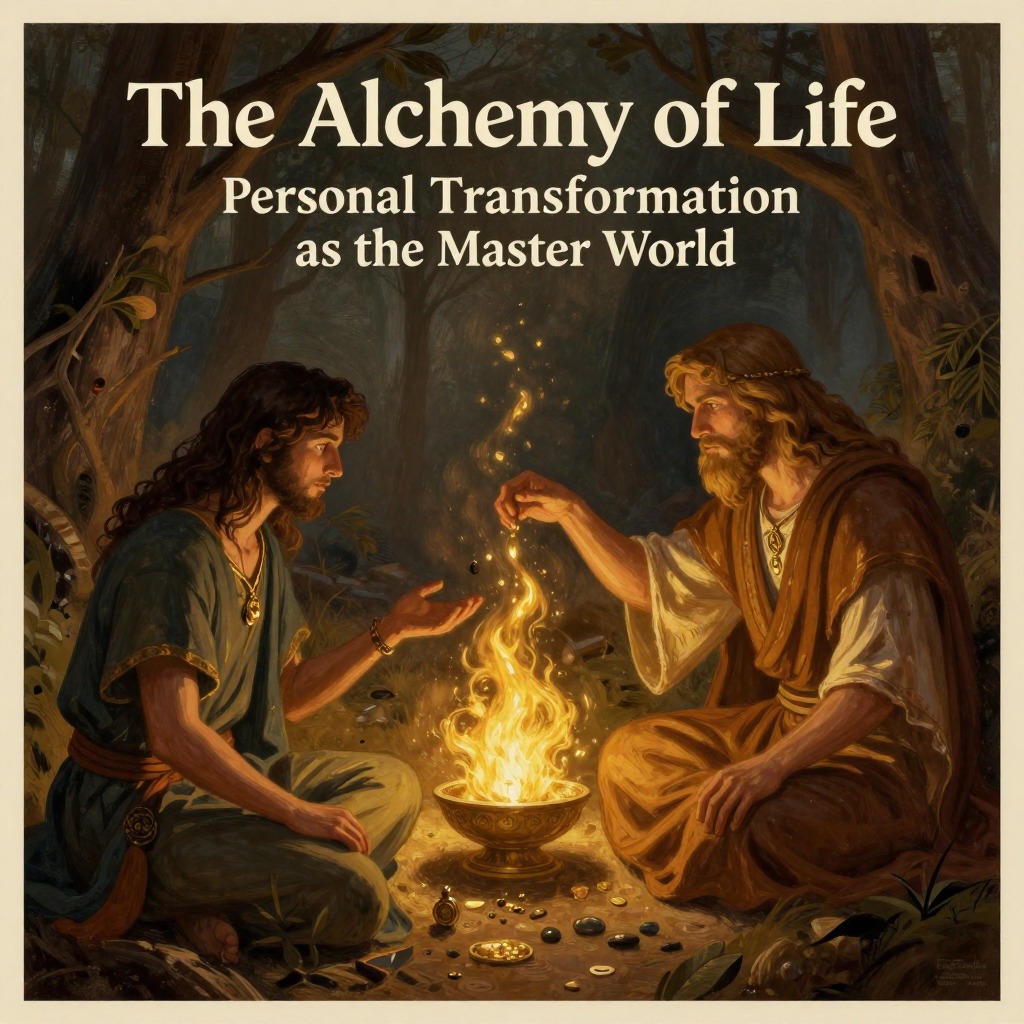
The alchemist demonstrates the reality of the Philosopher's Stone at a Coptic monastery. He places lead in an iron pan, heats it until liquid, then scrapes a sliver as thin as a hair from the yellow glass egg, wraps it in wax, and adds it to the molten lead. The mixture turns a reddish color, almost like blood, and when cooled, the lead has become gold. The alchemist divides the gold disk into four parts: one for the monk as payment for hospitality, one for Santiago to replace the money he gave to the hostile chief, one for himself, and a fourth kept for Santiago in case he ever needs it. The alchemist explains that this transformation was his destiny, not Santiago's, and that he only wanted to show that it was possible.
Symbolic Meaning and the Path to Realization
The Philosopher's Stone and the Elixir of Life are not merely physical objects but represent the culmination of the alchemical process, which is itself a metaphor for spiritual evolution. The Englishman, who has spent years studying alchemical texts, tells Santiago that the Master Work is the discovery of the Soul of the World, and that the alchemists who found it "understood that when something evolves, everything around that thing evolves as well." The alchemist himself explains that gold is the metal that has evolved the furthest, and that the true alchemists were those who sought not just gold but to live out their destiny. Those who sought only the gold never found the secret, because they forgot that "lead, copper, and iron have their own destinies to fulfill. And anyone who interferes with the destiny of another thing never will discover his own."
The Master Work as a Test of Destiny
The alchemist's possession of the Philosopher's Stone and Elixir of Life is not an end in itself but a tool for teaching. When Santiago asks to learn how to transform lead into gold, the alchemist refuses, saying that was his own destiny, not Santiago's. Instead, the alchemist guides Santiago toward his own treasure by teaching him to listen to his heart and to understand the Language of the World. The Master Work thus becomes a symbol of the completed Personal Legend—something that cannot be given or taught but must be earned through one's own journey. The alchemist's final act of turning lead into gold at the monastery serves as a concrete demonstration that the principles of alchemy are real, but also as a reminder that the true treasure is not the gold itself but the transformation of the soul that the quest requires.