The Abandoned Church
The AlchemistThe Abandoned Church is the ruined Andalusian chapel where Santiago begins and ends his journey, serving as the physical location of his treasure and the symbolic frame for his entire quest. It is the place where the narrative opens and closes, transforming from a shepherd's makeshift shelter into the site of ultimate discovery, and its decayed structure—with a fallen roof and a sycamore growing from the sacristy—mirrors the story's central theme of finding hidden value beneath unpromising surfaces.
Description and Setting
The church stands in the Andalusian countryside, its roof long collapsed and an enormous sycamore tree growing from the spot where the sacristy once stood. Santiago arrives there at dusk with his flock, sweeps the floor with his jacket, and lies down using a book as a pillow. Through the half-destroyed roof he can see the stars. The building is abandoned and ruined, yet it provides shelter; Santiago lays planks across the gate to keep his sheep from wandering. He has never visited this particular church before, despite having traveled through those parts many times, and he reflects that the world is huge and inexhaustible when one allows the sheep to set the route.
Narrative Role as Beginning and End
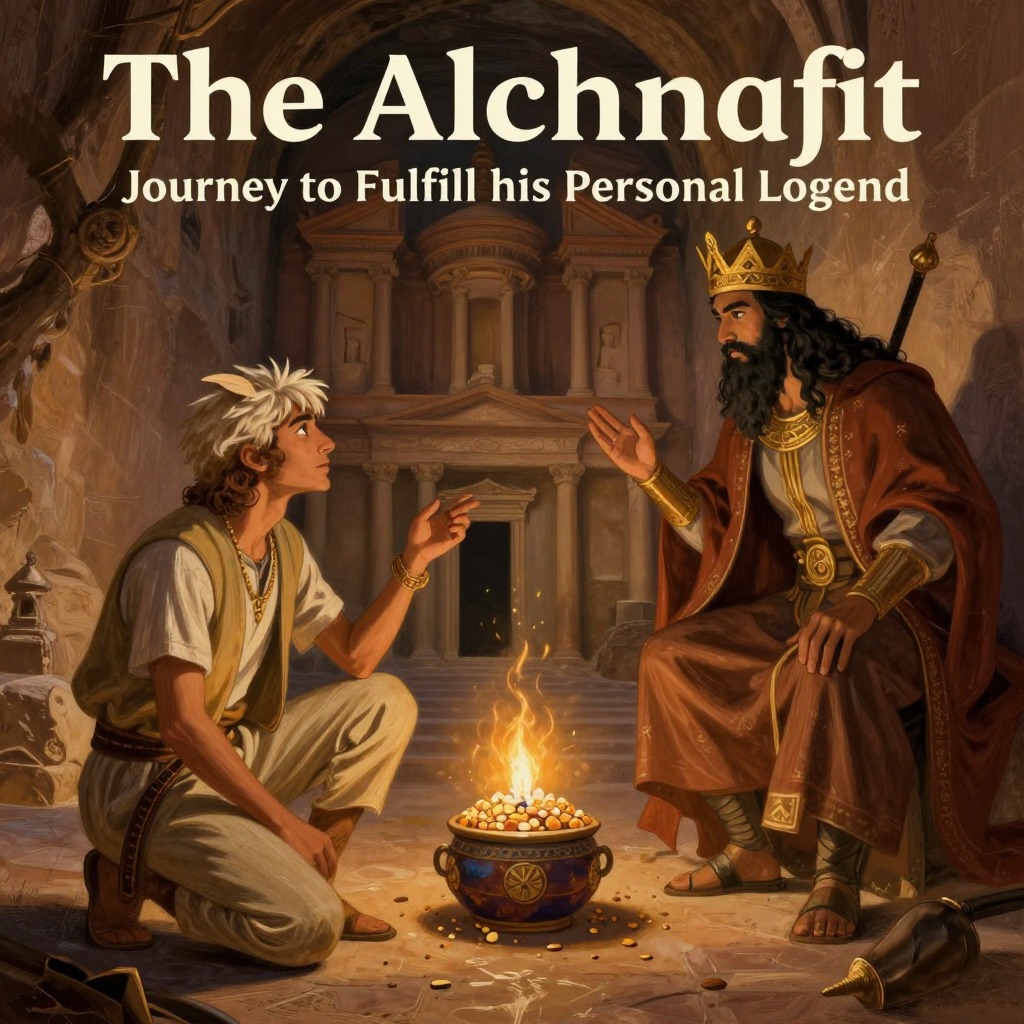
The church is the setting for Santiago's recurrent dream of a child who transports him to the Egyptian pyramids and speaks of hidden treasure. He awakens there twice from the same dream, and it is this repetition that eventually drives him to seek interpretation from the old woman in Tarifa. The church thus becomes the point of departure for his entire quest. At the novel's conclusion, after being beaten by refugees at the Pyramids and learning that the treasure was never in Egypt, Santiago returns to the very same church. He digs at the base of the sycamore and finds a chest of Spanish gold coins, precious stones, gold masks adorned with red and white feathers, and stone statues embedded with jewels—the spoils of a long-forgotten conquest. The church is therefore both the origin and the destination, the place where the dream is born and where it is fulfilled.
Symbolic and Thematic Significance
The church's ruined state—a sacred building whose roof has fallen in and whose interior is overgrown—embodies the novel's insistence that the most valuable things are often hidden in plain sight, beneath neglect and decay. The sycamore growing from the sacristy is the precise marker of the treasure's location, and the church itself becomes a kind of secular sanctuary where Santiago's Personal Legend is both conceived and realized. The building also represents the principle that the path to one's destiny is circular: Santiago must cross an ocean, a desert, and an entire continent only to return to the place he started, having learned that the treasure was always at home. The church is thus a physical manifestation of the novel's core teaching—that the universe conspires to help those who pursue their destiny, and that the journey itself is the real treasure.
Connection to Omens and the Language of the World
The church is intimately tied to the novel's system of omens. Santiago's dream there is the first omen that sets his quest in motion, and the scarab beetle that appears where his tears fall at the Pyramids—an omen that leads him to dig—is ultimately a sign pointing back to the church. The old woman interprets the dream as a message in the language of the world, and Melchizedek later tells Santiago that God has prepared a path for everyone to follow, marked by omens. The church, as the site of the original dream, is the place where that path begins. When Santiago finally returns, he reflects that the path was written in the omens and that there was no way he could go wrong. The church thus anchors the novel's spiritual geography: it is the sacred space where the divine communicates with the ordinary, and where the ordinary—a shepherd's dream—transforms into an extraordinary journey.