falcon
The AlchemistThe falcon appears in The Alchemist as the constant companion of the alchemist, a creature that embodies the desert's wisdom and the interconnectedness of all life. More than a mere pet, the falcon is a practical tool for survival, a symbol of the Language of the World, and a key element in the alchemist's teachings about destiny, love, and the Soul of the World.
Role as the Alchemist's Companion and Hunter
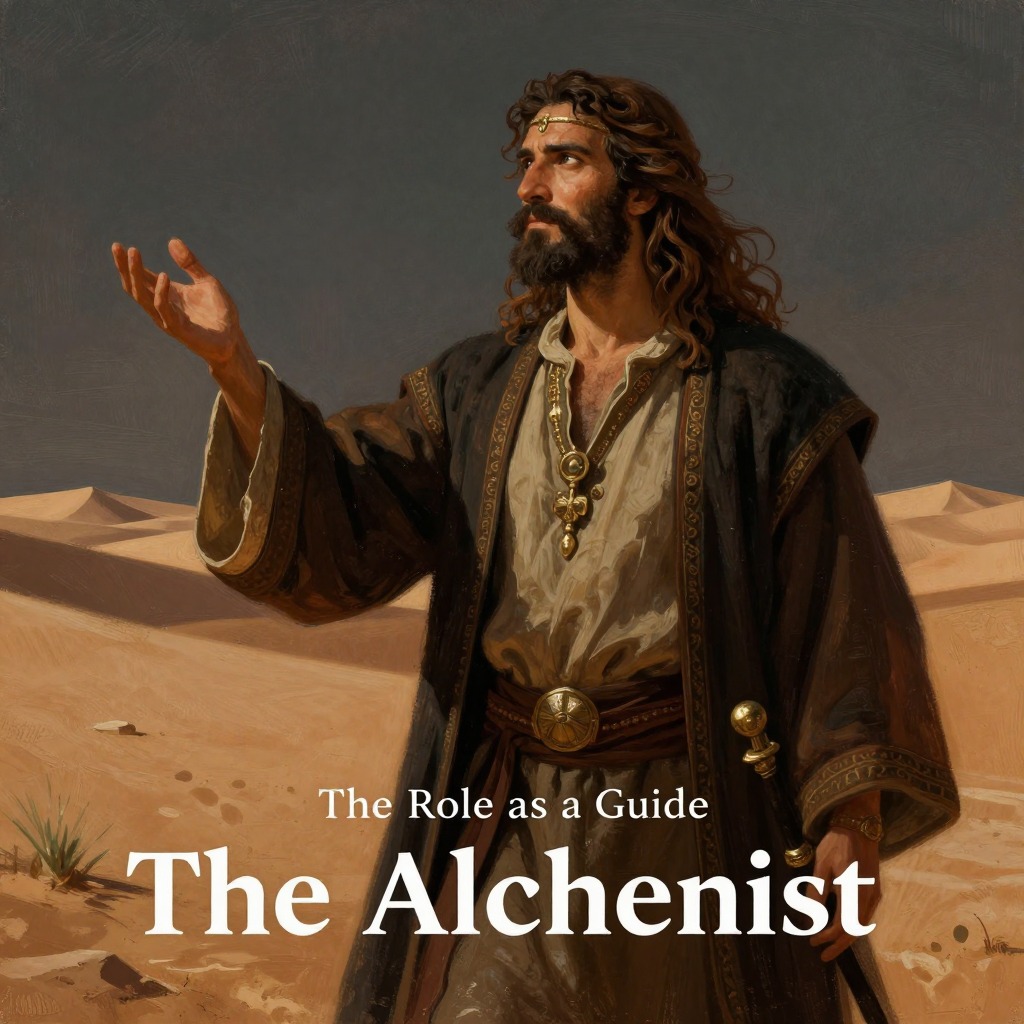
The falcon is first introduced as a physical presence perched on the left shoulder of the mysterious horseman who confronts Santiago after his vision of the invading army. This horseman, later revealed to be the alchemist, is described as "a horseman dressed completely in black, with a falcon perched on his left shoulder." The bird is not merely decorative; it is an active participant in their journey across the desert. The alchemist relies on the falcon for sustenance, as "the bird knew the language of the desert well, and whenever they stopped, he flew off in search of game." On the first day of their journey together, the falcon returned with a rabbit, and on the second with two birds, demonstrating its essential role in their survival. The falcon's hunting is also a practical lesson: when the alchemist is asked why he is feeding his falcon while Santiago fears for their lives, he replies, "You're the one who may die. I already know how to turn myself into the wind." This contrast underscores the falcon's role as a creature of the present moment, living out its own destiny without fear.
Symbol of the Language of the World and Love
The falcon is also a powerful symbol in Santiago's philosophical and spiritual education. When Santiago, desperate to transform himself into the wind to save his life, speaks to the desert, he uses the falcon as a metaphor for love. He tells the desert, "Love is the falcon's flight over your sands. Because for him, you are a green field, from which he always returns with game. He knows your rocks, your dunes, and your mountains, and you are generous to him." This explanation frames the falcon's relationship with the desert as a cycle of creation and consumption that is itself an expression of love. The desert, in turn, understands this dynamic, acknowledging that it creates game for the falcon, which the falcon then takes. Santiago concludes that this cycle—where the game becomes the falcon, the falcon becomes man, and man becomes the desert—is the very essence of love, the force that "turns lead into gold, and makes the gold return to the earth." The falcon thus becomes a living illustration of the universal language that connects all things.
The Falcon's Flight as an Omen and a Test
The falcon's flight is also a source of omens and a test of Santiago's courage. When the alchemist first appears, he demands of Santiago, "Who dares to read the meaning of the flight of the hawks?" This question is a direct challenge, and Santiago's response—that he read what the birds wanted to tell him to save the oasis—demonstrates his growing mastery of the Language of the World. The alchemist later tests Santiago again by asking him to find life in the desert, a task that leads them to a cobra. The alchemist explains that this test was necessary because "the Pyramids are surrounded by the desert." The falcon, as a creature of the desert, is implicitly linked to this ability to read signs and find life where others see only barrenness. The bird's presence reinforces the idea that the desert is not empty but full of meaning for those who can interpret its language.
The Falcon's Thematic Significance: Destiny and the Present Moment
The falcon ultimately represents the fulfillment of destiny and the importance of living in the present. The alchemist, who has already mastered his own destiny, continues to live in the desert with his falcon, even though he understands the Language of the World and can transform lead into gold. He "didn't need to demonstrate his science and art to anyone." The falcon, like the alchemist, is a being that has found its purpose and lives it out without hesitation. In this way, the falcon serves as a model for Santiago: a creature that does not question its path but simply follows the omens and fulfills its role in the grand design of the Soul of the World. The bird's silent, purposeful existence is a constant reminder that the journey itself, with all its trials and discoveries, is the true treasure.