the Englishman
The AlchemistThe Englishman is a learned, bookish seeker of alchemy who joins the caravan to Al-Fayoum Oasis in search of the legendary alchemist, representing the intellectual path to understanding the Soul of the World. His journey parallels Santiago's but contrasts sharply: where Santiago learns through action, observation, and the language of the desert, the Englishman relies on years of study, chemical journals, and rare volumes, and initially fails to grasp the simple truths that Santiago intuits. His role in the narrative is to embody the tension between theoretical knowledge and lived experience, and to serve as a foil whose eventual, grudging shift toward practice underscores the novel's central lesson that destiny is realized through action, not erudition.
Identity and Background
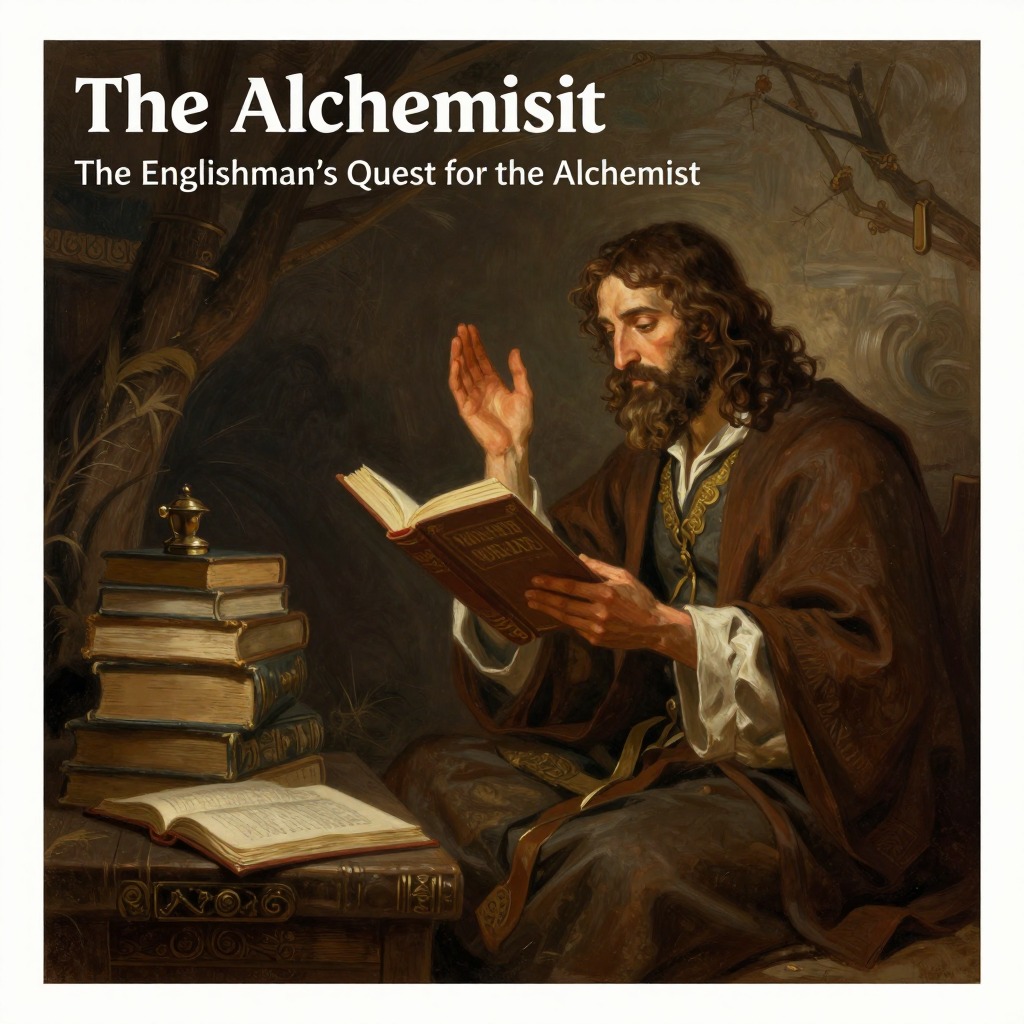
The Englishman is introduced sitting on a bench in a warehouse that smells of animals, sweat, and dust, reflecting on his unlikely circumstances: "I never thought I'd end up in a place like this," he thinks, as he leafs through the pages of a chemical journal. He has spent ten years at university and has exhausted much of the fortune left to him by his father in fruitless pursuit of the Philosopher's Stone. His studies have taken him through Esperanto, the world's religions, and finally alchemy, but he has reached a point beyond which he cannot seem to go. He has tried in vain to establish a relationship with an alchemist, but the alchemists are strange people who think only about themselves and almost always refuse to help him. He has purchased all the rarest and most important volumes on alchemy, and has spent enormous amounts of time at the great libraries of the world. A friend returning from an archaeological expedition in the desert told him about an Arab at Al-Fayoum Oasis who is said to be two hundred years old and able to transform any metal into gold. This news sends him canceling all his commitments and pulling together his most important books, and he finds himself in the dusty, smelly warehouse, waiting for a caravan to cross the Sahara.
Encounter with Santiago and Shared Omens
When Santiago enters the warehouse, the Englishman initially appears unfriendly and closes off conversation. But when Santiago takes out Urim and Thummim and begins playing with them, the Englishman shouts their name in recognition. He explains that these stones are the only form of divination permitted by God, carried by priests in a golden breastplate, and that he learned about them from the Bible. He produces his own identical pair of stones from his pocket. When Santiago says the stones were a gift from a king, the Englishman does not dismiss the claim; instead he observes that shepherds were the first to recognize a king the rest of the world refused to acknowledge. He tells Santiago that everything in life is an omen, and that he is in search of the universal language, among other things—which is why he is there, seeking an alchemist. When the warehouse boss announces a caravan leaving for Al-Fayoum, the Englishman declares it a good luck omen, and says that if he could, he would write a huge encyclopedia just about the words luck and coincidence, because it is with those words that the universal language is written.
The Intellectual Path to Alchemy
The Englishman spends most of the caravan journey immersed in his books, while Santiago observes the desert and the caravan. The Englishman is fascinated by Santiago's story of the progress achieved at the crystal shop, and explains that this is the principle that governs all things: in alchemy it is called the Soul of the World, a positive force that is always at work when someone wants something with all their heart. He tells Santiago that everything on the face of the earth has a soul, whether mineral, vegetable, or animal—or even just a simple thought. When Santiago returns the Englishman's books, saying he has learned that the world has a soul and that many alchemists realized their destinies and discovered the Soul of the World, the Philosopher's Stone, and the Elixir of Life, the Englishman is disappointed. He thinks Santiago's soul must be too primitive to understand those things. He takes back his books and packs them away, telling Santiago to go back to watching the caravan, adding that it didn't teach him anything either.
Arrival at the Oasis and the Search for the Alchemist
When the caravan reaches Al-Fayoum, the Englishman is impatient to meet the alchemist, and compares the oasis to The Thousand and One Nights. He and Santiago search for the alchemist, but find the oasis much larger than they imagined, with hundreds of tents. The Englishman is reluctant to ask others about his reasons for being there, but finally agrees that Santiago, who speaks better Arabic, should do so. After a woman at the well directs them south, the Englishman vanishes to find the alchemist. He returns the next day, reporting that he waited all afternoon and evening, and that the alchemist appeared with the first stars of evening. When the Englishman told him what he was seeking, the alchemist asked if he had ever transformed lead into gold, and when the Englishman said that was what he had come to learn, the alchemist simply said, "Go and try." The Englishman then builds a furnace outside his tent and begins the first phase of the work, separating out the sulfur. He tells Santiago that his fear of failure had kept him from attempting the Master Work, but that he is happy at least that he did not wait twenty years.
The Alchemist's Assessment and the Englishman's Role
When Santiago later meets the alchemist, he tells him that it is not he but the other foreigner, the Englishman, who is looking for him. The alchemist replies that the Englishman has other things to do first, but that he is on the right track, having begun to try to understand the desert. The Englishman's trajectory thus mirrors the novel's central theme: that true understanding comes not from books alone but from action and immersion in the world. He begins as a figure of pure intellect, frustrated by his inability to progress, and ends by taking the first practical step toward his goal. The alchemist's final story, told to Santiago as they part, about the Roman centurion whose words became immortal, reinforces the idea that every person plays a central role in the history of the world, often without knowing it—a lesson the Englishman, in his own way, is beginning to learn.