the candy seller
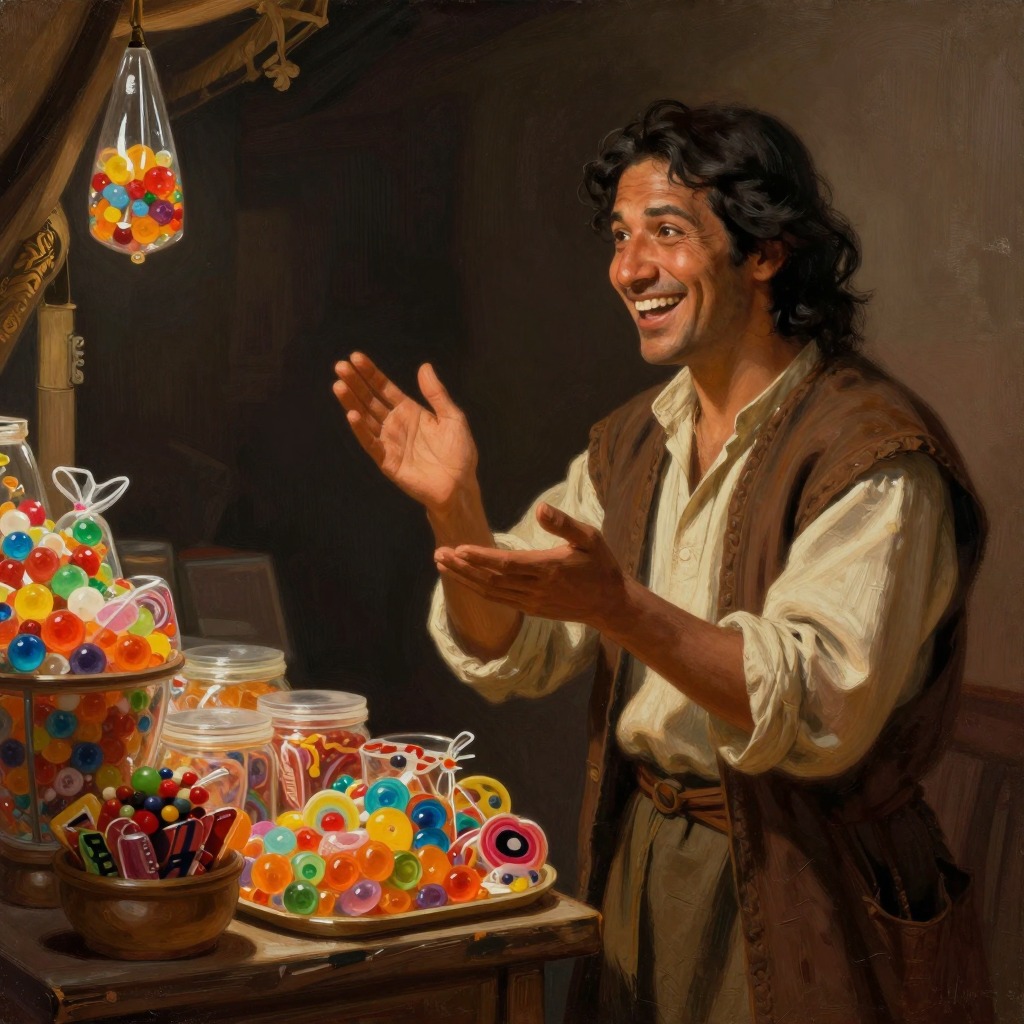
The AlchemistThe candy seller is a minor character in Paulo Coelho's The Alchemist who appears only briefly but carries significant thematic weight. He is first encountered by Santiago in the Tangier marketplace on the morning after the boy has been robbed of all his money. The candy seller is assembling his stall for the day, and Santiago, destitute and alone, helps him set it up. In return, the candy seller gives Santiago the first sweet he has made that day—the boy's first meal in Africa. This act of generosity, offered without any request, embodies the principle of feeding the hungry that the crystal merchant later explains is required by the Koran, though the candy seller performs it instinctively, without invoking religious law.
Character and Significance
The candy seller is defined by his complete contentment with his present life. Santiago observes that the man is "happy, aware of what his life was about, and ready to begin a day's work." His smile reminds Santiago of the mysterious old king Melchizedek, whom the boy had met in Tarifa. This resemblance is not coincidental: the candy seller's smile is one of several recurring smiles in the novel—including that of the crystal merchant—that Santiago later recognizes as a kind of mark left by the old king on those who are following their destiny. The candy seller works not to accumulate money for a future journey or to impress a shopkeeper's daughter, but simply because making candy is what he wants to do. In this, he contrasts sharply with the baker in Tarifa, who dreamed of travel but chose security instead, and with the crystal merchant, who dreams of Mecca but is afraid to realize it.
Encounter with Santiago
The encounter occurs at a pivotal moment in Santiago's journey. Having been robbed the previous day, the boy has spent the night weeping in the empty marketplace, feeling betrayed by God and by his own faith in dreams. When he awakens, he decides to reinvent himself as an adventurer rather than a victim. Helping the candy seller is his first act in this new identity. During their work, Santiago realizes that the candy seller speaks Arabic and he himself speaks Spanish, yet they understand each other perfectly. This observation leads Santiago to a profound insight: "There must be a language that doesn't depend on words." He connects this wordless communication to his earlier experience with his sheep, and concludes that if he can learn this language, he can learn to understand the world itself. The candy seller thus becomes the catalyst for Santiago's first major step toward mastering the Language of the World.
Thematic Role
The candy seller embodies the novel's central teaching that happiness lies in pursuing one's Personal Legend in the present moment, not in deferring life for a future reward. He is a living demonstration of the principle that "when you want something, all the universe conspires in helping you to achieve it"—not because he seeks treasure or adventure, but because he is already living his destiny. His smile, which Santiago later recalls when he sees the crystal merchant's hair resembling the old king's, functions as an omen, a sign that the forces guiding the boy's journey are present even in the most ordinary encounters. The candy seller never reappears in the narrative, but his brief presence leaves a lasting impression on Santiago, helping to shift the boy's mindset from despair to purposeful action and from passive victimhood to active participation in his own quest.